

Must Read
CIVIL SOCIETY DISCUSSION. Senate finance committee chairman Sherwin Gatchalian speaks to budget watchdogs regarding the national budget process in a hearing on CIVIL SOCIETY DISCUSSION. Senate finance committee chairman Sherwin Gatchalian speaks to budget watchdogs regarding the national budget process in a hearing on
Bicam reconciles education, health, agri 2026 budgets on first day
MANILA, Philippines – The proposed 2026 budgets of the education, health, and agriculture sectors took centerstage during the first day of the bicameral conference committee (bicam) meetings on Saturday, December 13.
It is during these bicam meetings that the House of Representatives and the Senate reconcile their versions of the proposed budget.
This was also the first time in history that the bicam deliberations were livestreamed following public scrutiny due to the flood control corruption scandal linked to budget insertions.
Farm-to-market roads
Bicam discussions were at a deadlock for nearly an hour on Saturday night as House lawmakers and senators butt heads over proposed funding for farm-to-market roads.
Under the Senate’s version of the spending plan, the Department of Agriculture (DA) would receive P16 billion in funding to construct farm-to-market roads. However, the House contingent appealed to nearly double the funding to P33 billion to cover projects in far-flung areas of the country.
Senators, however, questioned whether the DA was ready to take on the additional funding as it takes over construction of the roads from the Department of Public Works and Highways.
Senator Imee Marcos flagged that the DA had only 65 people nationwide for the task, while Senators Pia Cayetano and Erwin Tulfo raised concerns that farm-to-market roads would become the next target for infrastructure corruption.
“Kung iisipin, wala nga ‘yung flood control, dito naman sa farm-to-market. Ito naman ang iisipin mo na dito magkaroon ng problema. I mean, lumipat lang from flood control dito naman sa farm-to-market. Magiging source of corruption,” Tulfo said.
(If you think about it, there are no flood control projects but there are farm-to-market roads. You will suspect it will cause problems. I mean, it may have just moved from flood control to farm-to-market. It will be a source of corruption.)
While the bicam eventually agreed to nearly double funding for farm-to-market roads at P33 billion, Cayetano, Legarda, and Tulfo voiced their reservations surrounding the move.
Play Video 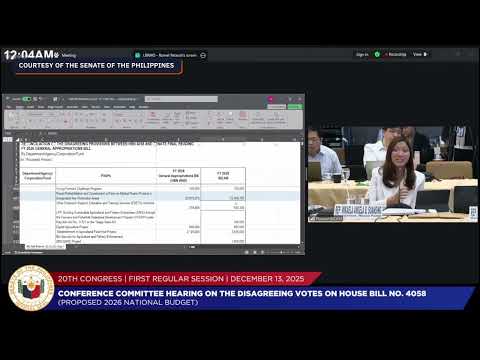
“I want to see countryside development. Rest assured, that is what’s in my heart. But I cannot stand to see corruption continue to happen,” Cayetano said.
‘Soft pork’ in health?
House and Senate lawmakers agreed to increase funding for the Department of Health’s (DOH) MAIFIP program (Medical Assistance for Indigent and Financially Incapacitated Patients) to P51 billion from P49 billion.
The program offers financial assistance to cover the medical costs for indigent patients. It is also among the four social aid programs criticized by budget watchdogs as a form of pork.
Senators raised concerns that the program would perpetuate political patronage since recipients often relied on guarantee letters from politicians to receive funds. But the House contingent argued that reducing funding for MAIFIP would affect some 1.1 million patients since the universal healthcare law has yet to be fully implemented.
“Until such time that the UHC law is really completely properly implemented and PhilHealth is able to handle all of this, I believe that we must provide for the poorest of the poor,” said Senator Loren Legarda.
Lawmakers from both chambers of Congress also agreed to tighten the wording of a general provision that prohibits elected officials from participating in ayuda (social aid) distribution since the current language only covers cash transfers.
From PhilHealth to foreign-assisted projects
Senator Imee Marcos also questioned how the Department of Finance used the P60 billion in “excess” Philippine Health Insurance Corporation (PhilHealth) funds that were transferred to the national treasury in 2024.
Bataan 2nd District Representative Abet Garcia explained that the funding went to the following programs:
- Health emergency allowance for frontline health workers during the COVID-19 pandemic – P27.45 billion
- Foreign-assisted projects – P13 billion
- MAIFIP – P10 billion
- Procurement of various medical equipment for DOH hospitals – P4.1 billion
- Funding for three DOH health facilities – P3.37 billion
- Health Facilities Enhancement Program – P1.69 billion
Marcos’ remarks come after the Supreme Court ordered the return of P60 billion, which will be done through an appropriation in the 2026 spending plan.
Garcia also said they would require PhilHealth to submit a detailed breakdown and clarify how future appropriations would comply with the high court’s ruling.
Education gets lion’s share
The bicam approved a whopping P1.38 trillion in funding for agencies in the education sector, which includes the Department of Education (DepEd), state universities and colleges (SUCs), and the Commission on Higher Education (CHED).
DepEd’s Office of the Secretary will receive P961 billion in funding, SUCs will get P138 billion, while CHED will receive P47 billion.
Lawmakers from both the House and Senate also agreed to transfer P2 billion of funding for the Tulong Dunong student assistance program to CHED from the SUCs. They believed the move would streamline implementation and allow more students to access assistance.
Under the Tulong Dunong program, eligible students with a combined gross income of less than P400,000 can receive P15,000 in assistance per academic year.
The Bicam meeting will resume on Sunday, December 14, at 2 pm. – Rappler.com
Disclaimer: The articles reposted on this site are sourced from public platforms and are provided for informational purposes only. They do not necessarily reflect the views of MEXC. All rights remain with the original authors. If you believe any content infringes on third-party rights, please contact service@support.mexc.com for removal. MEXC makes no guarantees regarding the accuracy, completeness, or timeliness of the content and is not responsible for any actions taken based on the information provided. The content does not constitute financial, legal, or other professional advice, nor should it be considered a recommendation or endorsement by MEXC.
You May Also Like

CLARITY Act Gains Support as Bitcoin Policy Momentum Builds
The post CLARITY Act Gains Support as Bitcoin Policy Momentum Builds appeared on BitcoinEthereumNews.com. The crypto regulation in the United States has gained momentum ahead of midterm elections in 2026. Satoshi Action Fund CEO has promised a massive Bitcoin announcement that may change crypto adoption optics. The Clarity Act has already received minimum required support from the Democratic Senators. Crypto regulation in the U.S. is picking up speed heading into the 2026 midterms. The Satoshi Action Fund, led by Dennis Porter, has ramped up lobbying efforts in Washington D.C., pushing lawmakers to prioritize the CLARITY Act. Porter also teased that a “massive” Bitcoin announcement is coming next week; one he claims could change the trajectory of Bitcoin adoption in the U.S. Industry voices are urging traders to watch closely. Benjamin Aaron Semchee, chairman of Averliz, told followers that Porter’s call deserves attention, underscoring how policy shifts could hit markets fast. What Crypto Regulations Are Expected from Washington D.C? Building on the GENIUS Act The U.S. lawmakers came together from both major parties to pass the GENIUS Act, which focuses on stablecoins as a form of payment. With the country’s labor data having revealed weakness, lawmakers are now more keen than ever to tap into the emerging technologies to create new and higher paying jobs. Bipartisan Push for the CLARITY Act Momentum is now behind the CLARITY Act, which aims to overhaul crypto market structure rules. On Friday, 12 Democratic Senators, led by Senator Ruben Gallego, reaffirmed their intent to work across the aisle. “We hope our Republican colleagues will agree to a bipartisan authorship process, as is the norm for legislation of this scale. Given our shared interest in moving forward quickly on this issue, we hope they will agree to reasonable requests to allow for true collaboration,” the Dem Senators noted. Related: Ray Dalio Warns of US ‘Economic Heart Attack’ From Debt, Sees…
Share
BitcoinEthereumNews2025/09/20 21:02

Why Investors Choose Pepeto As 2025’s Best Crypto: The Next Bitcoin Story
Desks still pass that story around because it’s proof that one coin can change everything. And the question that always […] The post Why Investors Choose Pepeto As 2025’s Best Crypto: The Next Bitcoin Story appeared first on Coindoo.
Share
Coindoo2025/09/18 04:39

Japanese and South Korean stock markets opened lower across the board, with South Korea's KOSPI index falling 2.67%.
PANews reported on December 15 that the Nikkei 225 index opened down 404.45 points, or 0.80%, at 50432.10 on Monday, December 15. The South Korean KOSPI index opened
Share
PANews2025/12/15 08:04