Dragonfly managing partner Haseeb Qureshi has sharpened his defense of Ethereum’s valuation, arguing that critics are using the wrong financial framework and that ETH should be analyzed more like an early-stage Amazon than a mature “value” stock. Speaking on the Milk Road Show on 9 December 2025, Qureshi revisited his now-viral valuation clash with investor Santiago “Santi” Santos, hosted by ThreadGuy, which reignited the debate over how to price layer 1 blockchains. At the core of Qureshi’s thesis is a simple but controversial claim: fee revenue on Ethereum is effectively pure margin and should be treated as profit, not as “revenue” in the traditional corporate sense. “Blockchains don’t have revenue. They have profit,” he said. “When chains charge fees, that’s profit. There’s no expenses for a chain. Chains don’t pay expenses, right? There’s no AWS hosting cost for Ethereum.” Qureshi Pushes Back On Claims Ethereum Is Overvalued Santos had argued that Ethereum is trading at “300 plus” times sales, calling these price-to-sales (P/S) levels “embarrassing” relative to traditional companies and suggesting valuations are “way ahead of their skis.” Qureshi did not contest the magnitude of the multiples but rejected P/S as the right lens. Related Reading: Ethereum Sees Largest Binance Inflow Since 2023 – Warning Sign? “He was insisting in the debate that the right way to look at these things is price of sales. So if you look at price sales for Ethereum, it’s something like 380. If you look at Amazon, I think Amazon topped out at price of sales of 42. And this was during the bubble,” Qureshi said. He countered that for a blockchain, what equity investors would call “sales” is closer to the GDP or GMV of the on-chain economy, which is not directly measured at the protocol level. The only clean, observable line is fee income, which he treats as net income. “The sales in some sense is like the GDP of the blockchain which we’re not measuring,” he argued. “The right thing to understand for a chain is the profit… The right thing to understand is what is the profit of Ethereum relative to the profit of Amazon.” That opens the door to the Amazon analogy. Qureshi emphasized that Amazon delayed profitability for almost two decades to prioritize growth, yet public markets still assigned it extremely high earnings multiples. “Amazon literally made no profit, no profit until basically about 20 years in as a business,” he said. “In the year I think it was 2013… Amazon had a PE ratio… over 600 whereas today the PE ratio of Ethereum of course is something like 380.” Because Ethereum’s P/S and P/E converge under his “fees = profit” assumption, Qureshi’s argument is that investors should compare ETH’s 300–380x multiple to Amazon’s P/E history, not to its much lower P/S, if they are going to use a single headline ratio at all. The broader context, he stressed, is that Ethereum and other L1s are still in an exponential build-out phase, more akin to early internet or e-commerce infrastructure than to late-cycle dividend payers. Related Reading: Ethereum Inches Toward A Critical Decision Point: Bullish Break Or Deeper Dive? “This technology has been getting bigger and bigger over time. It’s gobbling up the entire world of finance from where it started,” he said, referencing his essay “In Defense of Exponentials.” “None of [these technologies] started printing a bunch of profit immediately in the first five or even 10 years.” Despite choppy price action and underperformance of altcoins versus AI equities and gold, Qureshi said his conviction in the long-dated Ethereum thesis has increased, not weakened, through the public debate. “If anything, I have become more confident in my view,” he said, adding that nothing material had changed in the last months to justify a major portfolio rethink. “What exactly has changed in the last 2 months between, you know, ETH going to like $4,800 and ETH being at $3,000? The answer is basically nothing.” Shared some post-debate reflections on my L1 debate with @santiagoroel, my rebuttal against the “crypto is all a big casino” doomers, and where I think we are in the crypto macro cycle 👇 https://t.co/9uMJFuLVrX — Haseeb >|< (@hosseeb) December 9, 2025 For Qureshi, a genuine repositioning would require a clear invalidation of core assumptions—such as a quantum break of cryptography or a structural collapse in on-chain stablecoin demand. Short-term swings, in his view, are simply the pendulum of sentiment moving around a still-fixed fundamental anchor. His message to skeptics is that if markets tolerated Amazon at 600x earnings while it scaled into a dominant platform, dismissing Ethereum at roughly 300–380x on a “too high on P/S” argument alone is analytically inconsistent. At press time, ETH traded at $3,325. Featured image created with DALL.E, chart from TradingView.comDragonfly managing partner Haseeb Qureshi has sharpened his defense of Ethereum’s valuation, arguing that critics are using the wrong financial framework and that ETH should be analyzed more like an early-stage Amazon than a mature “value” stock. Speaking on the Milk Road Show on 9 December 2025, Qureshi revisited his now-viral valuation clash with investor Santiago “Santi” Santos, hosted by ThreadGuy, which reignited the debate over how to price layer 1 blockchains. At the core of Qureshi’s thesis is a simple but controversial claim: fee revenue on Ethereum is effectively pure margin and should be treated as profit, not as “revenue” in the traditional corporate sense. “Blockchains don’t have revenue. They have profit,” he said. “When chains charge fees, that’s profit. There’s no expenses for a chain. Chains don’t pay expenses, right? There’s no AWS hosting cost for Ethereum.” Qureshi Pushes Back On Claims Ethereum Is Overvalued Santos had argued that Ethereum is trading at “300 plus” times sales, calling these price-to-sales (P/S) levels “embarrassing” relative to traditional companies and suggesting valuations are “way ahead of their skis.” Qureshi did not contest the magnitude of the multiples but rejected P/S as the right lens. Related Reading: Ethereum Sees Largest Binance Inflow Since 2023 – Warning Sign? “He was insisting in the debate that the right way to look at these things is price of sales. So if you look at price sales for Ethereum, it’s something like 380. If you look at Amazon, I think Amazon topped out at price of sales of 42. And this was during the bubble,” Qureshi said. He countered that for a blockchain, what equity investors would call “sales” is closer to the GDP or GMV of the on-chain economy, which is not directly measured at the protocol level. The only clean, observable line is fee income, which he treats as net income. “The sales in some sense is like the GDP of the blockchain which we’re not measuring,” he argued. “The right thing to understand for a chain is the profit… The right thing to understand is what is the profit of Ethereum relative to the profit of Amazon.” That opens the door to the Amazon analogy. Qureshi emphasized that Amazon delayed profitability for almost two decades to prioritize growth, yet public markets still assigned it extremely high earnings multiples. “Amazon literally made no profit, no profit until basically about 20 years in as a business,” he said. “In the year I think it was 2013… Amazon had a PE ratio… over 600 whereas today the PE ratio of Ethereum of course is something like 380.” Because Ethereum’s P/S and P/E converge under his “fees = profit” assumption, Qureshi’s argument is that investors should compare ETH’s 300–380x multiple to Amazon’s P/E history, not to its much lower P/S, if they are going to use a single headline ratio at all. The broader context, he stressed, is that Ethereum and other L1s are still in an exponential build-out phase, more akin to early internet or e-commerce infrastructure than to late-cycle dividend payers. Related Reading: Ethereum Inches Toward A Critical Decision Point: Bullish Break Or Deeper Dive? “This technology has been getting bigger and bigger over time. It’s gobbling up the entire world of finance from where it started,” he said, referencing his essay “In Defense of Exponentials.” “None of [these technologies] started printing a bunch of profit immediately in the first five or even 10 years.” Despite choppy price action and underperformance of altcoins versus AI equities and gold, Qureshi said his conviction in the long-dated Ethereum thesis has increased, not weakened, through the public debate. “If anything, I have become more confident in my view,” he said, adding that nothing material had changed in the last months to justify a major portfolio rethink. “What exactly has changed in the last 2 months between, you know, ETH going to like $4,800 and ETH being at $3,000? The answer is basically nothing.” Shared some post-debate reflections on my L1 debate with @santiagoroel, my rebuttal against the “crypto is all a big casino” doomers, and where I think we are in the crypto macro cycle 👇 https://t.co/9uMJFuLVrX — Haseeb >|< (@hosseeb) December 9, 2025 For Qureshi, a genuine repositioning would require a clear invalidation of core assumptions—such as a quantum break of cryptography or a structural collapse in on-chain stablecoin demand. Short-term swings, in his view, are simply the pendulum of sentiment moving around a still-fixed fundamental anchor. His message to skeptics is that if markets tolerated Amazon at 600x earnings while it scaled into a dominant platform, dismissing Ethereum at roughly 300–380x on a “too high on P/S” argument alone is analytically inconsistent. At press time, ETH traded at $3,325. Featured image created with DALL.E, chart from TradingView.com

Ethereum Should Be Valued Like Amazon, Says Dragonfly’s Qureshi

2025/12/11 10:00

Dragonfly managing partner Haseeb Qureshi has sharpened his defense of Ethereum’s valuation, arguing that critics are using the wrong financial framework and that ETH should be analyzed more like an early-stage Amazon than a mature “value” stock.

Speaking on the Milk Road Show on 9 December 2025, Qureshi revisited his now-viral valuation clash with investor Santiago “Santi” Santos, hosted by ThreadGuy, which reignited the debate over how to price layer 1 blockchains. At the core of Qureshi’s thesis is a simple but controversial claim: fee revenue on Ethereum is effectively pure margin and should be treated as profit, not as “revenue” in the traditional corporate sense.

“Blockchains don’t have revenue. They have profit,” he said. “When chains charge fees, that’s profit. There’s no expenses for a chain. Chains don’t pay expenses, right? There’s no AWS hosting cost for Ethereum.”

Qureshi Pushes Back On Claims Ethereum Is Overvalued

Santos had argued that Ethereum is trading at “300 plus” times sales, calling these price-to-sales (P/S) levels “embarrassing” relative to traditional companies and suggesting valuations are “way ahead of their skis.” Qureshi did not contest the magnitude of the multiples but rejected P/S as the right lens.

“He was insisting in the debate that the right way to look at these things is price of sales. So if you look at price sales for Ethereum, it’s something like 380. If you look at Amazon, I think Amazon topped out at price of sales of 42. And this was during the bubble,” Qureshi said.

He countered that for a blockchain, what equity investors would call “sales” is closer to the GDP or GMV of the on-chain economy, which is not directly measured at the protocol level. The only clean, observable line is fee income, which he treats as net income.

“The sales in some sense is like the GDP of the blockchain which we’re not measuring,” he argued. “The right thing to understand for a chain is the profit… The right thing to understand is what is the profit of Ethereum relative to the profit of Amazon.”

That opens the door to the Amazon analogy. Qureshi emphasized that Amazon delayed profitability for almost two decades to prioritize growth, yet public markets still assigned it extremely high earnings multiples.

“Amazon literally made no profit, no profit until basically about 20 years in as a business,” he said. “In the year I think it was 2013… Amazon had a PE ratio… over 600 whereas today the PE ratio of Ethereum of course is something like 380.”

Because Ethereum’s P/S and P/E converge under his “fees = profit” assumption, Qureshi’s argument is that investors should compare ETH’s 300–380x multiple to Amazon’s P/E history, not to its much lower P/S, if they are going to use a single headline ratio at all.

The broader context, he stressed, is that Ethereum and other L1s are still in an exponential build-out phase, more akin to early internet or e-commerce infrastructure than to late-cycle dividend payers.

“This technology has been getting bigger and bigger over time. It’s gobbling up the entire world of finance from where it started,” he said, referencing his essay “In Defense of Exponentials.” “None of [these technologies] started printing a bunch of profit immediately in the first five or even 10 years.”

Despite choppy price action and underperformance of altcoins versus AI equities and gold, Qureshi said his conviction in the long-dated Ethereum thesis has increased, not weakened, through the public debate.

“If anything, I have become more confident in my view,” he said, adding that nothing material had changed in the last months to justify a major portfolio rethink. “What exactly has changed in the last 2 months between, you know, ETH going to like $4,800 and ETH being at $3,000? The answer is basically nothing.”

For Qureshi, a genuine repositioning would require a clear invalidation of core assumptions—such as a quantum break of cryptography or a structural collapse in on-chain stablecoin demand. Short-term swings, in his view, are simply the pendulum of sentiment moving around a still-fixed fundamental anchor.

His message to skeptics is that if markets tolerated Amazon at 600x earnings while it scaled into a dominant platform, dismissing Ethereum at roughly 300–380x on a “too high on P/S” argument alone is analytically inconsistent.

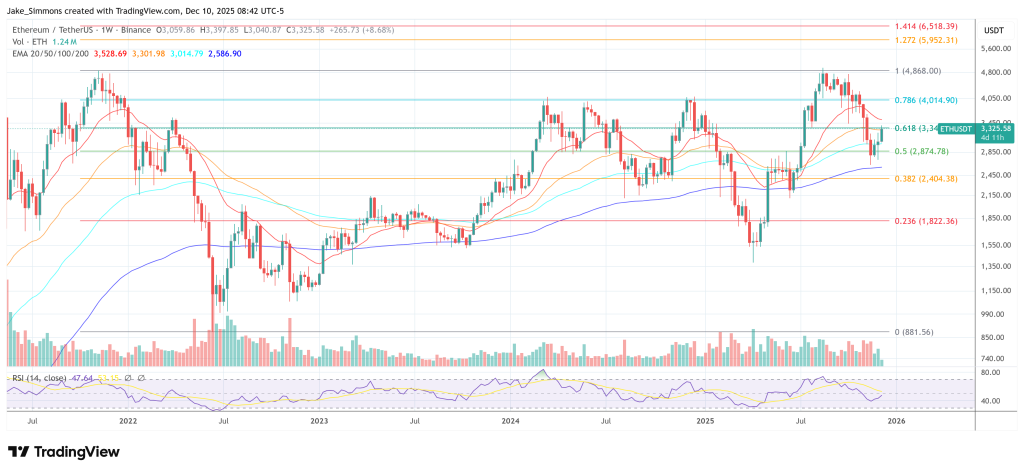
At press time, ETH traded at $3,325.
Ethereum price
Disclaimer: The articles reposted on this site are sourced from public platforms and are provided for informational purposes only. They do not necessarily reflect the views of MEXC. All rights remain with the original authors. If you believe any content infringes on third-party rights, please contact service@support.mexc.com for removal. MEXC makes no guarantees regarding the accuracy, completeness, or timeliness of the content and is not responsible for any actions taken based on the information provided. The content does not constitute financial, legal, or other professional advice, nor should it be considered a recommendation or endorsement by MEXC.

You May Also Like

US SEC approves options tied to Grayscale Digital Large Cap Fund and Cboe Bitcoin US ETF Index

US SEC approves options tied to Grayscale Digital Large Cap Fund and Cboe Bitcoin US ETF Index

PANews reported on September 18th that the U.S. Securities and Exchange Commission (SEC) announced that, in addition to approving universal listing standards for commodity-based trust units , the SEC has also approved the listing and trading of the Grayscale Digital Large Cap Fund, which holds spot digital assets based on the CoinDesk 5 index. The SEC also approved the listing and trading of PM-settled options on the Cboe Bitcoin US ETF Index and the Mini-Cboe Bitcoin US ETF Index, with expiration dates including third Fridays, non-standard expiration dates, and quarterly index expiration dates.
Share
PANews2025/09/18 07:18
Son of filmmaker Rob Reiner charged with homicide for death of his parents

Son of filmmaker Rob Reiner charged with homicide for death of his parents

FILE PHOTO: Rob Reiner, director of "The Princess Bride," arrives for a special 25th anniversary viewing of the film during the New York Film Festival in New York
Share
Rappler2025/12/16 09:59
3 Shiba Inu Alternatives Crypto Millionaires Are Silently Accumulating in 2025

3 Shiba Inu Alternatives Crypto Millionaires Are Silently Accumulating in 2025

The post 3 Shiba Inu Alternatives Crypto Millionaires Are Silently Accumulating in 2025 appeared on BitcoinEthereumNews.com. Despite its meteoric rise in 2021, Shiba Inu (SHIB) has matured into a large‑cap meme coin with limited room for outsized returns. According to market data, SHIB traded around $0.00001293 on September 20 , 2025, and had a market capitalization of roughly $7.62 billion. With over 589 trillion tokens in circulation and trading volumes in the hundreds of millions, SHIB offers stability but lacks the explosive upside that early adopters crave. As a result, crypto millionaires are quietly rotating capital into smaller, high‑potential projects. Three of the most widely accumulated alternatives are Little Pepe (LILPEPE), Bonk (BONK), and Sui (SUI)—tokens that pair innovative technology or strong community dynamics with significantly lower valuations. Little Pepe (LILPEPE): A presale‑backed memecoin with real infrastructure Little Pepe made headlines in September 2025 when it completed the twelfth stage of its presale, having raised over $25.48 million and distributed more than 15.75 billion tokens. The project immediately moved to stage 13 at a token price of $0.0022, marking a 120 percent increase from the first presale stage. Participants expect further upside because the confirmed listing price is $0.003, implying a 30% gain for Stage-13 buyers. Little Pepe isn’t just another meme coin; it operates on a purpose-built Layer 2 network designed to deliver high-speed, low-cost transactions. The project integrates launchpad functionality for new tokens and includes anti-sniper protection to ensure fair trading. A Certik audit and other independent reviews reinforce its security credentials. This mix of infrastructure and meme culture appeal has attracted significant presale investments—an early signal that influential investors expect LILPEPE to outgrow its current small market capitalization. Bonk, launched on Christmas 2022 as a holiday airdrop to the Solana community, has become Solana’s “main dog‑themed memecoin”. It has embedded itself in the Solana DeFi ecosystem and now counts nearly 983,000 holders. Real‑time data show…
Share
BitcoinEthereumNews2025/09/29 05:19
