The International Monetary Fund on Thursday released a new global assessment of the stablecoin market, warning that fragmented regulatory frameworks acrossThe International Monetary Fund on Thursday released a new global assessment of the stablecoin market, warning that fragmented regulatory frameworks across

IMF Warns: Fragmented Stablecoin Rules Create “Roadblocks” – New Guidelines Released

2025/12/05 06:53

The International Monetary Fund on Thursday released a new global assessment of the stablecoin market, warning that fragmented regulatory frameworks across countries are now creating structural “roadblocks” that threaten financial stability, weaken oversight, and slow the development of cross-border payments.

In its report titled “Understanding Stablecoins,” the IMF reviewed how major economies, including the United States, the United Kingdom, the European Union, and Japan, regulate stablecoins and found that national approaches remain widely inconsistent.

While some countries treat stablecoins as securities, others regulate them as payment instruments, permit only bank-issued tokens, or leave large parts of the market unregulated.

Stablecoins Are Moving Faster Than Regulators Can Track, IMF Warns

The IMF said this regulatory patchwork allows stablecoins to move across borders faster than oversight can follow.

Issuers can operate from lightly regulated jurisdictions while serving users in stricter markets, limiting authorities’ ability to monitor reserves, redemptions, liquidity management, and anti-money laundering controls.

The fund warned that this creates regulatory arbitrage and weakens global supervision.

The report also pointed to technical fragmentation. Stablecoins increasingly operate across different blockchains and exchanges that are not always interoperable.

According to the IMF, this lack of coordination raises transaction costs, slows market development, and creates barriers to efficient global payments.

Differences in national regulatory treatment further complicate cross-border usage and settlement.
Source: IMF

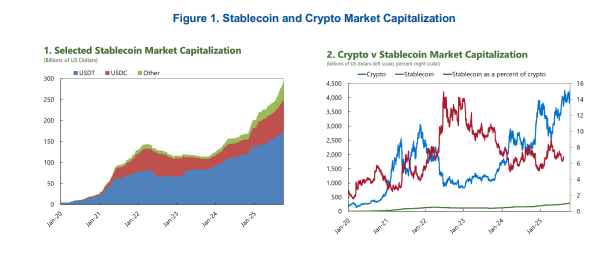
Stablecoins remain dominated by U.S. dollar-denominated tokens. The IMF said the global stablecoin market is now worth more than $300 billion. Tether’s USDT and Circle’s USDC make up the majority of that supply. About 40% of USDC’s reserves are held in short-term U.S. treasuries, while roughly 75% of USDT’s reserves are in short-term treasuries, with another 5% held in Bitcoin.

The concentration of reserves in government debt markets links stablecoins directly to traditional financial systems

Widespread use of foreign-currency stablecoins can weaken domestic monetary control, lower demand for local currency, and accelerate digital dollarization. Stablecoins also make it easier to bypass capital controls through unhosted wallets and offshore platforms.

In addition to monetary concerns, the fund cited broader financial stability concerns. Large-scale redemptions could force rapid sales of Treasury bills and repo assets, potentially disrupting short-term funding markets that are critical for monetary policy transmission.

The IMF also noted that the increasing interconnection between stablecoin issuers, banks, custodians, crypto exchanges, and funds also increases the risk of contagion spreading from digital markets into the wider financial system.

IMF Urges Unified Stablecoin Regulation as Cross-Border Risks Grow

To address these risks, the IMF released new global policy guidelines intended to reduce fragmentation. It called for harmonized definitions of stablecoins, consistent rules for reserve assets, and shared cross-border monitoring frameworks.

The fund said issuers should be subject to the principle of “same activity, same risk, same regulation,” regardless of whether the issuer is a bank, fintech company, or crypto platform.

The IMF also said stablecoins should be backed only by high-quality liquid assets such as short-term government securities, with strict limits on risky holdings. Issuers must guarantee full one-to-one redemption at par, on demand, at all times.

Strong international coordination on anti-money laundering enforcement, licensing, and supervision of large global stablecoin arrangements was also included in the new guidance.

The IMF’s warning comes as regulatory pressure is rising worldwide. In Europe, the European Central Bank recently warned that stablecoins, despite their small footprint in the euro area, now pose spillover risks due to their growing ties to U.S. Treasury markets.

The European Systemic Risk Board has also called for urgent safeguards against cross-border stablecoin structures operating under the EU’s MiCA framework.

In China, the central bank has described stablecoins as a threat to financial stability and monetary sovereignty, while the Bank of England and Basel regulators are reassessing how banks should hold capital against stablecoin exposure as usage expands.

The IMF concluded that without consistent global regulation, stablecoins could bypass national safeguards, destabilize vulnerable economies, and transmit financial shocks across borders at high speed.

Disclaimer: The articles reposted on this site are sourced from public platforms and are provided for informational purposes only. They do not necessarily reflect the views of MEXC. All rights remain with the original authors. If you believe any content infringes on third-party rights, please contact service@support.mexc.com for removal. MEXC makes no guarantees regarding the accuracy, completeness, or timeliness of the content and is not responsible for any actions taken based on the information provided. The content does not constitute financial, legal, or other professional advice, nor should it be considered a recommendation or endorsement by MEXC.

You May Also Like

Fed Makes First Rate Cut of the Year, Lowers Rates by 25 Bps

Fed Makes First Rate Cut of the Year, Lowers Rates by 25 Bps

The post Fed Makes First Rate Cut of the Year, Lowers Rates by 25 Bps appeared on BitcoinEthereumNews.com. The Federal Reserve has made its first Fed rate cut this year following today’s FOMC meeting, lowering interest rates by 25 basis points (bps). This comes in line with expectations, while the crypto market awaits Fed Chair Jerome Powell’s speech for guidance on the committee’s stance moving forward. FOMC Makes First Fed Rate Cut This Year With 25 Bps Cut In a press release, the committee announced that it has decided to lower the target range for the federal funds rate by 25 bps from between 4.25% and 4.5% to 4% and 4.25%. This comes in line with expectations as market participants were pricing in a 25 bps cut, as against a 50 bps cut. This marks the first Fed rate cut this year, with the last cut before this coming last year in December. Notably, the Fed also made the first cut last year in September, although it was a 50 bps cut back then. All Fed officials voted in favor of a 25 bps cut except Stephen Miran, who dissented in favor of a 50 bps cut. This rate cut decision comes amid concerns that the labor market may be softening, with recent U.S. jobs data pointing to a weak labor market. The committee noted in the release that job gains have slowed, and that the unemployment rate has edged up but remains low. They added that inflation has moved up and remains somewhat elevated. Fed Chair Jerome Powell had also already signaled at the Jackson Hole Conference that they were likely to lower interest rates with the downside risk in the labor market rising. The committee reiterated this in the release that downside risks to employment have risen. Before the Fed rate cut decision, experts weighed in on whether the FOMC should make a 25 bps cut or…
Share
BitcoinEthereumNews2025/09/18 04:36
Reform UK Gets Britain’s Biggest Political Donation Ever From Tether Investor

Reform UK Gets Britain’s Biggest Political Donation Ever From Tether Investor

The post Reform UK Gets Britain’s Biggest Political Donation Ever From Tether Investor appeared on BitcoinEthereumNews.com. In brief Reform UK landed a record-breaking $11.4 million (£9 million) donation from Christopher Harborne, the largest gift ever made to a UK political party by a living donor. The contribution helped push Reform’s Q3 fundraising to more than $12.9 million (£10.2 million), more than double that of the Tories. Harborne, a longtime donor across the British political spectrum, was listed as a shareholder of Bitfinex and Tether parent company DigFinex between 2017 and 2018. A Thailand-based investor in crypto firms just handed Nigel Farage’s Reform UK $11.4 million (£9 million), the largest single donation to a British political party from a living donor. Christopher Harborne, who has been listed as a shareholder in the parent company of stablecoin issuer Tether, pushed Reform UK’s total donations to more than $12.9 million (£10.2 million) between July and September, according to Electoral Commission figures released Thursday. That’s more than double what the Conservatives raised at $5.8 million (£4.6 million), and miles ahead of Labour’s $2.7 million (£2.1 million) and the Liberal Democrats’ $1.3 million (£1 million). The donation points to crypto-related funds making serious inroads into British politics ahead of the next general election. It also marks the first quarter since last year’s general election that Reform UK has out-fundraised the Conservatives, as Farage’s party leads in national opinion polls. Reform UK has already staked out a position for itself as the crypto industry’s champion in Westminster, with Farage promising to slash capital gains taxes on cryptocurrency and force the Bank of England to establish a Bitcoin reserve. Harborne’s donation dwarfed all other Q3 contributions, with the next-largest being games programmer Jeremy Elliott San’s $1.3 million (£1 million) to the Conservatives, followed by Labour’s $459,000 (£362,625) from Unite and the Liberal Democrats’ $63,300 (£50,000) from Neale Powell-Cook. Mega donor The reclusive Harborne…
Share
BitcoinEthereumNews2025/12/05 07:41