The post Meet Denis Dariotis, the Billion-Dollar GoQuant Founder Who Started Trading at 9 Years Old appeared on BitcoinEthereumNews.com. Denis Dariotis, the 22-year-old founder and CEO of cryptocurrency-focused trading software firm GoQuant, remembers the constraints and pressures of maximizing his trading portfolio while he was still in the third grade at school. “I remember telling my teachers I had to take 10 minutes out of class to check my portfolio when the market opened and closed,” Dariotis said in an interview. The child trading prodigy recalled how a teacher wanted to see his computer screen and what he was trading. But he shut the laptop saying, “No, I’m afraid that’s private” — an interesting presage of the crypto-focused dark pool app Dariotis released just last month. Dariotis grew up in Montreal, where his earliest memory of the trading world was being attracted to the symbols flashing green and red on the CNBC morning show his parents had on in the background. It was only a matter of time until he made the connection between the tickers on the TV screen and the money in his piggybank. From his early days at school, audaciously following the investment thesis of Warren Buffet, the next logical step was getting into computer programming. “When I was about 11 or 12 years old, I took an interest in computer programming, starting with basic web development languages, and then evolving into Python and C++,” he recalls. Listening to the way Dariotis tells it, his evolution toward building trading infrastructure seems the most natural thing in the world. By the age of 13 he realized he was spending too much time scanning a ton of datasets, and wasn’t there some way to use his computing knowhow to automate that process? That way, he could spend more time on researching trading strategies and getting alpha. Having been hitherto unaware of quant trading, Dariotis began back-testing strategies and… The post Meet Denis Dariotis, the Billion-Dollar GoQuant Founder Who Started Trading at 9 Years Old appeared on BitcoinEthereumNews.com. Denis Dariotis, the 22-year-old founder and CEO of cryptocurrency-focused trading software firm GoQuant, remembers the constraints and pressures of maximizing his trading portfolio while he was still in the third grade at school. “I remember telling my teachers I had to take 10 minutes out of class to check my portfolio when the market opened and closed,” Dariotis said in an interview. The child trading prodigy recalled how a teacher wanted to see his computer screen and what he was trading. But he shut the laptop saying, “No, I’m afraid that’s private” — an interesting presage of the crypto-focused dark pool app Dariotis released just last month. Dariotis grew up in Montreal, where his earliest memory of the trading world was being attracted to the symbols flashing green and red on the CNBC morning show his parents had on in the background. It was only a matter of time until he made the connection between the tickers on the TV screen and the money in his piggybank. From his early days at school, audaciously following the investment thesis of Warren Buffet, the next logical step was getting into computer programming. “When I was about 11 or 12 years old, I took an interest in computer programming, starting with basic web development languages, and then evolving into Python and C++,” he recalls. Listening to the way Dariotis tells it, his evolution toward building trading infrastructure seems the most natural thing in the world. By the age of 13 he realized he was spending too much time scanning a ton of datasets, and wasn’t there some way to use his computing knowhow to automate that process? That way, he could spend more time on researching trading strategies and getting alpha. Having been hitherto unaware of quant trading, Dariotis began back-testing strategies and…

Meet Denis Dariotis, the Billion-Dollar GoQuant Founder Who Started Trading at 9 Years Old

Denis Dariotis, the 22-year-old founder and CEO of cryptocurrency-focused trading software firm GoQuant, remembers the constraints and pressures of maximizing his trading portfolio while he was still in the third grade at school.

“I remember telling my teachers I had to take 10 minutes out of class to check my portfolio when the market opened and closed,” Dariotis said in an interview.

The child trading prodigy recalled how a teacher wanted to see his computer screen and what he was trading. But he shut the laptop saying, “No, I’m afraid that’s private” — an interesting presage of the crypto-focused dark pool app Dariotis released just last month.

Dariotis grew up in Montreal, where his earliest memory of the trading world was being attracted to the symbols flashing green and red on the CNBC morning show his parents had on in the background. It was only a matter of time until he made the connection between the tickers on the TV screen and the money in his piggybank.

From his early days at school, audaciously following the investment thesis of Warren Buffet, the next logical step was getting into computer programming. “When I was about 11 or 12 years old, I took an interest in computer programming, starting with basic web development languages, and then evolving into Python and C++,” he recalls.

Listening to the way Dariotis tells it, his evolution toward building trading infrastructure seems the most natural thing in the world. By the age of 13 he realized he was spending too much time scanning a ton of datasets, and wasn’t there some way to use his computing knowhow to automate that process? That way, he could spend more time on researching trading strategies and getting alpha.

Having been hitherto unaware of quant trading, Dariotis began back-testing strategies and researching different elements of portfolio construction, optimization, risk management and “really getting into the weeds of every element of how quant markets operate.”

It wasn’t long before a breakthrough came: At the ripe old age of 15, Dariotis says he basically licensed his strategies and started consulting for a major Canadian bank, which was his first main client. This was followed by a few other investment managers. Later, at a trading and data science conference in New York, a large hedge fund tried to hire Dariotis on the spot.

“But then they were like, ‘Hang on a second, how old are you?’ And then I was like, ‘I’m 15,’ and they sort of freaked out.”

This was also around the time Dariotis started looking at crypto. The initial realization was how retail-orientated crypto markets are, lacking any real institutional-grade infrastructure. Crypto suffered severely from having fragmented liquidity spread across many venues: centralized and decentralized exchanges, OTC desks.

Having applied his data market toolset to crypto, Dariotis saw latency delays in the manner that trading venues updated order books. He realized the best way to go was to build the whole infrastructure stack.

By January of 2025, GoQuant had bagged a $3 million pre-seed round, plus a $4 million seed round led by crypto trading firm GSR. It now handles over $1 billion in trading volume each day, and employs about 80 staff spread across the U.S., Europe, India, the Philippines and Morocco.

Recent additions to the brand include the GoDark institutional-grade dark pool, and a GoCredit lending platform which has about half a billion dollars of crypto loans in the pipeline.

“We really want to be at the center of how value moves,” Dariotis said. “So we’re largely a tech provider, rather than a financial intermediary, at a point in time where everything is essentially becoming a market: prediction markets, the ‘perpification’ of all sorts of assets, the tokenization of all sorts of assets. Everything is becoming tradable so there is a need for a core platform that connects everything and does so in a performant manner.”

So what’s Dariotis’ advice to other kids who are busily building billion-dollar companies in their bedrooms?

“You have to be flexible, willing to adapt and potentially to pivot,” he said. “We started off just handling data and we could have just stayed in our little data world and probably done very well. You want to avoid creating product silos — even if these could be $100 million businesses on their own — when they have the potential to be worth multiples more by building a whole connected ecosystem.”

Source: https://www.coindesk.com/business/2025/11/29/meet-the-billion-dollar-crypto-founder-who-started-trading-at-9-years-old


Market Opportunity
MY Logo
MY Price(MY)
$0.1453
$0.1453$0.1453
+13.78%
USD
MY (MY) Live Price Chart
Disclaimer: The articles reposted on this site are sourced from public platforms and are provided for informational purposes only. They do not necessarily reflect the views of MEXC. All rights remain with the original authors. If you believe any content infringes on third-party rights, please contact service@support.mexc.com for removal. MEXC makes no guarantees regarding the accuracy, completeness, or timeliness of the content and is not responsible for any actions taken based on the information provided. The content does not constitute financial, legal, or other professional advice, nor should it be considered a recommendation or endorsement by MEXC.

You May Also Like

The Best Crypto Presale in 2025? Solana and ADA Struggle, but Lyno AI Surges With Growing Momentum

The Best Crypto Presale in 2025? Solana and ADA Struggle, but Lyno AI Surges With Growing Momentum

The post The Best Crypto Presale in 2025? Solana and ADA Struggle, but Lyno AI Surges With Growing Momentum appeared on BitcoinEthereumNews.com. With the development of 2025, certain large cryptocurrencies encounter continuous issues and a new player secures an impressive advantage. Solana is struggling with congestion, and the ADA of Cardano is still at a significantly lower level than its highest price. In the meantime, Lyno AI presale is gaining momentum, attracting a large number of investors. Solana Faces Setbacks Amid Market Pressure However, despite the hype surrounding ETFs, Solana fell by 7% to $ 203, due to the constant congestion problems that hamper its network functionality. This makes adoption slow and aggravates traders who want to get things done quickly. Recent upgrades should combat those issues but the competition is rising, and Solana continues to lag in terms of user adoption and ecosystem development. Cardano Struggles to Regain Momentum ADA, the token of a Cardano, costs 72% less than the 2021 high and is developing more slowly than Ethereum Layer 2 solutions. The adoption of the coin is not making any progress despite the good forecasts. Analysts believe that the road to regain the past heights is long before Cardano can go back, with more technological advancements getting more and more attention. Lyno AI’s Explosive Presale Growth In stark contrast, Lyno AI is currently in its Early Bird presale, in which tokens are sold at 0.05 per unit and have already sold 632,398 tokens and raised 31,462 dollars. The next stage price will be established at $0.055 and the final target will be at $0.10. Audited by Cyberscope , Lyno AI provides a cross-chain AI arbitrage platform that enables retail traders to compete with institutions. Its AI algorithms perform trades in 15+ blockchains in real time, opening profitable arbitrage opportunities to everyone. Those who make purchases above 100 dollars are also offered the possibility of winning in the 100K Lyno AI…
Share
BitcoinEthereumNews2025/09/18 18:22
Nobel-winning economist exposes ugly truth behind age of 'know-nothingism' in US

Nobel-winning economist exposes ugly truth behind age of 'know-nothingism' in US

Paul Krugman revealed the simple and unsurprising reason for a baffling political mystery: why America has rejected renewable energy just when it's become cheaper
Share
Rawstory2026/02/17 08:06
Selling Pressure Persists in Crypto Funds, CoinShares Reports

Selling Pressure Persists in Crypto Funds, CoinShares Reports

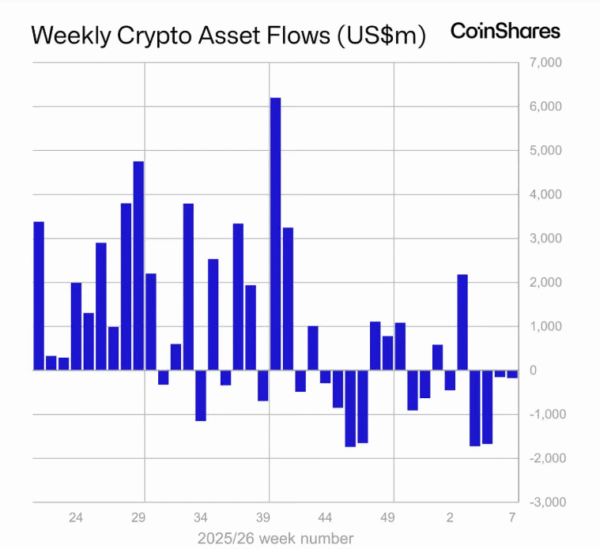
Crypto funds lose $3.74B in four weeks as U.S. outflows drive continued institutional caution. Crypto investment products from BlackRock, Fidelity, and Bitwise
Share
LiveBitcoinNews2026/02/17 07:59