Galaxy Digital CEO Mike Novogratz says the October 10th crash in crypto was far more than a routine shakeout, claiming that roughly a third of market makers in parts of the ecosystem were effectively wiped out. “We had a flash crash and it did a lot of damage to the fabric of the market,” Novogratz told Anthony Scaramucci on the first-ever episode of “All Things Markets,” recorded November 26. “Even on Hyperliquid, the market makers, you know, 30 percent of them went out of business. Got zeroed.” Scaramucci framed the last 20 trading days as another brutal reminder of crypto’s structural volatility. “I know I have a trap door on my portfolio,” he said. “Once in a while I’ll be walking across the living room feeling beautiful about myself. And then, boom, a trap door opens and I have fallen into the basement of the house.” Related Reading: Will Crypto Explode If Kevin Hassett Takes Over The Fed In 2026? According to Novogratz, this particular trap door opened at Binance. “It started really by, you know, at Binance, they had an oracle which set price misfunction,” he said. That error hit a synthetic stablecoin and “created a cascade where people were getting stopped out because there was the wrong price.” The dislocation then bled into levered perpetual markets “like Hyperliquid, like Uniswap,” where “as prices went down, people started getting liquidated.” He argued that the way crypto participants use leverage turned a technical glitch into a systemic event. “What people don’t understand about crypto is that the crypto investor doesn’t play for 10, 11, 12 percent returns,” he said. “Crypto investor call themselves degens with pride. They want to turn one into 15. And so they trade a very volatile asset with a lot of leverage.” Perpetual futures make that leverage particularly dangerous for liquidity providers. “Perpetual futures are not normal futures,” Novogratz said, crediting “the genius that Arthur Hayes and his group of people” for a design where “as longs get liquidated, they’re paired off against shorts.” In a fast collapse, “you could be short and you lose your short position. Well, if you’re long on another exchange against that short position, you’re shit out of luck. And that happened to a lot of market makers.” Will The Crypto Market Recover? The result, he said, was a sharp loss of liquidity and retail capital. “We lost a lot of liquidity in the market. We lost a lot of retail punters who lost their stack,” he noted, adding that after such a wipeout “it takes a while for Humpty Dumpty to get put back together again.” Novogratz said he initially expected higher levels to hold. “I actually, to be fair, thought we were going to hold at higher levels at $90,000,” he admitted. “And we went all the way to $80,000. $80,000 was a maximum pain point… Got to $1.80 on XRP. We got to $125 on Solana. Real pain points.” He links the subsequent rebound to macro tailwinds, not healed sentiment. “Now we bounce up. We bounce because of the Fed. But we’re not out of the woods,” he said. “I do think Bitcoin will climb back towards $100,000 by the end of the year, but there’ll be sellers waiting there. We’ve done some medium-term damage to the psychology of the market.” Related Reading: Crypto Has Entered Late-Cycle Territory, Says Global Liquidity Veteran On the spot side, he highlighted massive profit-taking by early holders against ETF-driven inflows. “We had one $9 billion seller,” he said. “That’s one-third of all of IBIT’s flows of the year.” As US wealth channels move “from a zero weighting to a 3 to 4 percent weighting” in Bitcoin, that “was met with OG sellers.” “In the long run, that’s healthy,” he said. “In the short run, that’s painful.” Novogratz also argued that crypto is being repriced as a real business ecosystem rather than a pure story. “It’s a transition from just being a story — ‘we’re the most important industry… we’re going to decentralize the world’ — to ‘show me what crypto actually does,’” he said. “Some businesses are making money. Some businesses aren’t. There are some token ecosystems that make common sense to an investor and there’s some that all feel like they’re just an association.” Overlaying it all is a macro backdrop he views as increasingly supportive. He called the Fed’s recent signals and plans to ease bank cash requirements in repo “a monstrous liquidity boom that’s coming,” adding that “they’re going to bring rates down to 2 percent in the next 16 months” and that inflation will “creep higher,” implying negative real rates. For crypto, the message is double-edged: structurally de-levered, with fewer market makers and wounded sentiment, but still tied to a global liquidity cycle that Novogratz believes is turning in its favor — once Humpty Dumpty gets put back together again. At press time, Bitcoin traded at $91,115. Featured image from YouTube, chart from TradingView.comGalaxy Digital CEO Mike Novogratz says the October 10th crash in crypto was far more than a routine shakeout, claiming that roughly a third of market makers in parts of the ecosystem were effectively wiped out. “We had a flash crash and it did a lot of damage to the fabric of the market,” Novogratz told Anthony Scaramucci on the first-ever episode of “All Things Markets,” recorded November 26. “Even on Hyperliquid, the market makers, you know, 30 percent of them went out of business. Got zeroed.” Scaramucci framed the last 20 trading days as another brutal reminder of crypto’s structural volatility. “I know I have a trap door on my portfolio,” he said. “Once in a while I’ll be walking across the living room feeling beautiful about myself. And then, boom, a trap door opens and I have fallen into the basement of the house.” Related Reading: Will Crypto Explode If Kevin Hassett Takes Over The Fed In 2026? According to Novogratz, this particular trap door opened at Binance. “It started really by, you know, at Binance, they had an oracle which set price misfunction,” he said. That error hit a synthetic stablecoin and “created a cascade where people were getting stopped out because there was the wrong price.” The dislocation then bled into levered perpetual markets “like Hyperliquid, like Uniswap,” where “as prices went down, people started getting liquidated.” He argued that the way crypto participants use leverage turned a technical glitch into a systemic event. “What people don’t understand about crypto is that the crypto investor doesn’t play for 10, 11, 12 percent returns,” he said. “Crypto investor call themselves degens with pride. They want to turn one into 15. And so they trade a very volatile asset with a lot of leverage.” Perpetual futures make that leverage particularly dangerous for liquidity providers. “Perpetual futures are not normal futures,” Novogratz said, crediting “the genius that Arthur Hayes and his group of people” for a design where “as longs get liquidated, they’re paired off against shorts.” In a fast collapse, “you could be short and you lose your short position. Well, if you’re long on another exchange against that short position, you’re shit out of luck. And that happened to a lot of market makers.” Will The Crypto Market Recover? The result, he said, was a sharp loss of liquidity and retail capital. “We lost a lot of liquidity in the market. We lost a lot of retail punters who lost their stack,” he noted, adding that after such a wipeout “it takes a while for Humpty Dumpty to get put back together again.” Novogratz said he initially expected higher levels to hold. “I actually, to be fair, thought we were going to hold at higher levels at $90,000,” he admitted. “And we went all the way to $80,000. $80,000 was a maximum pain point… Got to $1.80 on XRP. We got to $125 on Solana. Real pain points.” He links the subsequent rebound to macro tailwinds, not healed sentiment. “Now we bounce up. We bounce because of the Fed. But we’re not out of the woods,” he said. “I do think Bitcoin will climb back towards $100,000 by the end of the year, but there’ll be sellers waiting there. We’ve done some medium-term damage to the psychology of the market.” Related Reading: Crypto Has Entered Late-Cycle Territory, Says Global Liquidity Veteran On the spot side, he highlighted massive profit-taking by early holders against ETF-driven inflows. “We had one $9 billion seller,” he said. “That’s one-third of all of IBIT’s flows of the year.” As US wealth channels move “from a zero weighting to a 3 to 4 percent weighting” in Bitcoin, that “was met with OG sellers.” “In the long run, that’s healthy,” he said. “In the short run, that’s painful.” Novogratz also argued that crypto is being repriced as a real business ecosystem rather than a pure story. “It’s a transition from just being a story — ‘we’re the most important industry… we’re going to decentralize the world’ — to ‘show me what crypto actually does,’” he said. “Some businesses are making money. Some businesses aren’t. There are some token ecosystems that make common sense to an investor and there’s some that all feel like they’re just an association.” Overlaying it all is a macro backdrop he views as increasingly supportive. He called the Fed’s recent signals and plans to ease bank cash requirements in repo “a monstrous liquidity boom that’s coming,” adding that “they’re going to bring rates down to 2 percent in the next 16 months” and that inflation will “creep higher,” implying negative real rates. For crypto, the message is double-edged: structurally de-levered, with fewer market makers and wounded sentiment, but still tied to a global liquidity cycle that Novogratz believes is turning in its favor — once Humpty Dumpty gets put back together again. At press time, Bitcoin traded at $91,115. Featured image from YouTube, chart from TradingView.com
30% Of Crypto Market Makers Got Wiped, Mike Novogratz Says

2025/11/28 09:00
4 min read

Galaxy Digital CEO Mike Novogratz says the October 10th crash in crypto was far more than a routine shakeout, claiming that roughly a third of market makers in parts of the ecosystem were effectively wiped out.

“We had a flash crash and it did a lot of damage to the fabric of the market,” Novogratz told Anthony Scaramucci on the first-ever episode of “All Things Markets,” recorded November 26. “Even on Hyperliquid, the market makers, you know, 30 percent of them went out of business. Got zeroed.”

Scaramucci framed the last 20 trading days as another brutal reminder of crypto’s structural volatility. “I know I have a trap door on my portfolio,” he said. “Once in a while I’ll be walking across the living room feeling beautiful about myself. And then, boom, a trap door opens and I have fallen into the basement of the house.”

According to Novogratz, this particular trap door opened at Binance. “It started really by, you know, at Binance, they had an oracle which set price misfunction,” he said. That error hit a synthetic stablecoin and “created a cascade where people were getting stopped out because there was the wrong price.” The dislocation then bled into levered perpetual markets “like Hyperliquid, like Uniswap,” where “as prices went down, people started getting liquidated.”

He argued that the way crypto participants use leverage turned a technical glitch into a systemic event. “What people don’t understand about crypto is that the crypto investor doesn’t play for 10, 11, 12 percent returns,” he said. “Crypto investor call themselves degens with pride. They want to turn one into 15. And so they trade a very volatile asset with a lot of leverage.”

Perpetual futures make that leverage particularly dangerous for liquidity providers. “Perpetual futures are not normal futures,” Novogratz said, crediting “the genius that Arthur Hayes and his group of people” for a design where “as longs get liquidated, they’re paired off against shorts.” In a fast collapse, “you could be short and you lose your short position. Well, if you’re long on another exchange against that short position, you’re shit out of luck. And that happened to a lot of market makers.”

Will The Crypto Market Recover?

The result, he said, was a sharp loss of liquidity and retail capital. “We lost a lot of liquidity in the market. We lost a lot of retail punters who lost their stack,” he noted, adding that after such a wipeout “it takes a while for Humpty Dumpty to get put back together again.”

Novogratz said he initially expected higher levels to hold. “I actually, to be fair, thought we were going to hold at higher levels at $90,000,” he admitted. “And we went all the way to $80,000. $80,000 was a maximum pain point… Got to $1.80 on XRP. We got to $125 on Solana. Real pain points.”

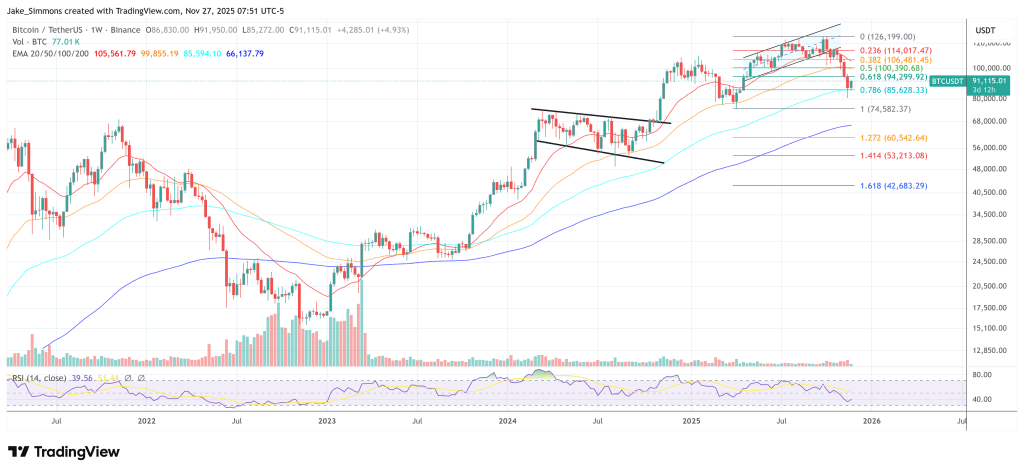
He links the subsequent rebound to macro tailwinds, not healed sentiment. “Now we bounce up. We bounce because of the Fed. But we’re not out of the woods,” he said. “I do think Bitcoin will climb back towards $100,000 by the end of the year, but there’ll be sellers waiting there. We’ve done some medium-term damage to the psychology of the market.”

On the spot side, he highlighted massive profit-taking by early holders against ETF-driven inflows. “We had one $9 billion seller,” he said. “That’s one-third of all of IBIT’s flows of the year.” As US wealth channels move “from a zero weighting to a 3 to 4 percent weighting” in Bitcoin, that “was met with OG sellers.” “In the long run, that’s healthy,” he said. “In the short run, that’s painful.”

Novogratz also argued that crypto is being repriced as a real business ecosystem rather than a pure story. “It’s a transition from just being a story — ‘we’re the most important industry… we’re going to decentralize the world’ — to ‘show me what crypto actually does,’” he said. “Some businesses are making money. Some businesses aren’t. There are some token ecosystems that make common sense to an investor and there’s some that all feel like they’re just an association.”

Overlaying it all is a macro backdrop he views as increasingly supportive. He called the Fed’s recent signals and plans to ease bank cash requirements in repo “a monstrous liquidity boom that’s coming,” adding that “they’re going to bring rates down to 2 percent in the next 16 months” and that inflation will “creep higher,” implying negative real rates.

For crypto, the message is double-edged: structurally de-levered, with fewer market makers and wounded sentiment, but still tied to a global liquidity cycle that Novogratz believes is turning in its favor — once Humpty Dumpty gets put back together again.

At press time, Bitcoin traded at $91,115.

Bitcoin price
Market Opportunity
Farcana Logo
Farcana Price(FAR)
$0.000916
$0.000916$0.000916
-0.54%
USD
Farcana (FAR) Live Price Chart
Disclaimer: The articles reposted on this site are sourced from public platforms and are provided for informational purposes only. They do not necessarily reflect the views of MEXC. All rights remain with the original authors. If you believe any content infringes on third-party rights, please contact service@support.mexc.com for removal. MEXC makes no guarantees regarding the accuracy, completeness, or timeliness of the content and is not responsible for any actions taken based on the information provided. The content does not constitute financial, legal, or other professional advice, nor should it be considered a recommendation or endorsement by MEXC.

You May Also Like

Michael Saylor’s Strategy follows Metaplanet, adding 6,269 BTC worth $729 million

Michael Saylor’s Strategy follows Metaplanet, adding 6,269 BTC worth $729 million

The post Michael Saylor’s Strategy follows Metaplanet, adding 6,269 BTC worth $729 million appeared on BitcoinEthereumNews.com. The two giant BTC holders, Strategy and Metaplanet, have stirred the waters despite the FUD in the Bitcoin market by acquiring a total of 6,269 Bitcoins. According to reports, Strategy has acquired 850 BTC while Metaplanet has acquired a bumper 5,419 tokens. Michael Saylor’s Strategy, the world’s largest corporate Bitcoin holder, purchased BTC worth $99.7 million at $117,344 per Bitcoin. This has brought its total Bitcoin holdings to 639,835 BTC, acquired for about $47.3 billion at $73,971 per Bitcoin. JUST IN: Strategy buys 850 BTC for $99.7M at $117,344 per BTC. Now holds 639,835 $BTCTotal spent: $47.33B Avg cost: $73,971 per BTCYTD BTC yield: 26.0% https://t.co/7iv2difHzR pic.twitter.com/O8WfDpJDxQ — Cryptopolitan (@CPOfficialtx) September 22, 2025 On the other hand, as reported by Cryptopolitan, Metaplanet purchased BTC worth $632.53 million at an average price of roughly $116,724 per Bitcoin. This has brought its total BTC holdings to 25,555 BTC, which was acquired for approximately $2.7 billion and purchased at an average price of $106,065 per BTC. Strategy slows down BTC purchase while Metaplanet adds speed The US company’s most recent Bitcoin purchase is in line with a recent trend of small purchases, showing a slowdown compared to the big purchases seen earlier this year. Strategy bought 3330 Bitcoin in September, which is a big drop from the 7,714 BTC it bought in August and a 75% drop from the 31,466 BTC it bought in July. In line with Bitcoin, Strategy’s stock has dropped about 2% in the last 30 days. Starting in 2020, the company put most of its money into Bitcoin. It used a mix of debt and stock to buy huge amounts of BTC, which turned the business intelligence software company into a Bitcoin giant. Still, the stock has gone up 2,200% since it started buying BTC. On the other hand,…
Share
BitcoinEthereumNews2025/09/22 22:54
Payward Revenue Hits $2.2 Billion as Kraken Exchange Reports Strong 2025 Growth

Payward Revenue Hits $2.2 Billion as Kraken Exchange Reports Strong 2025 Growth

TLDR Payward, Kraken’s parent company, earned $2.2 billion in 2025, a 33% increase from 2024’s $1.6 billion Trading revenue and asset-based services each contributed
Share
Blockonomi2026/02/04 20:11
Super Micro Computer (SMCI) Stock: Revenue Soars Past $12B on AI Server Boom

Super Micro Computer (SMCI) Stock: Revenue Soars Past $12B on AI Server Boom

TLDR Revenue hit $12.7 billion, crushing $10.42 billion estimate and up 123.4% year-over-year EPS of $0.69 beat consensus $0.49 by 40.8% in fiscal Q2 Q3 guidance
Share
Blockonomi2026/02/04 20:36