Quick Facts: ➡️ The market is seeing a major institutional rotation as long-term Bitcoin holders sell to new institutional players like traditional finance funds and ETFs. ➡️ Institutional buying is driving the demand for a faster Bitcoin execution layer, proving the “old cycle theory” is obsolete due to strong new liquidity. ➡️ Bitcoin Hyper ($HYPER) […]Quick Facts: ➡️ The market is seeing a major institutional rotation as long-term Bitcoin holders sell to new institutional players like traditional finance funds and ETFs. ➡️ Institutional buying is driving the demand for a faster Bitcoin execution layer, proving the “old cycle theory” is obsolete due to strong new liquidity. ➡️ Bitcoin Hyper ($HYPER) […]

Institutions Buying Bitcoin Are Fueling a Scalability Arms Race, And One L2 Is Leading the Pack

2025/11/18 20:17
5 min read

Quick Facts:

  • ➡ The market is seeing a major institutional rotation as long-term Bitcoin holders sell to new institutional players like traditional finance funds and ETFs.
  • ➡ Institutional buying is driving the demand for a faster Bitcoin execution layer, proving the “old cycle theory” is obsolete due to strong new liquidity.
  • ➡ Bitcoin Hyper ($HYPER) is a Layer 2 built using SVM technology to give Bitcoin sub-second transactions and low gas fees for dApps and utility.
  • ➡ Bitcoin maintains its role as the secure base layer, while Bitcoin Hyper transforms it from a ‘store of value’ to a high-speed playground for DeFi and general use.

For years, Bitcoin has been the heavyweight champ of security but the slowest runner on the track. Everyone trusted it, everyone bought it, but nobody could pretend it was fast.

Meme coins? Impossible. Cheap transactions? Forget it. dApps? Developers laughed and walked away. And with Bitcoin’s tiny throughput and poor scalability, the chain was basically a digital gold bar that sat still and looked pretty.
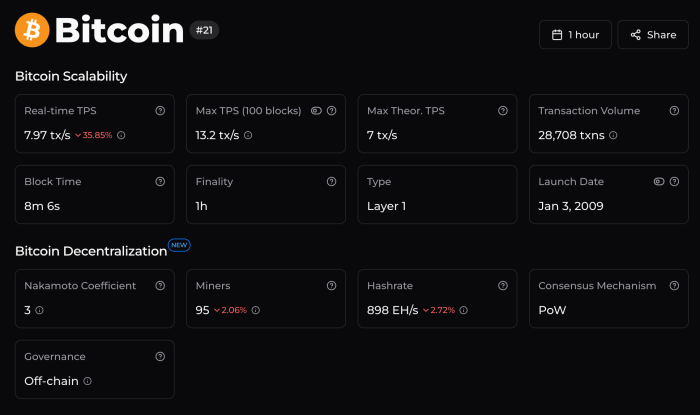
Bitcoin Scalability by Chainspect.

Now the market is shifting. Institutions are buying Bitcoin in size, and even OG Bitcoiners are cashing out to them. That alone shows Bitcoin is far from dead.

The current dip is a perfect illustration of this changing market structure. CryptoQuant founder and CEO, Ki Young Ju, posted on X that the selling is merely a rotation from original long-term holders to new institutional players like traditional finance funds and ETFs, with strong liquidity inflows from these new channels signaling that the old cycle theory is obsolete.

Bitcoin has simply reached the point where the next evolution needs more speed, more utility, and more tech than the base chain can offer. And that is exactly where Bitcoin Hyper ($HYPER) steps in.

With this new crypto project, the old chain feels like it just got a full makeover. A proper facelift. Bitcoin Hyper arrives as a Layer 2 built on the SVM, one of the fastest blockchain engines in the world.

Suddenly, Bitcoin unlocks sub-second transactions and tiny gas fees.

Developers, builders, and degens finally get what they always wanted but never had: high-speed action on Bitcoin itself.

Bitcoin is no longer limited to being a store of value. Payments feel instant again. Apps can live on-chain instead of being pushed elsewhere. Bitcoin stays as the trusted, solid base layer, while Bitcoin Hyper becomes the playground where everything actually happens.

And it is built for builders, for degens, and for the culture. Tooling, support, and incentives are all baked in, with enough raw speed to make the entire crypto world blink twice.

Bitcoin Hyper ($HYPER) – Bridging Bitcoin’s Past to a High-Speed ​​Future

Bitcoin earned its reputation by being the safest and most trusted base layer in crypto. It locks in value, keeps the chain secure, and does not break. But that strength came with a price.

Bitcoin never had the speed or flexibility needed for modern applications. Bitcoin Hyper ($HYPER) changes that by building a modular Layer 2 on top of Bitcoin’s settlement layer.

Bitcoin stays the rock. $HYPER becomes the engine.

Execution moves off-chain, using the Solana Virtual Machine (SVM), where transactions fire almost instantly and cost next to nothing.

The SVM is the key that unlocks all of this. Developers can use Rust and build smart contracts that actually feel modern. We go into further detail in our ‘What is Bitcoin Hyper‘ guide.

Suddenly, Bitcoin can support DeFi, lending, trading platforms, and even complex on-chain products that were never possible before.

Movement between layers stays smooth thanks to a built-in Canonical Bridge that lets $BTC flow into Hyper’s ecosystem with no hassle.

This architecture gives users everything they were missing: fast payments, cheap transfers, NFT marketplaces, gaming, and real room for builders.

Instead of watching other chains run ahead, Bitcoin finally gets its own high-speed playground. Bitcoin Hyper takes Bitcoin’s secure past and connects it to the kind of future people have been asking for.

Join the $HYPER presale today.

Why Buy $HYPER Now

Investors see a clear trend. Institutional money is pouring into Bitcoin after ETF approvals, but the base chain still cannot support modern financial tools.

That gap created demand for a real execution layer. Bitcoin Hyper fills that gap with speed, cheap transactions, and cross-chain features that Bitcoin always needed.

Buyers are getting early access to the ecosystem that will run everything on $HYPER.

With over $27.8M raised, the market already showed strong belief in the Layer 2 future of Bitcoin.

Institutions are now looking for scale, smart contracts, and real utility on top of Bitcoin. Bitcoin Hyper delivers all of that while letting Bitcoin remain the trusted, secure base layer underneath. Want in but not sure how? Check out our ‘How to Buy Bitcoin Hyper‘ guide.

If Bitcoin is leveling up, $HYPER is the ticket that gets you inside the upgrade.

Bitcoin Hyper brings Bitcoin into the high-speed era. Fast payments, cheap transactions, DeFi, meme coins, and full cross-chain movement all live under one system.

If Bitcoin needed an execution layer, Bitcoin Hyper built it. And $HYPER lets you take part in that future.

Buy $HYPER today for $0.013295.

Remember, this is not intended as financial advic,e and you should always do your own research before investing. 

Authored by Bogdan Patru, Bitcoinist — https://bitcoinist.com/institutions-buying-bitcoin-fuel-demand-for-bitcoin-hyper-l2

Market Opportunity
HashPack Logo
HashPack Price(PACK)
$0.00596
$0.00596$0.00596
-0.50%
USD
HashPack (PACK) Live Price Chart
Disclaimer: The articles reposted on this site are sourced from public platforms and are provided for informational purposes only. They do not necessarily reflect the views of MEXC. All rights remain with the original authors. If you believe any content infringes on third-party rights, please contact service@support.mexc.com for removal. MEXC makes no guarantees regarding the accuracy, completeness, or timeliness of the content and is not responsible for any actions taken based on the information provided. The content does not constitute financial, legal, or other professional advice, nor should it be considered a recommendation or endorsement by MEXC.

You May Also Like

FCA komt in 2026 met aangepaste cryptoregels voor Britse markt

FCA komt in 2026 met aangepaste cryptoregels voor Britse markt

De Britse financiële waakhond, de FCA, komt in 2026 met nieuwe regels speciaal voor crypto bedrijven. Wat direct opvalt: de toezichthouder laat enkele klassieke financiële verplichtingen los om beter aan te sluiten op de snelle en grillige wereld van digitale activa. Tegelijkertijd wordt er extra nadruk gelegd op digitale beveiliging,... Het bericht FCA komt in 2026 met aangepaste cryptoregels voor Britse markt verscheen het eerst op Blockchain Stories.
Share
Coinstats2025/09/18 00:33
United States Building Permits Change dipped from previous -2.8% to -3.7% in August

United States Building Permits Change dipped from previous -2.8% to -3.7% in August

The post United States Building Permits Change dipped from previous -2.8% to -3.7% in August appeared on BitcoinEthereumNews.com. Information on these pages contains forward-looking statements that involve risks and uncertainties. Markets and instruments profiled on this page are for informational purposes only and should not in any way come across as a recommendation to buy or sell in these assets. You should do your own thorough research before making any investment decisions. FXStreet does not in any way guarantee that this information is free from mistakes, errors, or material misstatements. It also does not guarantee that this information is of a timely nature. Investing in Open Markets involves a great deal of risk, including the loss of all or a portion of your investment, as well as emotional distress. All risks, losses and costs associated with investing, including total loss of principal, are your responsibility. The views and opinions expressed in this article are those of the authors and do not necessarily reflect the official policy or position of FXStreet nor its advertisers. The author will not be held responsible for information that is found at the end of links posted on this page. If not otherwise explicitly mentioned in the body of the article, at the time of writing, the author has no position in any stock mentioned in this article and no business relationship with any company mentioned. The author has not received compensation for writing this article, other than from FXStreet. FXStreet and the author do not provide personalized recommendations. The author makes no representations as to the accuracy, completeness, or suitability of this information. FXStreet and the author will not be liable for any errors, omissions or any losses, injuries or damages arising from this information and its display or use. Errors and omissions excepted. The author and FXStreet are not registered investment advisors and nothing in this article is intended…
Share
BitcoinEthereumNews2025/09/18 02:20
Google's AP2 protocol has been released. Does encrypted AI still have a chance?

Google's AP2 protocol has been released. Does encrypted AI still have a chance?

Following the MCP and A2A protocols, the AI Agent market has seen another blockbuster arrival: the Agent Payments Protocol (AP2), developed by Google. This will clearly further enhance AI Agents' autonomous multi-tasking capabilities, but the unfortunate reality is that it has little to do with web3AI. Let's take a closer look: What problem does AP2 solve? Simply put, the MCP protocol is like a universal hook, enabling AI agents to connect to various external tools and data sources; A2A is a team collaboration communication protocol that allows multiple AI agents to cooperate with each other to complete complex tasks; AP2 completes the last piece of the puzzle - payment capability. In other words, MCP opens up connectivity, A2A promotes collaboration efficiency, and AP2 achieves value exchange. The arrival of AP2 truly injects "soul" into the autonomous collaboration and task execution of Multi-Agents. Imagine AI Agents connecting Qunar, Meituan, and Didi to complete the booking of flights, hotels, and car rentals, but then getting stuck at the point of "self-payment." What's the point of all that multitasking? So, remember this: AP2 is an extension of MCP+A2A, solving the last mile problem of AI Agent automated execution. What are the technical highlights of AP2? The core innovation of AP2 is the Mandates mechanism, which is divided into real-time authorization mode and delegated authorization mode. Real-time authorization is easy to understand. The AI Agent finds the product and shows it to you. The operation can only be performed after the user signs. Delegated authorization requires the user to set rules in advance, such as only buying the iPhone 17 when the price drops to 5,000. The AI Agent monitors the trigger conditions and executes automatically. The implementation logic is cryptographically signed using Verifiable Credentials (VCs). Users can set complex commission conditions, including price ranges, time limits, and payment method priorities, forming a tamper-proof digital contract. Once signed, the AI Agent executes according to the conditions, with VCs ensuring auditability and security at every step. Of particular note is the "A2A x402" extension, a technical component developed by Google specifically for crypto payments, developed in collaboration with Coinbase and the Ethereum Foundation. This extension enables AI Agents to seamlessly process stablecoins, ETH, and other blockchain assets, supporting native payment scenarios within the Web3 ecosystem. What kind of imagination space can AP2 bring? After analyzing the technical principles, do you think that's it? Yes, in fact, the AP2 is boring when it is disassembled alone. Its real charm lies in connecting and opening up the "MCP+A2A+AP2" technology stack, completely opening up the complete link of AI Agent's autonomous analysis+execution+payment. From now on, AI Agents can open up many application scenarios. For example, AI Agents for stock investment and financial management can help us monitor the market 24/7 and conduct independent transactions. Enterprise procurement AI Agents can automatically replenish and renew without human intervention. AP2's complementary payment capabilities will further expand the penetration of the Agent-to-Agent economy into more scenarios. Google obviously understands that after the technical framework is established, the ecological implementation must be relied upon, so it has brought in more than 60 partners to develop it, almost covering the entire payment and business ecosystem. Interestingly, it also involves major Crypto players such as Ethereum, Coinbase, MetaMask, and Sui. Combined with the current trend of currency and stock integration, the imagination space has been doubled. Is web3 AI really dead? Not entirely. Google's AP2 looks complete, but it only achieves technical compatibility with Crypto payments. It can only be regarded as an extension of the traditional authorization framework and belongs to the category of automated execution. There is a "paradigm" difference between it and the autonomous asset management pursued by pure Crypto native solutions. The Crypto-native solutions under exploration are taking the "decentralized custody + on-chain verification" route, including AI Agent autonomous asset management, AI Agent autonomous transactions (DeFAI), AI Agent digital identity and on-chain reputation system (ERC-8004...), AI Agent on-chain governance DAO framework, AI Agent NPC and digital avatars, and many other interesting and fun directions. Ultimately, once users get used to AI Agent payments in traditional fields, their acceptance of AI Agents autonomously owning digital assets will also increase. And for those scenarios that AP2 cannot reach, such as anonymous transactions, censorship-resistant payments, and decentralized asset management, there will always be a time for crypto-native solutions to show their strength? The two are more likely to be complementary rather than competitive, but to be honest, the key technological advancements behind AI Agents currently all come from web2AI, and web3AI still needs to keep up the good work!
Share
PANews2025/09/18 07:00