Norway has reported a sharp rise in cryptocurrency tax declarations, with more than 73,000 people disclosing digital asset holdings in their 2024 tax returns, a 30% increase from the previous year, according to new figures from the Norwegian Tax Administration (Skatteetaten). The surge represents the largest year-on-year increase in crypto reporting since records began and signals growing transparency in the country’s digital asset market.Source: Skatteetaten The total value of declared cryptocurrency holdings more than doubled to NOK 40.3 billion ($3.9 billion), the highest figure ever reported. Sevenfold Growth in Crypto Declarations — What’s Behind Norway’s Tax Turnaround? Tax Director Nina Schanke Funnemark said the increase reflects the success of recent measures aimed at encouraging voluntary compliance. “It is gratifying that more people are reporting that they own cryptocurrency and in this way ensuring that the tax is correct,” she said. “We have taken several measures in recent years to increase this number, and we see that these measures are having an effect.” In 2019, fewer than 10,000 Norwegians reported owning crypto assets. That number has now grown more than sevenfold. The increase comes after the tax agency began sending out digital reminders, known as dults, to taxpayers who may own crypto or virtual assets but failed to declare them. The latest data also reflects rising market prices throughout 2024, which significantly boosted the total declared value of digital holdings. Skatteetaten noted that crypto gains reached NOK 5.5 billion, while reported losses totaled NOK 2.9 billion for the same period. Under Norwegian law, cryptocurrency is treated as a capital asset, not a currency, meaning that profits and losses from trading are subject to capital gains tax.Source: Skatteetaten The current tax rate is a flat 22%, and the same rate applies to deductions for realized losses. Gains are triggered when digital assets are sold, swapped, or used to pay for goods or services. For example, if an investor sells 1 ETH that was purchased for 20,000 Norwegian kroner and sells it later for 50,000 kroner, the 30,000-kroner profit is taxed at 22%, resulting in a 6,600-kroner liability. FIFO to Wealth Tax: How Norway Calculates and Enforces Crypto Obligations The Norwegian system uses a First-In, First-Out (FIFO) method to calculate the cost basis of crypto sales, assuming the first coins bought are the first ones sold. In addition to capital gains tax, crypto holders must declare their digital assets as part of their net wealth each year. Wealth above NOK 1.7 million is subject to Norway’s wealth tax, with rates that vary based on income and municipality. Those earning from mining, staking, or airdrops must report such proceeds as regular income, which is taxed at a progressive rate depending on the taxpayer’s income level.Source: Skatteetaten Norway’s crypto taxation system relies heavily on self-reporting, meaning individuals are responsible for disclosing their own crypto activity through Skatteetaten’s online portal. Taxpayers must calculate their holdings, trades, and income in Norwegian kroner using the exchange rate on the transaction date. Failing to declare these assets can result in additional tax penalties or audits. Funnemark said many first-time filers tend to report small sums, but authorities have also uncovered large undeclared amounts through audits. Those who correct their declarations voluntarily can amend filings up to three years back to avoid penalties, provided the correction occurs before an official audit is initiated. How Far Will Norway Go to Keep Crypto in Check? The report added that from 2026, Norway’s oversight will expand further under new third-party reporting rules. Exchanges and wallet providers operating in the country will be required to report user data directly to Skatteetaten, giving the tax authority more accurate insight into residents’ crypto activity. “This is an important step towards more correct taxation of digital assets,” Tax Director Nina Schanke Funnemark said. “With this development, we will have a much better overview of who owns crypto assets, both in Norway and abroad.” Taxes collected from cryptocurrency activity in Norway flow into the country’s general government revenue, helping to fund public infrastructure, education, healthcare, and social services. Crypto-related tax income is treated no differently from that derived from stocks or other capital investments. The latest rise in declarations coincides with a broader regulatory tightening in Norway’s digital asset sector. In 2025, the government moved to align national law with the European Union’s Markets in Crypto-Assets (MiCA) regulation, introducing licensing requirements for crypto service providers and stronger consumer protection rules. A temporary ban on new high-energy crypto mining projects was also announced in June, citing environmental concerns and energy conservation priorities. Meanwhile, the government’s ethics watchdog, which oversees the $1.8 trillion Government Pension Fund Global, in 2024 said it was preparing to investigate crypto and gambling firms in its portfolio over money laundering risks. The council’s findings could lead to divestment from some companies, reflecting Norway’s cautious but active approach to the crypto sectorNorway has reported a sharp rise in cryptocurrency tax declarations, with more than 73,000 people disclosing digital asset holdings in their 2024 tax returns, a 30% increase from the previous year, according to new figures from the Norwegian Tax Administration (Skatteetaten). The surge represents the largest year-on-year increase in crypto reporting since records began and signals growing transparency in the country’s digital asset market.Source: Skatteetaten The total value of declared cryptocurrency holdings more than doubled to NOK 40.3 billion ($3.9 billion), the highest figure ever reported. Sevenfold Growth in Crypto Declarations — What’s Behind Norway’s Tax Turnaround? Tax Director Nina Schanke Funnemark said the increase reflects the success of recent measures aimed at encouraging voluntary compliance. “It is gratifying that more people are reporting that they own cryptocurrency and in this way ensuring that the tax is correct,” she said. “We have taken several measures in recent years to increase this number, and we see that these measures are having an effect.” In 2019, fewer than 10,000 Norwegians reported owning crypto assets. That number has now grown more than sevenfold. The increase comes after the tax agency began sending out digital reminders, known as dults, to taxpayers who may own crypto or virtual assets but failed to declare them. The latest data also reflects rising market prices throughout 2024, which significantly boosted the total declared value of digital holdings. Skatteetaten noted that crypto gains reached NOK 5.5 billion, while reported losses totaled NOK 2.9 billion for the same period. Under Norwegian law, cryptocurrency is treated as a capital asset, not a currency, meaning that profits and losses from trading are subject to capital gains tax.Source: Skatteetaten The current tax rate is a flat 22%, and the same rate applies to deductions for realized losses. Gains are triggered when digital assets are sold, swapped, or used to pay for goods or services. For example, if an investor sells 1 ETH that was purchased for 20,000 Norwegian kroner and sells it later for 50,000 kroner, the 30,000-kroner profit is taxed at 22%, resulting in a 6,600-kroner liability. FIFO to Wealth Tax: How Norway Calculates and Enforces Crypto Obligations The Norwegian system uses a First-In, First-Out (FIFO) method to calculate the cost basis of crypto sales, assuming the first coins bought are the first ones sold. In addition to capital gains tax, crypto holders must declare their digital assets as part of their net wealth each year. Wealth above NOK 1.7 million is subject to Norway’s wealth tax, with rates that vary based on income and municipality. Those earning from mining, staking, or airdrops must report such proceeds as regular income, which is taxed at a progressive rate depending on the taxpayer’s income level.Source: Skatteetaten Norway’s crypto taxation system relies heavily on self-reporting, meaning individuals are responsible for disclosing their own crypto activity through Skatteetaten’s online portal. Taxpayers must calculate their holdings, trades, and income in Norwegian kroner using the exchange rate on the transaction date. Failing to declare these assets can result in additional tax penalties or audits. Funnemark said many first-time filers tend to report small sums, but authorities have also uncovered large undeclared amounts through audits. Those who correct their declarations voluntarily can amend filings up to three years back to avoid penalties, provided the correction occurs before an official audit is initiated. How Far Will Norway Go to Keep Crypto in Check? The report added that from 2026, Norway’s oversight will expand further under new third-party reporting rules. Exchanges and wallet providers operating in the country will be required to report user data directly to Skatteetaten, giving the tax authority more accurate insight into residents’ crypto activity. “This is an important step towards more correct taxation of digital assets,” Tax Director Nina Schanke Funnemark said. “With this development, we will have a much better overview of who owns crypto assets, both in Norway and abroad.” Taxes collected from cryptocurrency activity in Norway flow into the country’s general government revenue, helping to fund public infrastructure, education, healthcare, and social services. Crypto-related tax income is treated no differently from that derived from stocks or other capital investments. The latest rise in declarations coincides with a broader regulatory tightening in Norway’s digital asset sector. In 2025, the government moved to align national law with the European Union’s Markets in Crypto-Assets (MiCA) regulation, introducing licensing requirements for crypto service providers and stronger consumer protection rules. A temporary ban on new high-energy crypto mining projects was also announced in June, citing environmental concerns and energy conservation priorities. Meanwhile, the government’s ethics watchdog, which oversees the $1.8 trillion Government Pension Fund Global, in 2024 said it was preparing to investigate crypto and gambling firms in its portfolio over money laundering risks. The council’s findings could lead to divestment from some companies, reflecting Norway’s cautious but active approach to the crypto sector

Norway Sees 30% Surge in Crypto Tax Reporting — $4B in Digital Assets Declared

2025/10/29 19:43
5 min read

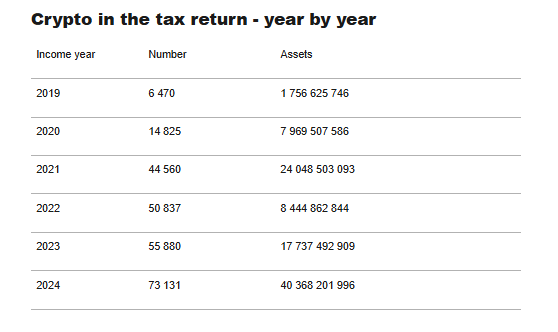
Norway has reported a sharp rise in cryptocurrency tax declarations, with more than 73,000 people disclosing digital asset holdings in their 2024 tax returns, a 30% increase from the previous year, according to new figures from the Norwegian Tax Administration (Skatteetaten).

The surge represents the largest year-on-year increase in crypto reporting since records began and signals growing transparency in the country’s digital asset market.
Source: Skatteetaten

The total value of declared cryptocurrency holdings more than doubled to NOK 40.3 billion ($3.9 billion), the highest figure ever reported.

Sevenfold Growth in Crypto Declarations — What’s Behind Norway’s Tax Turnaround?

Tax Director Nina Schanke Funnemark said the increase reflects the success of recent measures aimed at encouraging voluntary compliance.

“It is gratifying that more people are reporting that they own cryptocurrency and in this way ensuring that the tax is correct,” she said. “We have taken several measures in recent years to increase this number, and we see that these measures are having an effect.”

In 2019, fewer than 10,000 Norwegians reported owning crypto assets. That number has now grown more than sevenfold.

The increase comes after the tax agency began sending out digital reminders, known as dults, to taxpayers who may own crypto or virtual assets but failed to declare them.

The latest data also reflects rising market prices throughout 2024, which significantly boosted the total declared value of digital holdings. Skatteetaten noted that crypto gains reached NOK 5.5 billion, while reported losses totaled NOK 2.9 billion for the same period.

Under Norwegian law, cryptocurrency is treated as a capital asset, not a currency, meaning that profits and losses from trading are subject to capital gains tax.

Source: Skatteetaten

The current tax rate is a flat 22%, and the same rate applies to deductions for realized losses.

Gains are triggered when digital assets are sold, swapped, or used to pay for goods or services.

For example, if an investor sells 1 ETH that was purchased for 20,000 Norwegian kroner and sells it later for 50,000 kroner, the 30,000-kroner profit is taxed at 22%, resulting in a 6,600-kroner liability.

FIFO to Wealth Tax: How Norway Calculates and Enforces Crypto Obligations

The Norwegian system uses a First-In, First-Out (FIFO) method to calculate the cost basis of crypto sales, assuming the first coins bought are the first ones sold.

In addition to capital gains tax, crypto holders must declare their digital assets as part of their net wealth each year. Wealth above NOK 1.7 million is subject to Norway’s wealth tax, with rates that vary based on income and municipality.

Those earning from mining, staking, or airdrops must report such proceeds as regular income, which is taxed at a progressive rate depending on the taxpayer’s income level.

Source: Skatteetaten

Norway’s crypto taxation system relies heavily on self-reporting, meaning individuals are responsible for disclosing their own crypto activity through Skatteetaten’s online portal.

Taxpayers must calculate their holdings, trades, and income in Norwegian kroner using the exchange rate on the transaction date. Failing to declare these assets can result in additional tax penalties or audits.

Funnemark said many first-time filers tend to report small sums, but authorities have also uncovered large undeclared amounts through audits.

Those who correct their declarations voluntarily can amend filings up to three years back to avoid penalties, provided the correction occurs before an official audit is initiated.

How Far Will Norway Go to Keep Crypto in Check?

The report added that from 2026, Norway’s oversight will expand further under new third-party reporting rules.

Exchanges and wallet providers operating in the country will be required to report user data directly to Skatteetaten, giving the tax authority more accurate insight into residents’ crypto activity.

“This is an important step towards more correct taxation of digital assets,” Tax Director Nina Schanke Funnemark said. “With this development, we will have a much better overview of who owns crypto assets, both in Norway and abroad.”

Taxes collected from cryptocurrency activity in Norway flow into the country’s general government revenue, helping to fund public infrastructure, education, healthcare, and social services.

Crypto-related tax income is treated no differently from that derived from stocks or other capital investments.

The latest rise in declarations coincides with a broader regulatory tightening in Norway’s digital asset sector.

In 2025, the government moved to align national law with the European Union’s Markets in Crypto-Assets (MiCA) regulation, introducing licensing requirements for crypto service providers and stronger consumer protection rules.

A temporary ban on new high-energy crypto mining projects was also announced in June, citing environmental concerns and energy conservation priorities.

Meanwhile, the government’s ethics watchdog, which oversees the $1.8 trillion Government Pension Fund Global, in 2024 said it was preparing to investigate crypto and gambling firms in its portfolio over money laundering risks.

The council’s findings could lead to divestment from some companies, reflecting Norway’s cautious but active approach to the crypto sector.

Disclaimer: The articles reposted on this site are sourced from public platforms and are provided for informational purposes only. They do not necessarily reflect the views of MEXC. All rights remain with the original authors. If you believe any content infringes on third-party rights, please contact service@support.mexc.com for removal. MEXC makes no guarantees regarding the accuracy, completeness, or timeliness of the content and is not responsible for any actions taken based on the information provided. The content does not constitute financial, legal, or other professional advice, nor should it be considered a recommendation or endorsement by MEXC.

You May Also Like

CEO Sandeep Nailwal Shared Highlights About RWA on Polygon

CEO Sandeep Nailwal Shared Highlights About RWA on Polygon

The post CEO Sandeep Nailwal Shared Highlights About RWA on Polygon appeared on BitcoinEthereumNews.com. Polygon CEO Sandeep Nailwal highlighted Polygon’s lead in global bonds, Spiko US T-Bill, and Spiko Euro T-Bill. Polygon published an X post to share that its roadmap to GigaGas was still scaling. Sentiments around POL price were last seen to be bearish. Polygon CEO Sandeep Nailwal shared key pointers from the Dune and RWA.xyz report. These pertain to highlights about RWA on Polygon. Simultaneously, Polygon underlined its roadmap towards GigaGas. Sentiments around POL price were last seen fumbling under bearish emotions. Polygon CEO Sandeep Nailwal on Polygon RWA CEO Sandeep Nailwal highlighted three key points from the Dune and RWA.xyz report. The Chief Executive of Polygon maintained that Polygon PoS was hosting RWA TVL worth $1.13 billion across 269 assets plus 2,900 holders. Nailwal confirmed from the report that RWA was happening on Polygon. The Dune and https://t.co/W6WSFlHoQF report on RWA is out and it shows that RWA is happening on Polygon. Here are a few highlights: – Leading in Global Bonds: Polygon holds 62% share of tokenized global bonds (driven by Spiko’s euro MMF and Cashlink euro issues) – Spiko U.S.… — Sandeep | CEO, Polygon Foundation (※,※) (@sandeepnailwal) September 17, 2025 The X post published by Polygon CEO Sandeep Nailwal underlined that the ecosystem was leading in global bonds by holding a 62% share of tokenized global bonds. He further highlighted that Polygon was leading with Spiko US T-Bill at approximately 29% share of TVL along with Ethereum, adding that the ecosystem had more than 50% share in the number of holders. Finally, Sandeep highlighted from the report that there was a strong adoption for Spiko Euro T-Bill with 38% share of TVL. He added that 68% of returns were on Polygon across all the chains. Polygon Roadmap to GigaGas In a different update from Polygon, the community…
Share
BitcoinEthereumNews2025/09/18 01:10
XRP Price Targets $1.65 Next, But BTC Correction Could Push It Down First

XRP Price Targets $1.65 Next, But BTC Correction Could Push It Down First

XRP targets $1.65 resistance, but Bitcoin’s incomplete wave pattern may trigger pullback to $1.30 first. Technical indicators show mixed signals with RSI at 36
Share
LiveBitcoinNews2026/02/09 01:45
Moonshot MAGAX vs Shiba Inu: The AI-Powered Meme-to-Earn Revolution Challenging a Meme Coin Giant

Moonshot MAGAX vs Shiba Inu: The AI-Powered Meme-to-Earn Revolution Challenging a Meme Coin Giant

Discover how Moonshot MAGAX’s AI-powered meme-to-earn platform outpaces Shiba Inu with innovative tokenomics and growth potential in 2025.
Share
Blockchainreporter2025/09/18 03:15