Author: nairolf Compiled by: TechFlow What is HIP-3? Here is @HyperliquidX’s HIP-3 explained in very simple terms. HIP-3 allows developers to deploy perpetual contract markets on HyperCore. To ensure market quality and protect users, deployers must stake 500,000 HYPE. If malicious market manipulation occurs, validators have the right to reduce the deployer's stake. You should already be familiar with HyperCore, right? It includes the status of margin and matching engine. Simply put, it is the exchange backend of Hyperliquid. HIP is short for Improvement Proposals. Simply put, it is how the protocol is changed. The main purpose of HIP-3 is to allow anyone to deploy a perpetual contract market. Currently, the process for adding new tokens to perpetual swap exchanges is permissioned. This means that the core team decides which tokens to add based on demand, trading volume, and other criteria. HIP-3 allows anyone to list a token of their choice. Yes, literally any token. However, there are some restrictions. Only one token can be listed every 31 hours. Furthermore, you need to win the right to deploy through a Dutch auction (using HYPE). You need to pledge 500,000 HYPE and are responsible for setting up the market. This means choosing an oracle, defining leverage limits, handling settlement logic, and ensuring everything runs securely. 500,000 HYPE This is a security guarantee and also the way the protocol protects itself. If there is weird manipulation of the market for your token, validators can vote to slash your HYPE. In short, these HYPEs ensure that the tokens you list are legal. As a token deployer, you can take 50% of the total market fees. You can even set a custom fee. In other words, you can earn a portion of the fees from users trading the tokens you list. HIP-3 allows anyone to list tokens on the Hyperliquid perpetual contract exchange. To ensure market security, 500,000 HYPE must be pledged, and these pledges may be cut if suspicious behavior occurs. Author: nairolf Compiled by: TechFlow What is HIP-3? Here is @HyperliquidX’s HIP-3 explained in very simple terms. HIP-3 allows developers to deploy perpetual contract markets on HyperCore. To ensure market quality and protect users, deployers must stake 500,000 HYPE. If malicious market manipulation occurs, validators have the right to reduce the deployer's stake. You should already be familiar with HyperCore, right? It includes the status of margin and matching engine. Simply put, it is the exchange backend of Hyperliquid. HIP is short for Improvement Proposals. Simply put, it is how the protocol is changed. The main purpose of HIP-3 is to allow anyone to deploy a perpetual contract market. Currently, the process for adding new tokens to perpetual swap exchanges is permissioned. This means that the core team decides which tokens to add based on demand, trading volume, and other criteria. HIP-3 allows anyone to list a token of their choice. Yes, literally any token. However, there are some restrictions. Only one token can be listed every 31 hours. Furthermore, you need to win the right to deploy through a Dutch auction (using HYPE). You need to pledge 500,000 HYPE and are responsible for setting up the market. This means choosing an oracle, defining leverage limits, handling settlement logic, and ensuring everything runs securely. 500,000 HYPE This is a security guarantee and also the way the protocol protects itself. If there is weird manipulation of the market for your token, validators can vote to slash your HYPE. In short, these HYPEs ensure that the tokens you list are legal. As a token deployer, you can take 50% of the total market fees. You can even set a custom fee. In other words, you can earn a portion of the fees from users trading the tokens you list. HIP-3 allows anyone to list tokens on the Hyperliquid perpetual contract exchange. To ensure market security, 500,000 HYPE must be pledged, and these pledges may be cut if suspicious behavior occurs.

Hyperliquid's HIP-3 Upgrade in One Minute

2025/10/14 08:00
2 min read

Author: nairolf

Compiled by: TechFlow

What is HIP-3?

Here is @HyperliquidX’s HIP-3 explained in very simple terms.

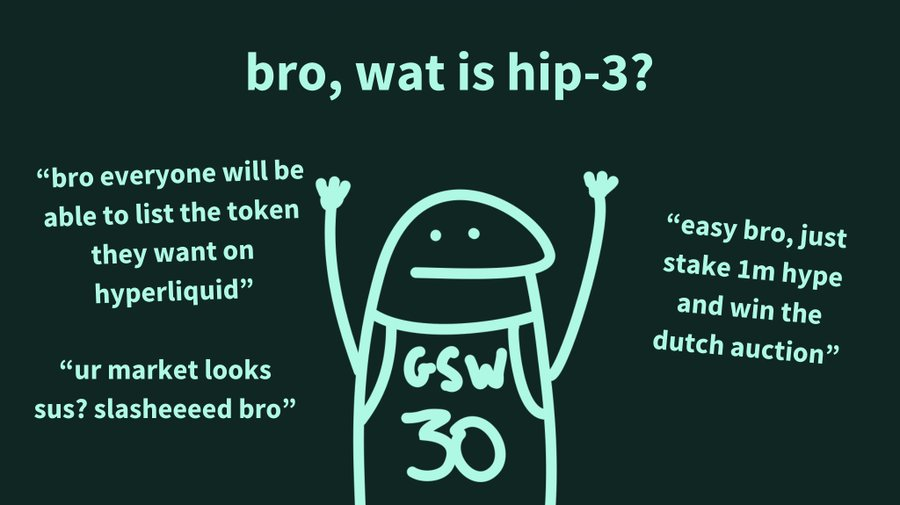
HIP-3 allows developers to deploy perpetual contract markets on HyperCore.

To ensure market quality and protect users, deployers must stake 500,000 HYPE. If malicious market manipulation occurs, validators have the right to reduce the deployer's stake.

You should already be familiar with HyperCore, right? It includes the status of margin and matching engine.

Simply put, it is the exchange backend of Hyperliquid.

HIP is short for Improvement Proposals. Simply put, it is how the protocol is changed.

The main purpose of HIP-3 is to allow anyone to deploy a perpetual contract market.

Currently, the process for adding new tokens to perpetual swap exchanges is permissioned.

This means that the core team decides which tokens to add based on demand, trading volume, and other criteria.

HIP-3 allows anyone to list a token of their choice. Yes, literally any token.

However, there are some restrictions. Only one token can be listed every 31 hours. Furthermore, you need to win the right to deploy through a Dutch auction (using HYPE).

You need to pledge 500,000 HYPE and are responsible for setting up the market.

This means choosing an oracle, defining leverage limits, handling settlement logic, and ensuring everything runs securely.

500,000 HYPE This is a security guarantee and also the way the protocol protects itself.

If there is weird manipulation of the market for your token, validators can vote to slash your HYPE.

In short, these HYPEs ensure that the tokens you list are legal.

As a token deployer, you can take 50% of the total market fees. You can even set a custom fee.

In other words, you can earn a portion of the fees from users trading the tokens you list.

HIP-3 allows anyone to list tokens on the Hyperliquid perpetual contract exchange.

To ensure market security, 500,000 HYPE must be pledged, and these pledges may be cut if suspicious behavior occurs.

Market Opportunity
Hyperliquid Logo
Hyperliquid Price(HYPE)
$32.33
$32.33$32.33
-0.43%
USD
Hyperliquid (HYPE) Live Price Chart
Disclaimer: The articles reposted on this site are sourced from public platforms and are provided for informational purposes only. They do not necessarily reflect the views of MEXC. All rights remain with the original authors. If you believe any content infringes on third-party rights, please contact service@support.mexc.com for removal. MEXC makes no guarantees regarding the accuracy, completeness, or timeliness of the content and is not responsible for any actions taken based on the information provided. The content does not constitute financial, legal, or other professional advice, nor should it be considered a recommendation or endorsement by MEXC.

You May Also Like

Polygon Tops RWA Rankings With $1.1B in Tokenized Assets

Polygon Tops RWA Rankings With $1.1B in Tokenized Assets

The post Polygon Tops RWA Rankings With $1.1B in Tokenized Assets appeared on BitcoinEthereumNews.com. Key Notes A new report from Dune and RWA.xyz highlights Polygon’s role in the growing RWA sector. Polygon PoS currently holds $1.13 billion in RWA Total Value Locked (TVL) across 269 assets. The network holds a 62% market share of tokenized global bonds, driven by European money market funds. The Polygon POL $0.25 24h volatility: 1.4% Market cap: $2.64 B Vol. 24h: $106.17 M network is securing a significant position in the rapidly growing tokenization space, now holding over $1.13 billion in total value locked (TVL) from Real World Assets (RWAs). This development comes as the network continues to evolve, recently deploying its major “Rio” upgrade on the Amoy testnet to enhance future scaling capabilities. This information comes from a new joint report on the state of the RWA market published on Sept. 17 by blockchain analytics firm Dune and data platform RWA.xyz. The focus on RWAs is intensifying across the industry, coinciding with events like the ongoing Real-World Asset Summit in New York. Sandeep Nailwal, CEO of the Polygon Foundation, highlighted the findings via a post on X, noting that the TVL is spread across 269 assets and 2,900 holders on the Polygon PoS chain. The Dune and https://t.co/W6WSFlHoQF report on RWA is out and it shows that RWA is happening on Polygon. Here are a few highlights: – Leading in Global Bonds: Polygon holds 62% share of tokenized global bonds (driven by Spiko’s euro MMF and Cashlink euro issues) – Spiko U.S.… — Sandeep | CEO, Polygon Foundation (※,※) (@sandeepnailwal) September 17, 2025 Key Trends From the 2025 RWA Report The joint publication, titled “RWA REPORT 2025,” offers a comprehensive look into the tokenized asset landscape, which it states has grown 224% since the start of 2024. The report identifies several key trends driving this expansion. According to…
Share
BitcoinEthereumNews2025/09/18 00:40
Explosive 25% Penalty On Nations Trading With Tehran

Explosive 25% Penalty On Nations Trading With Tehran

The post Explosive 25% Penalty On Nations Trading With Tehran appeared on BitcoinEthereumNews.com. Trump Iran Tariffs: Explosive 25% Penalty On Nations Trading
Share
BitcoinEthereumNews2026/02/07 08:10
Trump scolded after unusual change at annual governors meeting

Trump scolded after unusual change at annual governors meeting

President Donald Trump is taking a massive departure from tradition by only inviting Republicans to the annual National Governors Association meeting — an event
Share
Rawstory2026/02/07 08:16