SwissBorg founding partner Alex Fazel believes the market is entering a multi-year, structurally different bull phase that could deliver “generational wealth,” laying out what he called an “alt season bible” for 2025–2026 in a wide-ranging interview with Altcoin Daily. Speaking in a probabilistic framework, Fazel argued that the confluence of a strengthening business cycle, easier monetary policy, and twin technology booms in crypto/Web3 and artificial intelligence creates the same kind of tailwinds that powered the post-dot-com “recovery cycle” in equities. “I really want to prove to everyone that this is the biggest cycle and the biggest chance for everyone to generate generational wealth,” he said, adding that his views are expressed in probabilities rather than certainties. The 2025–26 Crypto Altcoin Cycle Will Be Historic Fazel’s market structure thesis centers on a familiar rotation: Bitcoin leading, followed by Ethereum and the top-cap cohort, and then a broader dispersion into mid- and small-caps as Bitcoin dominance rolls over. He insisted that the current advance lacks the hallmark “euphoria stage”—a late-cycle condition he considers statistically common and, therefore, still ahead. “It is extremely rare… to have a bull cycle without euphoria,” he said, noting that sizable drawdowns will punctuate the trend without invalidating it. “We won’t see a long bear market anymore… We’re going to see a very extended bull run but with really big corrections along the way.” Related Reading: 2%–4% In Crypto? Morgan Stanley Thinks That’s The Smart Move Now To gauge cycle magnitude, Fazel prefers total crypto market capitalization over date-calling. He mapped prior expansions—roughly 45x from 2014 to 2017 and ~27x into 2021—into a conservative inference that a 2x–3x from the last cycle’s ~$3 trillion top would imply a $6–$9 trillion total capitalization before this run is exhausted. That—along with a still-missing euphoria phase—forms one of his primary exit heuristics. “Rather than just thinking about how long, look at how high,” he said. On sector leadership, Fazel’s team compiled a year-over-year basket (September 2024 to early September 2025) of tokens that outperformed Bitcoin on sustained timeframes to filter out “pump-and-dump noise.” The list he highlighted was dominated by DeFi and exchange-adjacent assets: Virtuals (AI-agent) with a 20x,Hyperliquid’s HYPE 7x, Sui and its DeepBook DEX as strong performers, Curve and Ethena Labs 2.5x–3x, SwissBorg’s BORG ~2.5x, and Raydium. His conclusion was blunt: “DeFi is the best sector to invest in,” with exchange tokens repeatedly among the most resilient leaders since 2018 due to clear product-market fit in speculation and fee generation. Fazel stitched those returns to an explicit capital-flows mechanism: buybacks. He showed a positive correlation, in his view, between top token performers and sustained buyback programs, and drew a parallel to equities where many of the cycle’s strongest stocks—including AI bellwethers—have announced large, continuing repurchases. He cautioned, however, that buybacks can be overwhelmed by emissions. “If you have $20 million buying the token, but an airdrop is emitting $53 million, do the math,” he said, citing this dynamic to explain why some well-known tokens underperformed despite revenue. What Else To Look For On Altcoins From there, he proposed a simple four-quadrant framework for token “pumpamentals”: clear utility that investors perceive as valuable; loyalty via locking; strong, sustainable, and scalable buybacks; and burns or other mechanisms that reduce float. Layer-1s, he argued, typically tick only the first two boxes and still rely on inflationary issuance for staking yields. By contrast, exchange tokens and some DeFi assets can check all four—particularly if fee-linked buybacks are hard-wired, ongoing, and diversified across product lines. Fazel also outlined an increasingly prominent buyer cohort of digital asset treasuries (DATs)—public companies that raise in fiat and accumulate crypto for their balance sheets—observing that this structure can “pump the stock and the token.” He pointed to high-profile examples in Bitcoin and Ethereum, stressing that balance-sheet accumulation simultaneously adds buy pressure and removes sell pressure. More broadly, he framed today’s market as a “supercycle” moment because retail, institutions, and corporate treasuries are now converging on crypto exposure—initially in BTC and ETH, but progressively further out the risk curve as confidence grows. Related Reading: 70% Decline In Corporate Crypto Treasury Buying: What’s Going On? Much of Fazel’s playbook is operational at SwissBorg itself. He disclosed that the company, founded in 2017 and now at “300+ employees” and “$2.4 billion” in assets under management, has shifted to a 50% revenue-to-buyback policy for its BORG token and intentionally delisted from centralized exchanges to “control supply” and concentrate liquidity and volume in-app. Fazel repeatedly returned to risk management, urging investors to think in probabilities and to be willing to “divorce” underperforming tokens that lack real revenues or sound token economics. He also addressed dilution fears sparked by the proliferation of new tokens, contending that almost none reach meaningful size. “Out of all these coins… 0.00001% have a market cap above $1 million,” he said, arguing that the sheer number of microcap launches should not preclude an altseason in larger, revenue-generating names. His timeline remains conditional, but his conviction in the structure is clear. He expects Bitcoin could suffer 30%–40% pullbacks without derailing a longer advance, believes the equity backdrop is still “AI-led” rather than in a blow-off, and contends crypto adoption curves move faster than Web2 because they build atop the existing internet. As for a headline Bitcoin target, he demurred on specifics, but hinted the ceiling is higher than casual forecasts imply. “Almost $200k for Bitcoin seems too small,” he said at one point, before pivoting back to total-market metrics and the presence—or not—of broad-based euphoria. At press time, the total crypto market cap stood at $4.2 trillion. Featured image created with DALL.E, chart from TradingView.comSwissBorg founding partner Alex Fazel believes the market is entering a multi-year, structurally different bull phase that could deliver “generational wealth,” laying out what he called an “alt season bible” for 2025–2026 in a wide-ranging interview with Altcoin Daily. Speaking in a probabilistic framework, Fazel argued that the confluence of a strengthening business cycle, easier monetary policy, and twin technology booms in crypto/Web3 and artificial intelligence creates the same kind of tailwinds that powered the post-dot-com “recovery cycle” in equities. “I really want to prove to everyone that this is the biggest cycle and the biggest chance for everyone to generate generational wealth,” he said, adding that his views are expressed in probabilities rather than certainties. The 2025–26 Crypto Altcoin Cycle Will Be Historic Fazel’s market structure thesis centers on a familiar rotation: Bitcoin leading, followed by Ethereum and the top-cap cohort, and then a broader dispersion into mid- and small-caps as Bitcoin dominance rolls over. He insisted that the current advance lacks the hallmark “euphoria stage”—a late-cycle condition he considers statistically common and, therefore, still ahead. “It is extremely rare… to have a bull cycle without euphoria,” he said, noting that sizable drawdowns will punctuate the trend without invalidating it. “We won’t see a long bear market anymore… We’re going to see a very extended bull run but with really big corrections along the way.” Related Reading: 2%–4% In Crypto? Morgan Stanley Thinks That’s The Smart Move Now To gauge cycle magnitude, Fazel prefers total crypto market capitalization over date-calling. He mapped prior expansions—roughly 45x from 2014 to 2017 and ~27x into 2021—into a conservative inference that a 2x–3x from the last cycle’s ~$3 trillion top would imply a $6–$9 trillion total capitalization before this run is exhausted. That—along with a still-missing euphoria phase—forms one of his primary exit heuristics. “Rather than just thinking about how long, look at how high,” he said. On sector leadership, Fazel’s team compiled a year-over-year basket (September 2024 to early September 2025) of tokens that outperformed Bitcoin on sustained timeframes to filter out “pump-and-dump noise.” The list he highlighted was dominated by DeFi and exchange-adjacent assets: Virtuals (AI-agent) with a 20x,Hyperliquid’s HYPE 7x, Sui and its DeepBook DEX as strong performers, Curve and Ethena Labs 2.5x–3x, SwissBorg’s BORG ~2.5x, and Raydium. His conclusion was blunt: “DeFi is the best sector to invest in,” with exchange tokens repeatedly among the most resilient leaders since 2018 due to clear product-market fit in speculation and fee generation. Fazel stitched those returns to an explicit capital-flows mechanism: buybacks. He showed a positive correlation, in his view, between top token performers and sustained buyback programs, and drew a parallel to equities where many of the cycle’s strongest stocks—including AI bellwethers—have announced large, continuing repurchases. He cautioned, however, that buybacks can be overwhelmed by emissions. “If you have $20 million buying the token, but an airdrop is emitting $53 million, do the math,” he said, citing this dynamic to explain why some well-known tokens underperformed despite revenue. What Else To Look For On Altcoins From there, he proposed a simple four-quadrant framework for token “pumpamentals”: clear utility that investors perceive as valuable; loyalty via locking; strong, sustainable, and scalable buybacks; and burns or other mechanisms that reduce float. Layer-1s, he argued, typically tick only the first two boxes and still rely on inflationary issuance for staking yields. By contrast, exchange tokens and some DeFi assets can check all four—particularly if fee-linked buybacks are hard-wired, ongoing, and diversified across product lines. Fazel also outlined an increasingly prominent buyer cohort of digital asset treasuries (DATs)—public companies that raise in fiat and accumulate crypto for their balance sheets—observing that this structure can “pump the stock and the token.” He pointed to high-profile examples in Bitcoin and Ethereum, stressing that balance-sheet accumulation simultaneously adds buy pressure and removes sell pressure. More broadly, he framed today’s market as a “supercycle” moment because retail, institutions, and corporate treasuries are now converging on crypto exposure—initially in BTC and ETH, but progressively further out the risk curve as confidence grows. Related Reading: 70% Decline In Corporate Crypto Treasury Buying: What’s Going On? Much of Fazel’s playbook is operational at SwissBorg itself. He disclosed that the company, founded in 2017 and now at “300+ employees” and “$2.4 billion” in assets under management, has shifted to a 50% revenue-to-buyback policy for its BORG token and intentionally delisted from centralized exchanges to “control supply” and concentrate liquidity and volume in-app. Fazel repeatedly returned to risk management, urging investors to think in probabilities and to be willing to “divorce” underperforming tokens that lack real revenues or sound token economics. He also addressed dilution fears sparked by the proliferation of new tokens, contending that almost none reach meaningful size. “Out of all these coins… 0.00001% have a market cap above $1 million,” he said, arguing that the sheer number of microcap launches should not preclude an altseason in larger, revenue-generating names. His timeline remains conditional, but his conviction in the structure is clear. He expects Bitcoin could suffer 30%–40% pullbacks without derailing a longer advance, believes the equity backdrop is still “AI-led” rather than in a blow-off, and contends crypto adoption curves move faster than Web2 because they build atop the existing internet. As for a headline Bitcoin target, he demurred on specifics, but hinted the ceiling is higher than casual forecasts imply. “Almost $200k for Bitcoin seems too small,” he said at one point, before pivoting back to total-market metrics and the presence—or not—of broad-based euphoria. At press time, the total crypto market cap stood at $4.2 trillion. Featured image created with DALL.E, chart from TradingView.com
SwissBorg Founder Predicts Biggest Crypto Altcoin Cycle ‘Of Our Lifetime’

2025/10/07 02:00
5 min read

SwissBorg founding partner Alex Fazel believes the market is entering a multi-year, structurally different bull phase that could deliver “generational wealth,” laying out what he called an “alt season bible” for 2025–2026 in a wide-ranging interview with Altcoin Daily.

Speaking in a probabilistic framework, Fazel argued that the confluence of a strengthening business cycle, easier monetary policy, and twin technology booms in crypto/Web3 and artificial intelligence creates the same kind of tailwinds that powered the post-dot-com “recovery cycle” in equities. “I really want to prove to everyone that this is the biggest cycle and the biggest chance for everyone to generate generational wealth,” he said, adding that his views are expressed in probabilities rather than certainties.

The 2025–26 Crypto Altcoin Cycle Will Be Historic

Fazel’s market structure thesis centers on a familiar rotation: Bitcoin leading, followed by Ethereum and the top-cap cohort, and then a broader dispersion into mid- and small-caps as Bitcoin dominance rolls over. He insisted that the current advance lacks the hallmark “euphoria stage”—a late-cycle condition he considers statistically common and, therefore, still ahead. “It is extremely rare… to have a bull cycle without euphoria,” he said, noting that sizable drawdowns will punctuate the trend without invalidating it. “We won’t see a long bear market anymore… We’re going to see a very extended bull run but with really big corrections along the way.”

To gauge cycle magnitude, Fazel prefers total crypto market capitalization over date-calling. He mapped prior expansions—roughly 45x from 2014 to 2017 and ~27x into 2021—into a conservative inference that a 2x–3x from the last cycle’s ~$3 trillion top would imply a $6–$9 trillion total capitalization before this run is exhausted. That—along with a still-missing euphoria phase—forms one of his primary exit heuristics. “Rather than just thinking about how long, look at how high,” he said.

On sector leadership, Fazel’s team compiled a year-over-year basket (September 2024 to early September 2025) of tokens that outperformed Bitcoin on sustained timeframes to filter out “pump-and-dump noise.” The list he highlighted was dominated by DeFi and exchange-adjacent assets: Virtuals (AI-agent) with a 20x,Hyperliquid’s HYPE 7x, Sui and its DeepBook DEX as strong performers, Curve and Ethena Labs 2.5x–3x, SwissBorg’s BORG ~2.5x, and Raydium. His conclusion was blunt: “DeFi is the best sector to invest in,” with exchange tokens repeatedly among the most resilient leaders since 2018 due to clear product-market fit in speculation and fee generation.

Fazel stitched those returns to an explicit capital-flows mechanism: buybacks. He showed a positive correlation, in his view, between top token performers and sustained buyback programs, and drew a parallel to equities where many of the cycle’s strongest stocks—including AI bellwethers—have announced large, continuing repurchases. He cautioned, however, that buybacks can be overwhelmed by emissions. “If you have $20 million buying the token, but an airdrop is emitting $53 million, do the math,” he said, citing this dynamic to explain why some well-known tokens underperformed despite revenue.

What Else To Look For On Altcoins

From there, he proposed a simple four-quadrant framework for token “pumpamentals”: clear utility that investors perceive as valuable; loyalty via locking; strong, sustainable, and scalable buybacks; and burns or other mechanisms that reduce float. Layer-1s, he argued, typically tick only the first two boxes and still rely on inflationary issuance for staking yields. By contrast, exchange tokens and some DeFi assets can check all four—particularly if fee-linked buybacks are hard-wired, ongoing, and diversified across product lines.

Fazel also outlined an increasingly prominent buyer cohort of digital asset treasuries (DATs)—public companies that raise in fiat and accumulate crypto for their balance sheets—observing that this structure can “pump the stock and the token.” He pointed to high-profile examples in Bitcoin and Ethereum, stressing that balance-sheet accumulation simultaneously adds buy pressure and removes sell pressure. More broadly, he framed today’s market as a “supercycle” moment because retail, institutions, and corporate treasuries are now converging on crypto exposure—initially in BTC and ETH, but progressively further out the risk curve as confidence grows.

Much of Fazel’s playbook is operational at SwissBorg itself. He disclosed that the company, founded in 2017 and now at “300+ employees” and “$2.4 billion” in assets under management, has shifted to a 50% revenue-to-buyback policy for its BORG token and intentionally delisted from centralized exchanges to “control supply” and concentrate liquidity and volume in-app.

Fazel repeatedly returned to risk management, urging investors to think in probabilities and to be willing to “divorce” underperforming tokens that lack real revenues or sound token economics. He also addressed dilution fears sparked by the proliferation of new tokens, contending that almost none reach meaningful size. “Out of all these coins… 0.00001% have a market cap above $1 million,” he said, arguing that the sheer number of microcap launches should not preclude an altseason in larger, revenue-generating names.

His timeline remains conditional, but his conviction in the structure is clear. He expects Bitcoin could suffer 30%–40% pullbacks without derailing a longer advance, believes the equity backdrop is still “AI-led” rather than in a blow-off, and contends crypto adoption curves move faster than Web2 because they build atop the existing internet. As for a headline Bitcoin target, he demurred on specifics, but hinted the ceiling is higher than casual forecasts imply. “Almost $200k for Bitcoin seems too small,” he said at one point, before pivoting back to total-market metrics and the presence—or not—of broad-based euphoria.

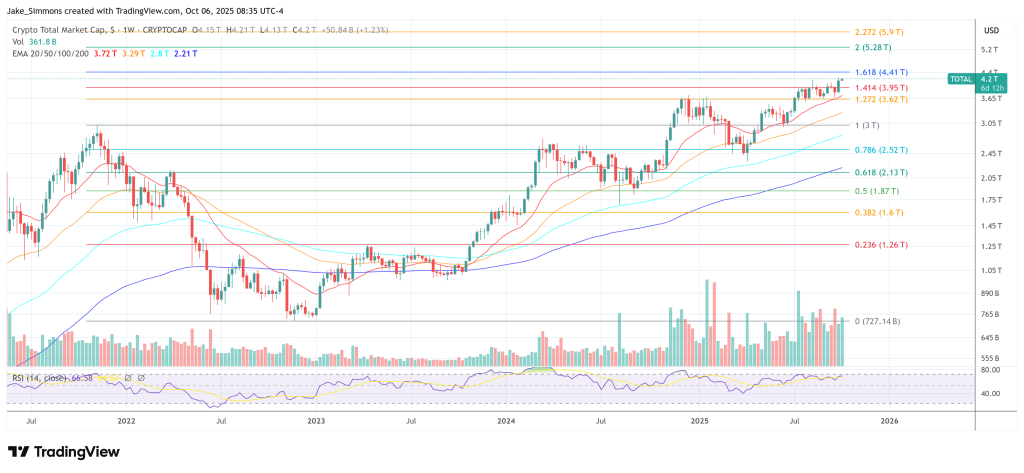
At press time, the total crypto market cap stood at $4.2 trillion.

Total crypto market cap
Market Opportunity
ALEX Lab Logo
ALEX Lab Price(ALEX)
$0.00091
$0.00091$0.00091
+1.11%
USD
ALEX Lab (ALEX) Live Price Chart
Disclaimer: The articles reposted on this site are sourced from public platforms and are provided for informational purposes only. They do not necessarily reflect the views of MEXC. All rights remain with the original authors. If you believe any content infringes on third-party rights, please contact service@support.mexc.com for removal. MEXC makes no guarantees regarding the accuracy, completeness, or timeliness of the content and is not responsible for any actions taken based on the information provided. The content does not constitute financial, legal, or other professional advice, nor should it be considered a recommendation or endorsement by MEXC.

You May Also Like

FCA komt in 2026 met aangepaste cryptoregels voor Britse markt

FCA komt in 2026 met aangepaste cryptoregels voor Britse markt

De Britse financiële waakhond, de FCA, komt in 2026 met nieuwe regels speciaal voor crypto bedrijven. Wat direct opvalt: de toezichthouder laat enkele klassieke financiële verplichtingen los om beter aan te sluiten op de snelle en grillige wereld van digitale activa. Tegelijkertijd wordt er extra nadruk gelegd op digitale beveiliging,... Het bericht FCA komt in 2026 met aangepaste cryptoregels voor Britse markt verscheen het eerst op Blockchain Stories.
Share
Coinstats2025/09/18 00:33
United States Building Permits Change dipped from previous -2.8% to -3.7% in August

United States Building Permits Change dipped from previous -2.8% to -3.7% in August

The post United States Building Permits Change dipped from previous -2.8% to -3.7% in August appeared on BitcoinEthereumNews.com. Information on these pages contains forward-looking statements that involve risks and uncertainties. Markets and instruments profiled on this page are for informational purposes only and should not in any way come across as a recommendation to buy or sell in these assets. You should do your own thorough research before making any investment decisions. FXStreet does not in any way guarantee that this information is free from mistakes, errors, or material misstatements. It also does not guarantee that this information is of a timely nature. Investing in Open Markets involves a great deal of risk, including the loss of all or a portion of your investment, as well as emotional distress. All risks, losses and costs associated with investing, including total loss of principal, are your responsibility. The views and opinions expressed in this article are those of the authors and do not necessarily reflect the official policy or position of FXStreet nor its advertisers. The author will not be held responsible for information that is found at the end of links posted on this page. If not otherwise explicitly mentioned in the body of the article, at the time of writing, the author has no position in any stock mentioned in this article and no business relationship with any company mentioned. The author has not received compensation for writing this article, other than from FXStreet. FXStreet and the author do not provide personalized recommendations. The author makes no representations as to the accuracy, completeness, or suitability of this information. FXStreet and the author will not be liable for any errors, omissions or any losses, injuries or damages arising from this information and its display or use. Errors and omissions excepted. The author and FXStreet are not registered investment advisors and nothing in this article is intended…
Share
BitcoinEthereumNews2025/09/18 02:20
Google's AP2 protocol has been released. Does encrypted AI still have a chance?

Google's AP2 protocol has been released. Does encrypted AI still have a chance?

Following the MCP and A2A protocols, the AI Agent market has seen another blockbuster arrival: the Agent Payments Protocol (AP2), developed by Google. This will clearly further enhance AI Agents' autonomous multi-tasking capabilities, but the unfortunate reality is that it has little to do with web3AI. Let's take a closer look: What problem does AP2 solve? Simply put, the MCP protocol is like a universal hook, enabling AI agents to connect to various external tools and data sources; A2A is a team collaboration communication protocol that allows multiple AI agents to cooperate with each other to complete complex tasks; AP2 completes the last piece of the puzzle - payment capability. In other words, MCP opens up connectivity, A2A promotes collaboration efficiency, and AP2 achieves value exchange. The arrival of AP2 truly injects "soul" into the autonomous collaboration and task execution of Multi-Agents. Imagine AI Agents connecting Qunar, Meituan, and Didi to complete the booking of flights, hotels, and car rentals, but then getting stuck at the point of "self-payment." What's the point of all that multitasking? So, remember this: AP2 is an extension of MCP+A2A, solving the last mile problem of AI Agent automated execution. What are the technical highlights of AP2? The core innovation of AP2 is the Mandates mechanism, which is divided into real-time authorization mode and delegated authorization mode. Real-time authorization is easy to understand. The AI Agent finds the product and shows it to you. The operation can only be performed after the user signs. Delegated authorization requires the user to set rules in advance, such as only buying the iPhone 17 when the price drops to 5,000. The AI Agent monitors the trigger conditions and executes automatically. The implementation logic is cryptographically signed using Verifiable Credentials (VCs). Users can set complex commission conditions, including price ranges, time limits, and payment method priorities, forming a tamper-proof digital contract. Once signed, the AI Agent executes according to the conditions, with VCs ensuring auditability and security at every step. Of particular note is the "A2A x402" extension, a technical component developed by Google specifically for crypto payments, developed in collaboration with Coinbase and the Ethereum Foundation. This extension enables AI Agents to seamlessly process stablecoins, ETH, and other blockchain assets, supporting native payment scenarios within the Web3 ecosystem. What kind of imagination space can AP2 bring? After analyzing the technical principles, do you think that's it? Yes, in fact, the AP2 is boring when it is disassembled alone. Its real charm lies in connecting and opening up the "MCP+A2A+AP2" technology stack, completely opening up the complete link of AI Agent's autonomous analysis+execution+payment. From now on, AI Agents can open up many application scenarios. For example, AI Agents for stock investment and financial management can help us monitor the market 24/7 and conduct independent transactions. Enterprise procurement AI Agents can automatically replenish and renew without human intervention. AP2's complementary payment capabilities will further expand the penetration of the Agent-to-Agent economy into more scenarios. Google obviously understands that after the technical framework is established, the ecological implementation must be relied upon, so it has brought in more than 60 partners to develop it, almost covering the entire payment and business ecosystem. Interestingly, it also involves major Crypto players such as Ethereum, Coinbase, MetaMask, and Sui. Combined with the current trend of currency and stock integration, the imagination space has been doubled. Is web3 AI really dead? Not entirely. Google's AP2 looks complete, but it only achieves technical compatibility with Crypto payments. It can only be regarded as an extension of the traditional authorization framework and belongs to the category of automated execution. There is a "paradigm" difference between it and the autonomous asset management pursued by pure Crypto native solutions. The Crypto-native solutions under exploration are taking the "decentralized custody + on-chain verification" route, including AI Agent autonomous asset management, AI Agent autonomous transactions (DeFAI), AI Agent digital identity and on-chain reputation system (ERC-8004...), AI Agent on-chain governance DAO framework, AI Agent NPC and digital avatars, and many other interesting and fun directions. Ultimately, once users get used to AI Agent payments in traditional fields, their acceptance of AI Agents autonomously owning digital assets will also increase. And for those scenarios that AP2 cannot reach, such as anonymous transactions, censorship-resistant payments, and decentralized asset management, there will always be a time for crypto-native solutions to show their strength? The two are more likely to be complementary rather than competitive, but to be honest, the key technological advancements behind AI Agents currently all come from web2AI, and web3AI still needs to keep up the good work!
Share
PANews2025/09/18 07:00
