The firm announced that both its Ethereum Trust ETF (ETHE) and Ethereum Mini Trust ETF (ETH) will now offer investors […] The post Grayscale Launches First U.S. Spot Crypto ETPs With Staking for Ethereum and Solana appeared first on Coindoo.The firm announced that both its Ethereum Trust ETF (ETHE) and Ethereum Mini Trust ETF (ETH) will now offer investors […] The post Grayscale Launches First U.S. Spot Crypto ETPs With Staking for Ethereum and Solana appeared first on Coindoo.

Grayscale Launches First U.S. Spot Crypto ETPs With Staking for Ethereum and Solana

2025/10/06 20:04
3 min read

The firm announced that both its Ethereum Trust ETF (ETHE) and Ethereum Mini Trust ETF (ETH) will now offer investors staking rewards – something no American-listed crypto ETP had done before.

The update doesn’t stop there. Grayscale also activated staking for its Solana Trust (GSOL), allowing investors to earn Solana yields through standard brokerage platforms rather than on-chain wallets. Once approved for uplisting as an exchange-traded product, GSOL could emerge as one of the first regulated Solana ETPs in the United States to integrate staking. Crypto reporter Eleanor Terrett called the rollout “a big day for crypto on Wall Street,” noting that it bridges the income potential of decentralized finance with the accessibility of traditional markets.

While this move signals a huge step forward, it also raises regulatory implications. Grayscale has filed new registration statements for its trusts with the U.S. Securities and Exchange Commission (SEC), though these funds aren’t governed by the stricter Investment Company Act of 1940 – the same framework that oversees conventional ETFs and mutual funds. That puts them in a unique category: accessible to investors, but not bound by every traditional rulebook.

READ MORE:

Bitcoin’s Massive Rally Leaves Altcoins Behind, Says 10x Research

The timing couldn’t be more strategic. Just last month, the SEC postponed rulings on similar staking requests from heavyweights BlackRock, Fidelity, and Franklin Templeton, leaving Grayscale as the first mover in this newly forming sector. Its decision to push ahead could set a precedent for how staking is integrated into regulated financial products going forward.

Meanwhile, the flood of crypto ETF filings shows no signs of slowing. Industry analyst Nate Geraci revealed that more than 30 new crypto-focused ETF applications hit the SEC’s desk in a single afternoon on October 4, hinting at a brewing arms race among financial institutions eager to capture the next wave of digital asset inflows.

By blending staking returns with familiar ETF structures, Grayscale has managed to do what few thought possible – introduce passive crypto income to Wall Street’s most conventional investors. Whether this innovation sparks a new wave of ETP evolution or regulatory scrutiny, one thing is clear: the line between DeFi and traditional finance just blurred in a very big way.


The information provided in this article is for educational purposes only and does not constitute financial, investment, or trading advice. Coindoo.com does not endorse or recommend any specific investment strategy or cryptocurrency. Always conduct your own research and consult with a licensed financial advisor before making any investment decisions.

The post Grayscale Launches First U.S. Spot Crypto ETPs With Staking for Ethereum and Solana appeared first on Coindoo.

Market Opportunity
Union Logo
Union Price(U)
$0.001476
$0.001476$0.001476
-0.40%
USD
Union (U) Live Price Chart
Disclaimer: The articles reposted on this site are sourced from public platforms and are provided for informational purposes only. They do not necessarily reflect the views of MEXC. All rights remain with the original authors. If you believe any content infringes on third-party rights, please contact service@support.mexc.com for removal. MEXC makes no guarantees regarding the accuracy, completeness, or timeliness of the content and is not responsible for any actions taken based on the information provided. The content does not constitute financial, legal, or other professional advice, nor should it be considered a recommendation or endorsement by MEXC.

You May Also Like

Hadron Labs Launches Bitcoin Summer on Neutron, Offering 5–10% BTC Yield
Hadron Labs Launches Bitcoin Summer on Neutron, Offering 5–10% BTC Yield

Hadron Labs launches 'Bitcoin Summer' on Neutron, BTC vaults for WBTC, eBTC, solvBTC, uniBTC and USDC. Earn 5–10% BTC via maxBTC, with up to 10x looping.
Share
Blockchainreporter2025/09/18 02:00
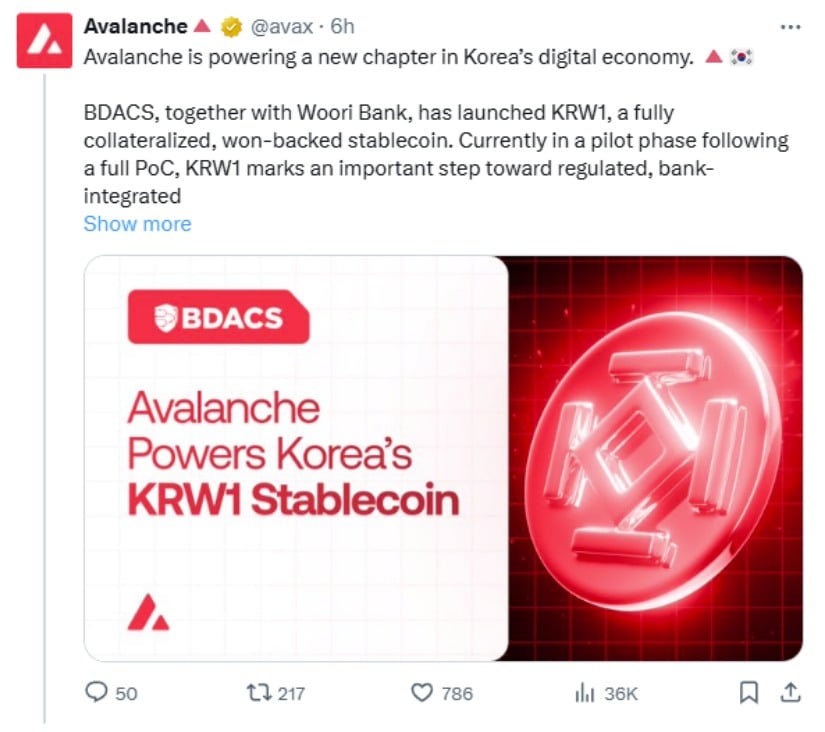
South Korea Launches First Won-Backed Stablecoin KRW1 on Avalanche

South Korea Launches First Won-Backed Stablecoin KRW1 on Avalanche

South Korea made history this week by launching its first Korean won-backed stablecoin.
Share
Brave Newcoin2025/09/19 03:15
Curve Finance votes on revenue-sharing model for CRV holders

Curve Finance votes on revenue-sharing model for CRV holders

The post Curve Finance votes on revenue-sharing model for CRV holders appeared on BitcoinEthereumNews.com. Curve Finance has proposed a new protocol called Yield Basis that would share revenue directly with CRV holders, marking a shift from one-off incentives to sustainable income. Summary Curve Finance has put forward a revenue-sharing protocol to give CRV holders sustainable income beyond emissions and fees. The plan would mint $60M in crvUSD to seed three Bitcoin liquidity pools (WBTC, cbBTC, tBTC), with 35–65% of revenue distributed to veCRV stakers. The DAO vote runs from up to Sept. 24, with the proposal seen as a major step to strengthen CRV tokenomics after past liquidity and governance challenges. Curve Finance founder Michael Egorov has introduced a proposal to give CRV token holders a more direct way to earn income, launching a system called Yield Basis that aims to turn the governance token into a sustainable, yield-bearing asset.  The proposal has been published on the Curve DAO (CRV) governance forum, with voting open until Sept. 24. A new model for CRV rewards Yield Basis is designed to distribute transparent and consistent returns to CRV holders who lock their tokens for veCRV governance rights. Unlike past incentive programs, which relied heavily on airdrops and emissions, the protocol channels income from Bitcoin-focused liquidity pools directly back to token holders. To start, Curve would mint $60 million worth of crvUSD, its over-collateralized stablecoin, with proceeds allocated across three pools — WBTC, cbBTC, and tBTC — each capped at $10 million. 25% of Yield Basis tokens would be reserved for the Curve ecosystem, and between 35% and 65% of Yield Basis’s revenue would be given to veCRV holders. By emphasizing Bitcoin (BTC) liquidity and offering yields without the short-term loss risks associated with automated market makers, the protocol hopes to draw in professional traders and institutions. Context and potential impact on Curve Finance The proposal comes as Curve continues to modify…
Share
BitcoinEthereumNews2025/09/18 14:37