

MTN, Telecel to bid for 5G licences as Ghana ends NGIC’s exclusive rights
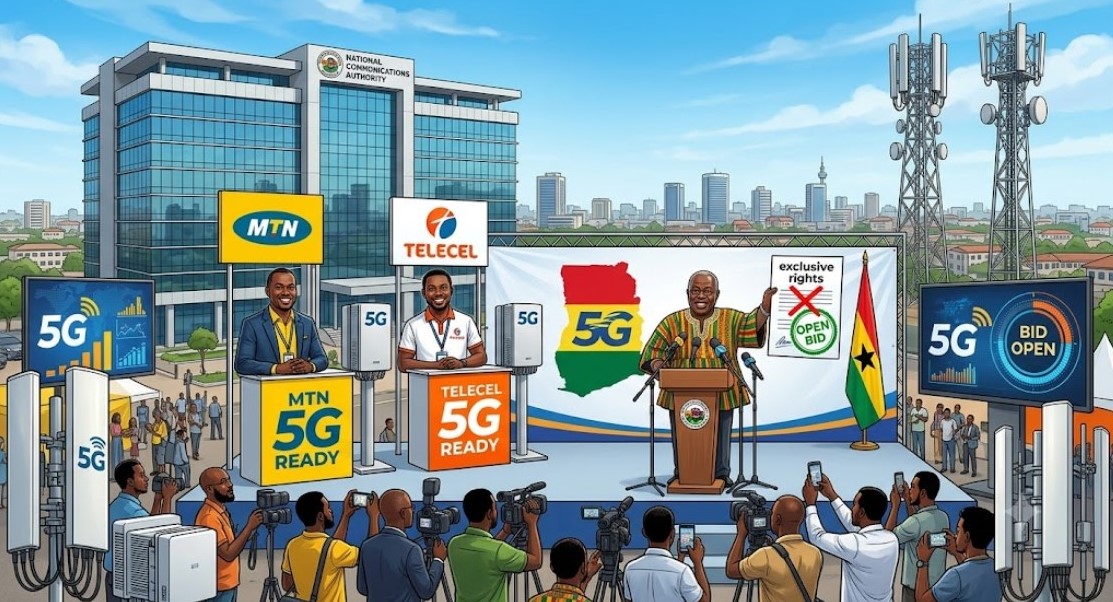
MTN Group and Telecel are preparing to bid for 5G licences in Ghana after the government revoked the licence that gave Next Gen InfraCo (NGIC) exclusive rights to build and deploy a 5G network.
According to a Bloomberg report citing information from MTN Ghana Chief Executive Officer Stephen Blewett and Telecel Group CEO Moh Damush, the auction for a 5G network is set to begin within weeks.
The latest development means that MTN, Telecel, state-owned AT Ghana and other telcos in Ghana can now bid and independently deploy their own 5G networks. This gives them control over the newly rolled-out network.
Recall that Ghana officially launched its first 5G network on March 3, 2026, where the network infrastructure is exclusively deployed by Next-Gen InfraCo (NGIC), a shared wholesale network provider that partnered with Indian billionaire Mukesh Ambani’s firm.
Following the launch, Radisys Corp., a unit of Ambani-controlled Reliance Industries Ltd., was selected to provide the network infrastructure. However, the termination of the exclusive concession granted to Next Gen Infraco comes eight years before its scheduled 2034 expiry.
As 5G services in Ghana are conditioned to be offered through a wholesale, neutral network intended for multiple providers, NGIC’s 4G/5G infrastructure was meant to be an open door for several telcos in Ghana.
The development now allows other telcos to own their own networks through auction and licence approval, thereby having a way to offer high-speed internet to over 41 million Ghanaian telecom subscribers.

Also Read: How 5G connections in Sub-Saharan Africa are expected to grow 11x to 370 million by 2031.
Competitive 5G licence bidding in Ghana
Launched in May 2024, NGIC was granted a ten-year licence to deploy and operate a shared 5G infrastructure. Although the commercial rollout was initially expected in June 2025, it encountered several delays. As of that time, it had only completed 16 of the 50 required sites in Accra and Kumasi.
Following the setbacks, the government set a deadline of late December 2025. It also warned that the terms of the agreement could be renegotiated, paving the way for independent 5G ownership to other telcos if NGIC failed to meet the deadline.
For Ghana, the slow rollout is inconsistent with the government’s goal of achieving 70% 5G population coverage by 2027, the year the West African country clocks 70.
Another consideration is the government’s plans to auction 5G spectrum in the 3.5 GHz and 26 GHz bands before the end of 2026. The initiative will allow additional operators or private networks to enter the market for growth-oriented competition.
At a stakeholders’ consultation forum in May, Ghana’s Ministry of Communications, Digital Technology and Innovations, Samuel Nartey George, acknowledged the consideration of the competitive national bidding process for spectrum allocation.
 Ghana’s Minister for Communication, Digital Technology and Innovations, Sam George
At the meeting, he called for provisions that would ensure spectrum goes to operators with credible deployment plans, especially for the less privileged and rural communities.
In its 5G rollout and coverage ambition, Ghana’s priority will not be on how many operators roll out the network, but how many Ghanaians access the network.


You May Also Like

6 Crypto Sportsbooks Ranked on On-Chain Transparency

Russia bans diesel exports as Ukrainian strikes intensify fuel crisis

Paradigm’s prediction markets terminal targets pros as Kalshi backing deepens



