XRP News: Ripple CTO Addresses XRPL Front-Running Claims
Key Insights:
- XRP news: XRPL’s pending transactions can expose traders to front-running and sandwich attacks.
- Ripple CTO says validators gain no edge unless they conspire, which would leave public evidence.
- Schwartz proposed a reservation fee system to protect users from being front-run after disclosure.
Ripple CTO Emeritus David Schwartz addressed renewed claims about front-running risks on the XRP Ledger. The discussion followed a post from XRPL marketplace XRPresso about pending transaction visibility. The post said some actors could view queued transactions before a ledger closes. Schwartz said the issue deserves a technical answer, even though he downplayed its current risk. He proposed a transaction reservation plan for users who want stronger ordering protection.
XRP News: XRPL Transaction Queue Sparks Front-Running Discussion
The latest XRP news centers on whether pending XRPL transactions can expose users to front-running or sandwich attacks. XRPresso said validators and well-connected nodes can see transactions before final validation.
The account said an actor could study a pending trade and submit competing transactions. Also, repeated submissions could improve placement inside the final ledger order.
 XRP News | Source: X
XRPL documentation says transaction order inside a ledger aims to discourage front-running. However, the concern focuses on visibility before settlement, especially around payments, offers, DEX trades, and AMM swaps.
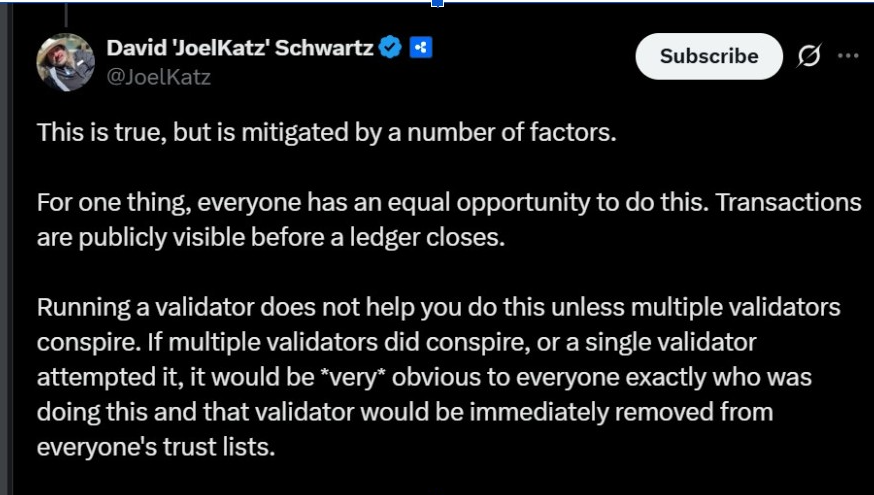
Schwartz responded that public visibility affects all participants, not only validators. He also said validator misuse would leave clear public evidence through signed proposals and validations.
Ripple CTO Says Validator Abuse Faces Public Checks
Schwartz said running a validator does not automatically create a special advantage. He argued that validators would need coordination to act ahead of unseen transactions.
Such coordination would appear in public data. According to his view, trust lists could remove a validator if the network saw clear misconduct.
Attackers would need to publish several planned transactions to attempt a sandwich without validator coordination. Those transactions would carry signatures and remain visible to the network.
He added that he had not seen reports of such attacks outside proof-of-concept work. In his explanation, profit depends on a narrow mix of deep volume and weak liquidity.
Proposed Reservation Plan Adds Protected Slots
The XRP news proposed a transaction reservation system for users who want extra protection. The plan would let a sender reserve a slot for a future ledger.
The sender would submit a reservation transaction with a ledger number and transaction ID. If successful, the latter transaction would run before any transaction formed after its disclosure.
The proposal would create a new ledger object called ReservedTxns. That object would store a ledger sequence number and a list of reserved transaction IDs.
Schwartz also described a new transaction type called TxnReserve. The transaction would need at least twice the normal fee and must meet standard execution rules. The target ledger would need to sit ahead of the current ledger. It also could not sit more than 16 ledgers ahead.
Each ReservedTxns object would also face capacity limits. Schwartz said one object could hold fewer than 32 transaction IDs under the proposed setup.
XRP News: Debate Moves to XRPL Design Review
The plan would require users to send two transactions for protected execution. One transaction would reserve the slot, while the second would carry out the intended action.
Under the proposal, the reserved transaction would execute first in the chosen ledger. The ledger would then remove it from the consensus set to prevent duplicate execution.
Schwartz also noted possible spam concerns. An attacker could try to fill reservation slots, but rising costs could limit that tactic. The XRP news provides developers and validators with a direct reference point to review as the front-running discussion continues.
The post XRP News: Ripple CTO Addresses XRPL Front-Running Claims appeared first on The Market Periodical.


You May Also Like

Metaplanet buys 5,075 Bitcoin in Q1 to become 3rd-largest treasury

Cardano Price Prediction 2027: Will ADA Recover to $2?