

Crypto News: SEC and CFTC Seek Public Input on Crypto Derivatives Rules
Key Insights:
- Crypto news: SEC and CFTC opened a 60-day review of crypto derivatives and portfolio margining rules.
- The review follows U.S. approval of crypto perpetual futures tied to major digital assets.
- CME is challenging the CFTC’s approval of Kalshi’s crypto perpetual futures in court.
The SEC and CFTC have opened a joint review of crypto derivatives rules in the United States. The agencies want public feedback on portfolio margining, cross-product risk, and market oversight. The 60-day comment period follows the recent approval of U.S. crypto perpetual futures. The crypto news comes as regulators, exchanges, and courts examine how crypto-linked contracts should fit under existing rules.
Crypto News: Agencies Open 60-Day Comment Window
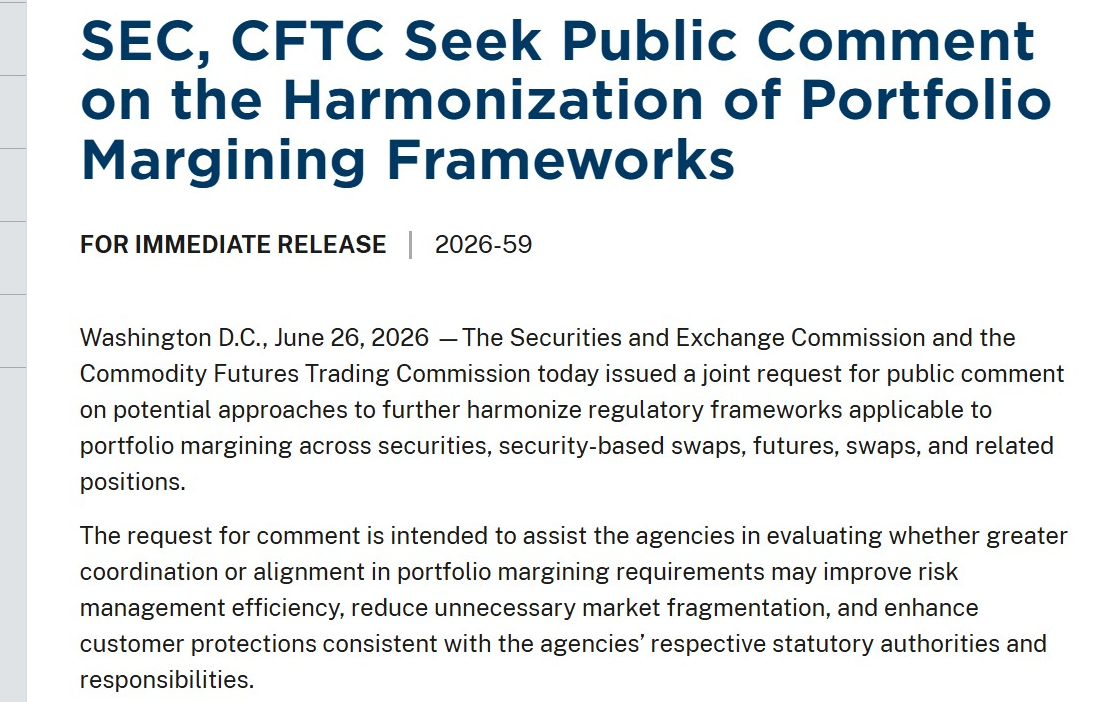
The Securities and Exchange Commission and the Commodity Futures Trading Commission are asking market participants to comment on margin rules across securities, swaps, futures, and related positions. The request will remain open for 60 days after publication in the Federal Register.
The agencies want to assess whether closer coordination can support better risk controls and clearer customer protections. The review covers portfolio margining, which allows firms to measure risk across connected positions instead of treating each product separately.
 Crypto News | Source: X
Portfolio margining can lower the amount of collateral held in separate accounts when related positions offset each other. Regulators also want feedback on whether current rules create gaps between securities and commodities markets.
This crypto news development arrives as digital asset derivatives gain more attention in regulated U.S. markets. Bitcoin, Ether, XRP, and other crypto-linked products now sit closer to the center of market structure debates.
Crypto Perpetual Futures Add Pressure to Rulemaking
The review follows the approval of crypto perpetual futures in the United States. Kalshi received CFTC approval to list perpetual futures tied to Bitcoin, Ether, XRP, and HYPE.
Perpetual futures allow traders to take price exposure without a fixed expiration date. That structure has raised questions because traditional futures usually expire on a set date.
 Source: X
CME Group has challenged the CFTC over the approval of crypto perpetual futures. CME argues that Kalshi’s contracts should fall under swap rules rather than futures rules because they do not have a fixed end date.
The CFTC has taken a different position. It argues that a contract does not lose its status as a futures product only because it lacks an expiration date.
This classification dispute matters because futures and swaps follow different rules. These rules affect clearing, reporting, margin treatment, execution, and the role of regulated market intermediaries.
Regulators Review Margin, Risk, and Market Boundaries
The SEC and CFTC are seeking input on cross-margining models, collateral use, customer protection rules, clearinghouse arrangements, and operational systems. They also want comments on capital treatment and segregation requirements.
The agencies are reviewing how margin rules should apply when products sit near the line between securities and commodities regulation. That issue has become more important as tokenized securities and crypto derivatives enter regulated markets.
SEC Chair Paul Atkins said stronger coordination could reduce overlap between the agencies. He also pointed to cross-margining as a way to free liquidity that remains separated across accounts.
CFTC Chair Michael Selig supported the review and linked it to risk management. He said closer cooperation could help release capital while maintaining market protections.
For crypto news readers, the request starts a formal process that could guide later policy decisions.
Court Cases Keep Crypto Derivatives in Focus
The review also comes during active legal disputes involving the CFTC, crypto derivatives, and prediction markets. The agency recently sued Kentucky after the state moved to apply gaming laws to prediction market operators.
The CFTC argues that federal law gives it authority over regulated futures, options, and swaps. Kentucky maintains that sports-linked event contracts should remain subject to state gambling rules.
The SEC and CFTC also asked for public input on derivatives definitions earlier this week. That separate request covers swaps, security-based swaps, mixed swaps, event contracts, and newer financial products. The latest crypto news shows how fast product design has moved across digital asset markets.
The post Crypto News: SEC and CFTC Seek Public Input on Crypto Derivatives Rules appeared first on The Market Periodical.
You May Also Like
What Happens to the XRP Price if the Crypto Bear Market Gets Worse?

The Manchester City Donnarumma Doubters Have Missed Something Huge

Solana SOL Reclaims $72, But Fading On-Chain Metrics Signal Weakening DEX Momentum

