

What Rising Treasury Yields Mean for Your Mortgage, Savings, and Stocks in 2026
TLDR
- The 10-year U.S. Treasury yield hit a 16-month high of 4.687%, while the 30-year yield rose to 5.198%, a level not seen since 2007.
- Rising yields are being driven by Middle East conflict, inflation fears, and a growing U.S. government deficit.
- Higher yields put pressure on stocks, raise borrowing costs, and increase mortgage rates.
- Bond markets globally are reacting, with Germany’s 10-year yield also reaching a 15-year high.
- Stocks paused on Wednesday, with U.S. futures pointing to modest gains as investors awaited Nvidia’s earnings report.
The 10-year U.S. Treasury yield climbed to 4.687% overnight on Tuesday, its highest level in 16 months. The 30-year yield reached 5.198%, a level not seen since 2007.
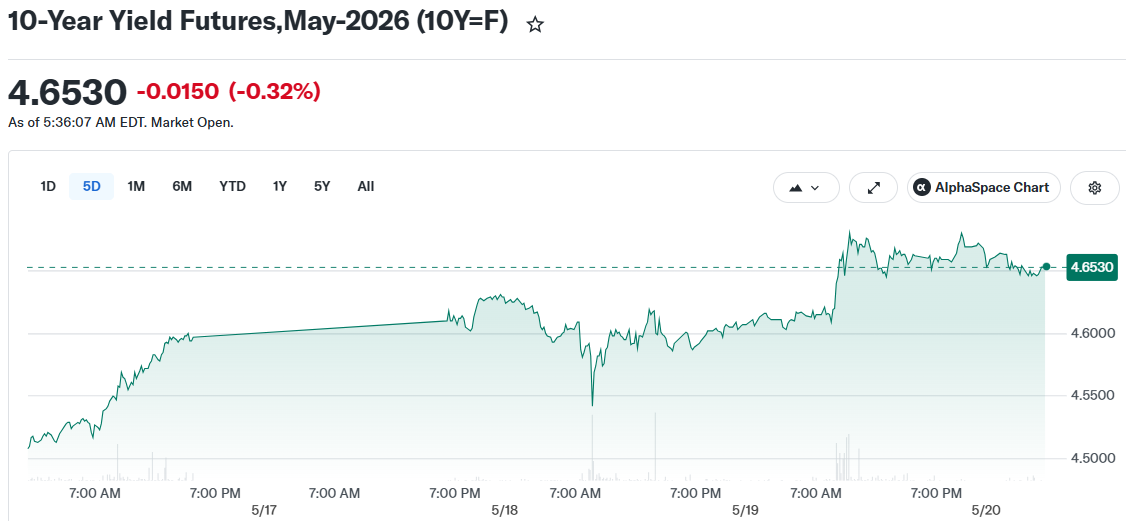 10-Year Yield Futures,May-2026 (10Y=F)
Both yields have since eased slightly to 4.65% and 5.17% respectively, but remain elevated. Two-year Treasurys are also at their highest since February 2025.
The bond market is reacting to several pressures building at once. The ongoing Middle East conflict has effectively closed the Strait of Hormuz, pushing energy prices higher and keeping inflation fears alive.
The Consumer Price Index rose 3.8% in April — the largest gain in three years. Gas prices surged over 28% in the same period.
A growing U.S. government deficit is adding to the pressure. With total national debt at $38.5 trillion, a 1% rise in interest rates would add $3.2 trillion in interest costs over the next decade.
The Federal Reserve Bank of Philadelphia released an economic outlook last Friday predicting lower growth, modest job gains, and continuing inflation. Futures markets are now beginning to price in the possibility that the Fed’s next move could be a rate hike rather than a cut.
What Rising Yields Mean for Investors and Borrowers
Higher Treasury yields directly reduce the market value of existing bonds. Investors holding long-dated bonds face paper losses if they sell before maturity.
Stock investors are also feeling the pressure. When the government offers a risk-free return of 5% or more, equities look less attractive by comparison. Tech stocks with high valuations are particularly exposed to this shift.
Companies also pay more to borrow money as yields rise, which can weigh on earnings. Mohit Kumar, chief European economist at Jefferies, said they advised clients to avoid longer-dated bonds given the current oil price shock.
Mortgage rates, which are tied to 10-year Treasury yields, are likely to move higher as a result. Variable-rate debt such as credit cards and home equity lines of credit could also become more expensive.
One benefit for savers is that higher yields push up returns on CDs and longer-term savings vehicles. New bonds also pay more interest than those issued at lower rates.
Global Markets React
Bond selloffs are not limited to the United States. European and Japanese longer-dated bonds have also sold off, pushing yields toward multi-year highs.
Germany’s 10-year yield, the eurozone benchmark, touched a 15-year high on Tuesday before easing 2 basis points to 3.17% on Wednesday.
Asian shares fell for a fourth straight session, with the MSCI Asia-Pacific index outside Japan down 0.5%. European shares edged up 0.2% as German yields pulled back slightly.
On Wednesday, two Chinese oil tankers exited the Strait of Hormuz, offering a brief positive signal for oil markets. Brent crude futures fell 2%. However, analysts noted that hopes for the strait reopening have collapsed before.
U.S. stock futures pointed to modest gains on Wednesday. Investors were watching closely for Nvidia’s earnings results due later in the day, with the broader market environment still clouded by elevated yields.
In Beijing, Chinese leader Xi Jinping met with Russian President Vladimir Putin, saying it was important to stop the Middle East conflict — a development the markets were monitoring.
The post What Rising Treasury Yields Mean for Your Mortgage, Savings, and Stocks in 2026 appeared first on CoinCentral.


You May Also Like

Lowe’s (LOW) Stock Falls After Earnings Beat Gets Overshadowed by Weak Guidance

David Schwartz Responds to XRP Critics With “Haters” Remark




