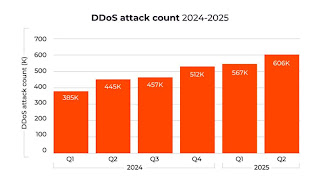
Gcore released its Q1-Q2 2025 Radar report into DDoS attack trends. The report reveals a significant escalation in the total number of DDoS attacks and their magnitude, measured in terabits per second (Tbps) The largest attack peaked at 2.2 Tbps, surpassing the 2 Tbps peak recorded in late 2024.Gcore released its Q1-Q2 2025 Radar report into DDoS attack trends. The report reveals a significant escalation in the total number of DDoS attacks and their magnitude, measured in terabits per second (Tbps) The largest attack peaked at 2.2 Tbps, surpassing the 2 Tbps peak recorded in late 2024.

Gcore Radar Report Reveals 41% Surge In DDoS Attack Volumes

2025/09/26 01:47
4 min read

Luxembourg, September 25th, 2025/CyberNewsWire/--Gcore, the global edge AI, cloud, network, and security solutions provider, today announced the findings of its Q1-Q2 2025 Radar report into DDoS attack trends.

DDoS attacks have reached unprecedented scale and disruption in 2025, and businesses need to act fast to protect themselves from this evolving threat. The report reveals a significant escalation in the total number of DDoS attacks and their magnitude, measured in terabits per second (Tbps).

It also highlights a clear shift: attackers are growing more strategic, blending brute-force volume with precise application-layer manipulation.

Key Insights From Q1-Q2 2025

·      Attack volumes increased by 41% compared to Q1-Q2 2024, evidencing dangerous long term growth trends predicted in prior Radar reports.

·      The largest attack peaked at 2.2 Tbps in Q1-Q2, surpassing the 2 Tbps peak recorded in late 2024.

·      DDoS attacks are becoming longer in duration but more harmful.

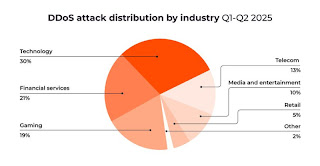
·      Attackers are shifting focus to financial services and tech, with tech overtaking gaming as the most targeted sector.

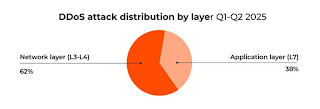
·      DDoS attacks at the application layer have increased by 10% from Q3-Q4 2024 to Q1-Q2 2025.

·      The total number of DDoS attacks climbed from 969,000 in H2 2024 to 1.17 million in H1 2025.
Andrey Slastenov, Head of Security at Gcore, commented:

Recent Data Shows Shift Toward Longer Sustained Assaults

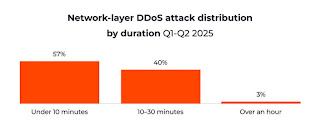
Attacks shorter than 10 minutes have decreased by about 33%, while those lasting between 10 and 30 minutes have nearly quadrupled. While previous reports highlighted the dominance of very short, intense DDoS attacks, this change indicates that attackers are adapting to the improved automatic detection and mitigation systems employed by companies to handle brief attacks. By extending attack durations, threat actors can circumvent these temporary defense thresholds, cause more extensive damage, and test infrastructure resilience over time.
Multi-vector attacks have also increasingly become a preferred tactic of attackers. By masking malicious activity within seemingly legitimate traffic, attackers complicate detection and extend their window to cause damage. This shift toward more sophisticated attacks underscores the need for an equally layered defense approach that anticipates attacker strategies and protects critical digital assets holistically.

Data Indicates Rise in Attacks on Vulnerable Sectors

Gaming is no longer the dominant target it once was. Its share of total DDoS attacks has dropped significantly (30% in the last year). This notable decline suggests attackers are shifting focus to other sectors such as tech (attacks increased by 15%) and financial services (attacks increased by 15%). These sectors are favored targets because they may be less protected against threat actors and have higher disruption potential.
The Domino Effect of Cyberattacks

Hosting providers, in particular, have become prime targets due to their role supporting SaaS, e-commerce, gaming, and financial clients. An attack on one hosting provider can have dangerous ripple effects: massive service outages and reputation damage to dozens of dependent companies.

Geographical Distribution of DDoS Attacks

With a presence that spans six continents, Gcore can accurately track the geographical sources of DDoS attacks. Gcore derives these insights from the attackers’ IP addresses and the geographic locations of the data centers where malicious traffic is targeted.

Although the United States and the Netherlands remain top sources for attacks (as found in previous Radar reports), Hong Kong is a new source of threats. Hong Kong now accounts for 17% of all network-layer and 10% of application-layer attacks. These findings indicate that attackers are expanding into emerging areas, highlighting the need for proactive and adaptive defenses across diverse regions.

Emerging Origins of Attacks

The rapid increase in application layer attacks (28% to 38% from Q3-Q4 2024 to Q1-Q2 2025) also reveals an overall trend toward multi-layered attacks targeting web application and API vulnerabilities, which particularly impact sectors with a high degree of customer interaction (ranging from e-commerce and online banking to logistics and public services).
To access the full report, please visit: https://gcore.com/resources/gcore-radar-attack-trends-q1-q2-2025

About Gcore

Gcore is a global edge AI, cloud, network, and security solutions provider. Headquartered in Luxembourg, with a team of 600 operating from ten offices worldwide, Gcore provides solutions to global leaders in numerous industries. Gcore manages its global IT infrastructure across six continents, with one of the best network performances in Europe, Africa, and LATAM due to the average response time of 30 ms worldwide. Gcore’s network consists of 210 points of presence worldwide in reliable Tier IV and Tier III data centers, with a total network capacity exceeding 200 Tbps.

Further information is available at gcore.com and updates are also shared on LinkedInTwitter, and Facebook.

Gcore Press Contact

pr@gcore.com

PR Agency Contact

gcore@aspectusgroup.com

Contact

Ms.

Kira Kurepina

Gcore

kira.kurepina@gcore.com

:::tip This story was published as a press release by Cybernewswire under HackerNoon’s Business Blogging Program. Do your own research before making any financial decision.

:::

\

Disclaimer: The articles reposted on this site are sourced from public platforms and are provided for informational purposes only. They do not necessarily reflect the views of MEXC. All rights remain with the original authors. If you believe any content infringes on third-party rights, please contact service@support.mexc.com for removal. MEXC makes no guarantees regarding the accuracy, completeness, or timeliness of the content and is not responsible for any actions taken based on the information provided. The content does not constitute financial, legal, or other professional advice, nor should it be considered a recommendation or endorsement by MEXC.

You May Also Like

CEO Sandeep Nailwal Shared Highlights About RWA on Polygon

CEO Sandeep Nailwal Shared Highlights About RWA on Polygon

The post CEO Sandeep Nailwal Shared Highlights About RWA on Polygon appeared on BitcoinEthereumNews.com. Polygon CEO Sandeep Nailwal highlighted Polygon’s lead in global bonds, Spiko US T-Bill, and Spiko Euro T-Bill. Polygon published an X post to share that its roadmap to GigaGas was still scaling. Sentiments around POL price were last seen to be bearish. Polygon CEO Sandeep Nailwal shared key pointers from the Dune and RWA.xyz report. These pertain to highlights about RWA on Polygon. Simultaneously, Polygon underlined its roadmap towards GigaGas. Sentiments around POL price were last seen fumbling under bearish emotions. Polygon CEO Sandeep Nailwal on Polygon RWA CEO Sandeep Nailwal highlighted three key points from the Dune and RWA.xyz report. The Chief Executive of Polygon maintained that Polygon PoS was hosting RWA TVL worth $1.13 billion across 269 assets plus 2,900 holders. Nailwal confirmed from the report that RWA was happening on Polygon. The Dune and https://t.co/W6WSFlHoQF report on RWA is out and it shows that RWA is happening on Polygon. Here are a few highlights: – Leading in Global Bonds: Polygon holds 62% share of tokenized global bonds (driven by Spiko’s euro MMF and Cashlink euro issues) – Spiko U.S.… — Sandeep | CEO, Polygon Foundation (※,※) (@sandeepnailwal) September 17, 2025 The X post published by Polygon CEO Sandeep Nailwal underlined that the ecosystem was leading in global bonds by holding a 62% share of tokenized global bonds. He further highlighted that Polygon was leading with Spiko US T-Bill at approximately 29% share of TVL along with Ethereum, adding that the ecosystem had more than 50% share in the number of holders. Finally, Sandeep highlighted from the report that there was a strong adoption for Spiko Euro T-Bill with 38% share of TVL. He added that 68% of returns were on Polygon across all the chains. Polygon Roadmap to GigaGas In a different update from Polygon, the community…
Share
BitcoinEthereumNews2025/09/18 01:10
SHIB Price Analysis for February 8

SHIB Price Analysis for February 8

The post SHIB Price Analysis for February 8 appeared on BitcoinEthereumNews.com. Original U.Today article Can traders expect SHIB to test the $0.0000070 range soon
Share
BitcoinEthereumNews2026/02/09 00:26
UK Looks to US to Adopt More Crypto-Friendly Approach

UK Looks to US to Adopt More Crypto-Friendly Approach

The post UK Looks to US to Adopt More Crypto-Friendly Approach appeared on BitcoinEthereumNews.com. The UK and US are reportedly preparing to deepen cooperation on digital assets, with Britain looking to copy the Trump administration’s crypto-friendly stance in a bid to boost innovation.  UK Chancellor Rachel Reeves and US Treasury Secretary Scott Bessent discussed on Tuesday how the two nations could strengthen their coordination on crypto, the Financial Times reported on Tuesday, citing people familiar with the matter.  The discussions also involved representatives from crypto companies, including Coinbase, Circle Internet Group and Ripple, with executives from the Bank of America, Barclays and Citi also attending, according to the report. The agreement was made “last-minute” after crypto advocacy groups urged the UK government on Thursday to adopt a more open stance toward the industry, claiming its cautious approach to the sector has left the country lagging in innovation and policy.  Source: Rachel Reeves Deal to include stablecoins, look to unlock adoption Any deal between the countries is likely to include stablecoins, the Financial Times reported, an area of crypto that US President Donald Trump made a policy priority and in which his family has significant business interests. The Financial Times reported on Monday that UK crypto advocacy groups also slammed the Bank of England’s proposal to limit individual stablecoin holdings to between 10,000 British pounds ($13,650) and 20,000 pounds ($27,300), claiming it would be difficult and expensive to implement. UK banks appear to have slowed adoption too, with around 40% of 2,000 recently surveyed crypto investors saying that their banks had either blocked or delayed a payment to a crypto provider.  Many of these actions have been linked to concerns over volatility, fraud and scams. The UK has made some progress on crypto regulation recently, proposing a framework in May that would see crypto exchanges, dealers, and agents treated similarly to traditional finance firms, with…
Share
BitcoinEthereumNews2025/09/18 02:21