

WayaWaya founder Teddy Ogallo lived a sheltered life, then had to rebuild everything
By the time Teddy Ogallo sits down at Artcaffe Westgate Mall in Nairobi’s Westlands, he already has a mental list running.
Not talking points for this interview, but customer problems, things that broke overnight, features that need reworking, small frictions that, if fixed, might bring him the next hundred users. He orders a latte.
I go for Kenyan tea, non-spiced. He’s present, but you can tell his mind is never far from the build.
Ask him who he is—especially on days he’s tired of the startup label—and he doesn’t hesitate. “I’m a builder,” he says.
It comes out effortlessly during our chat, as if it’s almost a default setting, something that predates his journey at WayaWaya, a Kenyan startup that provides conversational banking tools via WhatsApp and mobile apps.
He traces it back to his childhood in the barracks in Eldoret—a city in Western Kenya—a contained, almost ideal world. Good housing, a supermarket, a hospital, a proper school, everything in place, little reason to step outside.
“You had no reason to leave,” he says.
Then, at 17, that world fell apart. His father lost his job, and the transition into what he calls “real-life Kenya” was abrupt.
Suddenly, the cushioning was gone, replaced by scarcity, but with awareness of how most people actually live and get by.
That contrast—comfort, then lack—sits beneath how he sees things now. It shows up in how he talks about systems that don’t work, about people forced to find their own way around them, and about why he builds at all.
He tells me he doesn’t just want to solve problems, but leave a legacy that holds up under pressure.
Our conversation moves between those personal aspirations and what it takes to build something that lasts. For Ogallo, the two are not separate. They rarely are.
This interview has been edited for length and clarity.
How do you usually introduce yourself when you’re tired of talking about startups?
I know it’s cliché, but I’m a builder. I’ve always been a builder since I was four years old—building drones, building things. I’m an innovator and a builder. I’ve always been that character who thinks differently.
I started building, then I started asking myself: How do I create value out of everything I’ve built? That’s why my entrepreneurship journey started very, very early in life.
Because I’m this innovative builder, looking at problems, thinking of solutions, and actually building a workable solution.
If we weren’t doing this interview over coffee, where would you rather be right now?
I have this list. I usually make a list of customer requests and customer feedback. I’m a tech founder, so I’m involved with the daily build, finding solutions.
So I plan how to solve this list of problems for our customers, then plan to iterate on that process and use it to get even more customers. I’d be scaling and maintaining the customers we’ve already set up on our platform.
What’s been your most recent small win that had nothing to do with WayaWaya?
When you’re an entrepreneur, the startup becomes your life. Everything else is peripheral. I finished a small build project. Once I’m successful with WayaWaya, I’ll be able to build something bigger. I’ve been building a prototype of that technology solution, more hardware-oriented. I finished a prototype, and it worked. It’s at that point where you start thinking of getting a Chinese company to print the boards. That’s a success.
What’s something you’ve changed your mind about in the last year?
I used to believe in changing people, changing mindsets. But I’ve gotten tough lessons. Human beings, by the time someone has become an adult, have these rigid frames they live inside. You can’t really change those fundamental bits, character, aspiration. Those are the basics that most people can’t change.
That’s why in business, you have to develop a skill. Even as a founder, when you’re looking for team members, you look at their motivations, the things that drive them. Those are usually very hard to change in an adult. I spent a significant part of my life trying to change that in people.
You can’t teach an old dog new tricks…
Exactly. That’s something I’ve learned.
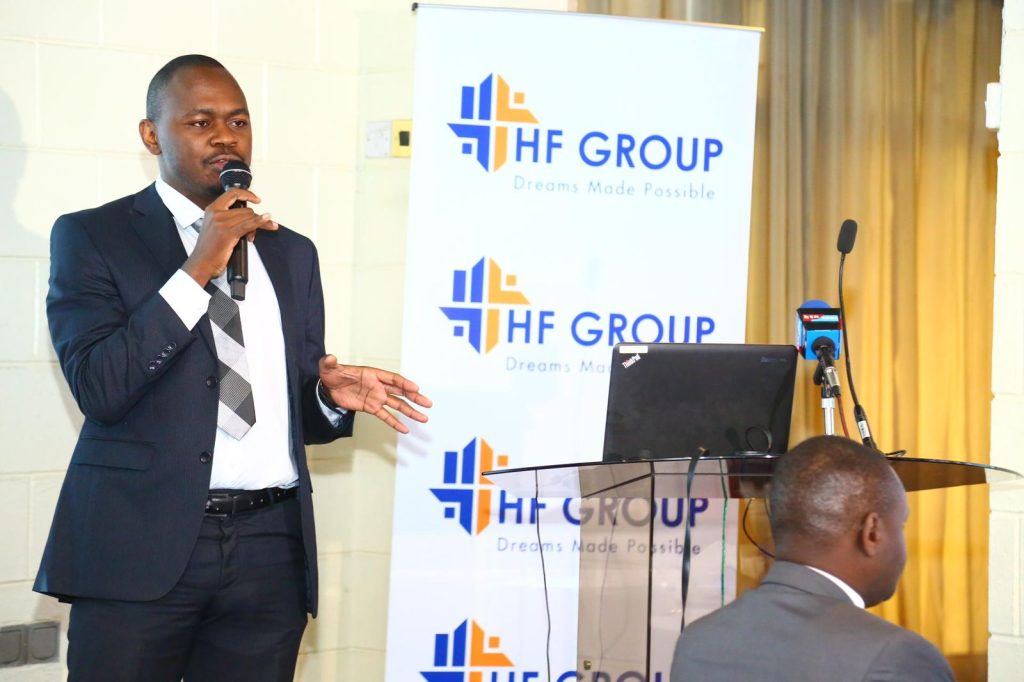 Teddy Ogallo at a past Housing Finance event. Image source: WayaWaya
Where did you grow up? What did it teach you about money, trust, and financial systems?
I was born in Eldoret [Western Kenya], in a sheltered setup. My dad was in the military, posted at one of the best-built barracks in Kenya, a flagship. This barracks had a supermarket, a good hospital, and a really good school. You had no reason to leave.
Bungalows. Everyone had their own room. Perfect, sheltered life. We only ventured out once every two months to town. Eldoret has more cushioning, more civil servant jobs, and more middle class than comparable towns. We didn’t know some of the struggles Kenyans go through.
Then life happened. My dad lost his job. We had to move when I was about 17. That was my welcome to real-life Kenya. I saw people buy milk in plastic containers; there was poverty. And then there was that drive. You could see people really pushing to escape that place.
So, I’m a teenager, the firstborn, wanting to pull my entire family out of that. That’s where I saw Kenyan resilience. Put a typical Kenyan in a tough situation, and you get stories of guys who started in places like Kawangware and are now somewhere out there in the world. Kenyans just don’t settle.
That contrast—shelter to crash course—taught me Kenyans are resilient and aggressive by nature.
On financial systems: at that point, the system was not built for the reality on the ground. We have one of the highest poverty rates—even as a middle-income country, our poverty rate is higher than most neighbors.
Our financial system is built for the ministers. That’s why micro-lending apps are prospering in Kenya.
I discovered quickly how it was built to fail. That’s how I started my entrepreneurship journey. Being in that situation, trying to start a business, nobody coming from nowhere is locked out. Completely locked out.
My first business: refurbishing phones and laptops at 17, selling online, and shipping. I had to figure out how to register a company in South Africa and set up a PayPal account because PayPal wasn’t available for Kenyans.
It was easier to set up outside the country than to open a processing account at a Kenyan bank. Our system is designed to slow you down.
We’re a low-trust society. Especially at the lower level, people will try to take advantage of that scarcity mindset. It gets better as you grow. The saving grace is that Kenyans are naturally friendly people. But we’re really low-trust. People will scam you if they can.
That informs how I approach technology—when I’m building a solution, I have to think: Where will bad actors get in? How will they take advantage? There’s always someone in Kenya trying to take advantage of the system.
If you weren’t building fintech infrastructure, what would you be doing, and would you be happier?
I would be building something bigger [laughs]. And I would definitely be happier.
One reason I’m building fintech is not just to solve problems I see—people like me at different stages of starting off—but it’s also selfish. I want to be successful. Success means having cash and having a network where you can raise more money.
My dream is to be an entrepreneur who builds industries. A reality where you go out and see an actual Kenyan-built phone. Even if it’s assembled in China or the US, it’s designed with Kenya in mind, with Kenyan realities.
The reality that someone in the village wants a phone or laptop that can last days on a charge. Most phone companies build for a world where most people have stable electricity and computers. But in Africa, those aren’t normal.
Being able to build for all that—to be a changemaker—if I were successful and doing something at a larger scale, that would be my dream.
What part of building WayaWaya has cost you the most, personally?
The pivot to artificial intelligence (AI). That has cost me a lot.
I started pivoting to AI in 2018. I could go pitch to a bank or an investor, and they would be asking: Why can’t I just Google instead of asking some chat thing? Why would I want that? Convincing people was so hard. I sacrificed a lot of time and resources.
The first bank client I got, it was a crazy deal. I was fighting to pay them just to deploy the solution to validate. I got in, validated, and integrated.
Then I realized there was this European company—one of the largest—that had signed agreements with banks to develop all future messaging platforms through them. But they didn’t have this solution.
So you’ve integrated. You’ve sacrificed. You’ve hired developers. Banks won’t let you connect from outside; you have to sit there on-site, paying out of pocket, posting the other side of the business.
Then, after all that work, a European company with over $1 billion in revenue puts its foot down. They say, if you don’t give us a percentage of your revenues, we’ll block you. And in Kenya, these companies have people on retainer inside, insiders who will block you.
After sacrificing all that, you get such companies blocking you. Companies afraid of the status quo changing.
Just getting that first launch—I was not just operating at a loss, I was almost paying the banks to get to the decision-maker. When you’re working with banks, sometimes you’ve not met the CEO. He doesn’t know what’s happening down there. You just want it to work out so it gets that spotlight, because you know the solution is actually good and can win on merit. No politics. I’m not good at politics.
Getting through gatekeepers with a revolutionary solution like AI, that was tough. Kenyan companies are bureaucratic. Even if you approach decision-makers first, they delegate to gatekeepers, who find a way to shoot it down. Decision-makers want it to go through the system, procedures, and tests. So it gets pushed down.
That cost me a lot of time, friendships, and relationships. But I felt AI was the future, so I kept at it.
When do you feel most at peace these days?
Those rare nights when I usually make a list of tasks we have to achieve daily—for the team and myself—those rare times when you’ve checked off the most important tasks, and you’re able to just pause.
Look at the skyline, whether it’s in Nairobi. Just imagine. When you look at that scale, it helps you visualize.
If you could succeed in checking off these tasks—items that were tough—entrepreneurs are really dreamers and ambitious. It makes you feel like you could conquer this place.
Those rare times when you feel you’ve achieved your tasks for a certain period, those are the times I feel proud of myself.
WayaWaya’s core idea—banking inside messaging apps—sounds obvious today. Why is it still not widely executed well?
Banking has traditionally been slow to adapt to new technologies and new methods. That’s why M-PESA overtook them.
Sometimes it makes me question my focus on banking, because you’ll get a go-ahead from management, but then you hit gatekeepers—mid-level guys used to thinking of banking in the traditional sense: a banking app, send money, withdraw.
Companies are trying to convince banks to have smarter smartphone apps. We’re coming and saying: skip this era of smartphones and jump to the AI era. Banks are slow to adapt to innovation. They want to see use cases. It’s chicken and egg. You need banks willing to go all the way and push these solutions out, not just a chatbot.
WayaWaya is adaptive banking. Instead of the same menu for every customer—send money, withdraw—imagine a banking solution that recognizes you. If you’re an investor, it gives you investor-specific features. If you’re a student, it helps you break down course payments over time. It adapts to different user personas in real time.
Someone who gets paid at the end of the month, pays bills and rent, and has 10,000 left, then goes on a night out. If they start overspending, the system can warn them: this goal hasn’t been achieved. Temporarily lock spending. Alert them. Give them a nudge.
So the issues are: bureaucracy. Banks are slow to adapt. Every other industry has brought in AI. Banks are the least, other than checking loans, for instant loans.
Regulators. Kenyan regulators block innovation. You get a letter asking for a license. You approach them, check everything off. Then the regulator stops replying. They say 4,000 startups applied for this licence, and they can’t keep up manually. In the US, regulators license thousands per state. Why can’t Kenya just licence 50? That squeezes innovation.
The bureaucracy and banks’ inability to adapt, that’s the answer.
How do you think about competition when global players like Google and OpenAI are now pushing no-code AI builders?
First, it’s validation. We actually had a no-code builder as early as 2019.
Since it’s a competition, we have an advantage. Our solution combines cross-border payments and banking. It takes a lot of time to go to every bank, connect to MasterCard, Visa, and the switches. That will take time for global players too, because they need boots on the ground to navigate those bureaucratic relationships and financial connections.
We build things that scale. We manually went to the offices. We connected to most national switches and mobile wallets, not just in Kenya. Stitching that together is a significant effort.
Our key differentiator is that we’ve done that groundwork. Now we embed, we enable our clients to embed payment steps in their agent flows.
You’ve built for SMEs, banks, and telcos. Which segment will define the next decade of African commerce?
Definitely SMEs.
Africa is in a peculiar place. Large-scale industrialization that happened in other countries may not happen the same way in Africa. Most people—even if they have a job—will have a business on the side. An Instagram shop. A day job plus a business. Or two businesses full-time.
I think SMEs will become so big that every two adults will have a business. Because this is Africa. It’s a way to survive.
That’s why we believe in automation tools. These businesses want solutions that cut down on hiring too many staff. They have day jobs. They’re not specialized. Give them tools that automate those specializations.
The other thing: the digital nature of Africa means a lot of businesses will go online. Africa has one of the highest growth rates in digital commerce in the world.
SMEs are the future. It’s just really hard to sell to them, onboard them, and have boots on the ground. But that’s changing step by step as innovators create compelling solutions SMEs cannot live without.
Cross-border payments remain broken in Africa. What’s the one bottleneck nobody is fixing?
Interoperability.
Look at Europe, open banking. India, UPI payments. Anyone can plug in. That’s why WhatsApp payments work in India. They’ve already solved interoperability. Banks seamlessly integrate with mobile wallets regardless of borders.
In the US, connecting to banking rails is straightforward. You might need minimum capital, but you don’t have to look for some regulator’s email for a year while they sit on your application and block it.
In Africa, interoperability is a friction point. Even when we connect to MasterCard’s sandbox platform, the banks reaching out are usually from Latin America or Europe, not Africa. It’s just not in our DNA to jump onto these interoperable platforms.
Our culture, our thinking—it’s constrained to a small place where people are just thinking of the next meal. Across Africa, we don’t have interoperability. Within countries—even Kenya—we don’t have interoperability.
You can’t pay out of your bank account unless it’s a Visa or MasterCard that charges you high fees. Dominant players like M-PESA force banks to connect to them on their terms.
Interoperability is the biggest issue, caused by our mentality, bureaucracy, and regulatory bottlenecks.
What has this journey taught you about yourself that you didn’t expect?
I’m the most resilient person I’ve ever met [laughs]. I don’t know if I’ll ever meet someone more resilient. Damn! I’m resilient.
My first startup—at 24, I had just signed a $2 million deal. Money in the account. Signed an Memorandum of Understanding (MoU) for over $10 million with one of the biggest companies in the world. Then the shareholders and engineers association threatened me. I had to surrender my shares. It was almost a humiliation ritual at the offices of those big companies.
I still remember signing that at the board, then being asked to leave. At 24, you know how much of a feat it is to build a company that secures a $2 million contract with an actual client. And being forced to give all that up.
Then, picking yourself up, bringing the fight to those big guys, and surviving.
What kind of founder do you hope people say you were?
A genuine changemaker.
I hope to get to a place where I don’t have to explain or give stories. It’s not about ego. It’s about how it’s impacted people’s lives.
The same way you say, “Can I M-PESA?” That impact, touching as many lives as possible. That’s being a genuine changemaker.


You May Also Like

What’s Expected for Bitcoin (BTC) Price by Year-End? Option Bulls’ Movements Analyzed: Two Levels Stand Out!

ECB rejects stablecoins as a path to wider euro influence




