Bitcoin fell 23% in Q1 2026, but these ‘unknown’ crypto tokens made gains
At first glance, the first quarter of 2026 looks like a standard crypto downturn. According to the 2026 Q1 Crypto Industry Report: Market Data & Insights from NFT Plazas, Bitcoin dropped nearly 23%, pulling total market capitalisation down more than 20% and briefly below $2.5 trillion for the first time since late 2024.
Ethereum performed even worse, shedding roughly 32% as DeFi activity slowed and Layer 2 competition intensified.
But this was not a typical correction. Capital did not leave the market; it repositioned.
Stablecoins accounted for roughly 75% of total trading volume during the quarter, with bots driving the majority of activity. This is a structural shift. Crypto markets are becoming more automated, more capital-efficient, and less dependent on broad retail momentum.
Liquidity is no longer chasing direction; it is now targeting opportunity. That change is already reshaping price action, and it explains why a select group of tokens managed to rally while the market fell.
The best-performing crypto tokens in Q1 2026:
1. Fetch.ai (FET) – AI demand turned into capital: Fetch.ai led the market with a 67% gain, driven by growing demand for decentralised AI agents.
As interest in autonomous systems accelerated, FET positioned itself as a core infrastructure layer. Its role within the broader ASI Alliance reinforced that positioning, giving it exposure to a rapidly expanding ecosystem.
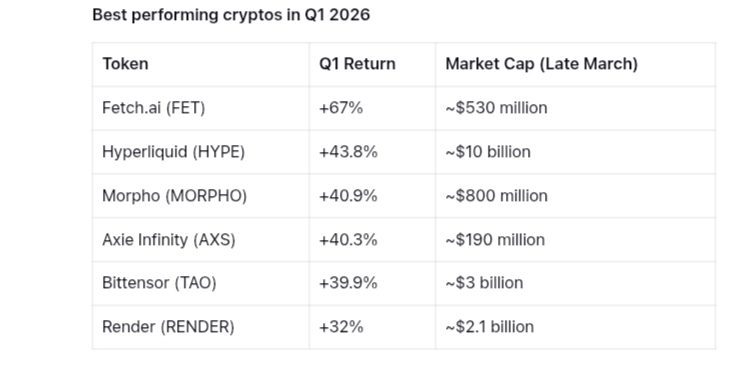 Top gainers crypto tokens in Q1
This was not a short-lived narrative pump. It was sustained capital flowing into AI infrastructure.
2. Hyperliquid (HYPE) – The rise of on-chain trading venues: Hyperliquid gained 43.8% as traders migrated towards decentralised derivatives platforms.
In a volatile environment, execution speed and liquidity matter. Hyperliquid delivered both, capturing flows from users seeking alternatives to centralised exchanges.
Its performance highlights a key trend: trading infrastructure is becoming as important as the assets being traded.
3. Morpho (MORPHO) – Efficiency becomes the edge: Morpho rose 40.9% by focusing on capital efficiency within DeFi lending markets.
Rather than competing purely on headline yields, the protocol optimises how capital is matched between lenders and borrowers. In a cautious market, that efficiency becomes a competitive advantage.
DeFi is not disappearing. It is becoming more precise.
4. Axie Infinity (AXS) – Gaming shows signs of life: Axie Infinity climbed 40.3%, marking a notable rebound for blockchain gaming.
Improved tokenomics and renewed ecosystem activity helped restore confidence, suggesting the sector still has growth potential.
However, gaming remains cyclical. Sustained momentum will depend on user retention, not just token performance.
5. Bittensor (TAO) – Fundamentals meet narrative: Bittensor delivered a 39.9% return, supported by strong fundamentals.
The network generated an estimated $43 million in quarterly revenue and gained credibility through high-profile industry backing, including from Nvidia. That combination sets it apart from purely narrative-driven AI tokens.
This is a sign of maturity. The market is starting to reward revenue, not just vision.
6. Render (RENDER) – Compute demand remains relentless: Render rose 32%, continuing to benefit from global GPU shortages.
As AI workloads expand, access to compute has become a bottleneck. Render addresses this by distributing GPU capacity across a decentralised network.
Its value is tied directly to demand, making it one of the clearest examples of a utility-driven crypto asset.
What Q1 2026 actually tells us
The divergence between Bitcoin’s decline and these gains is not random. It reflects a deeper transformation. Crypto is no longer moving as a single market. It is breaking into distinct sectors:
- AI and compute infrastructure
- Trading platforms and liquidity venues
- Capital-efficient DeFi protocols
- Gaming and user acquisition layers
Each sector is attracting capital independently. At the same time, stablecoin dominance and bot-driven trading are accelerating this shift. Liquidity is becoming more tactical, more automated, and more selective.
What happens next in 2026?
Also read: Western Union USDPT: Why Tether and Circle should fear the ‘last mile’ remittance battle
This fragmentation is unlikely to reverse. AI infrastructure will continue to attract capital as demand for decentralised compute grows. On-chain trading platforms will compete aggressively for volume. DeFi protocols that improve capital efficiency will gain relevance in a more cautious market environment.
The implication is that crypto is no longer a single trade driven by Bitcoin. It is now a collection of competing ecosystems. And for the first time, being in the right sector may matter more than simply being in the market.


You May Also Like

ekko Launches the Nature Footprint, Enabling Payment Providers to Embed Environmental Impact Insights and Action Into Everyday Spending

Ripple CEO Says CLARITY Act Is a Done Deal as Senate Prepares Markup