If the Pectra upgrade prompts a surge in DApp and Ethereum network activity, ETH prices could recover.If the Pectra upgrade prompts a surge in DApp and Ethereum network activity, ETH prices could recover.

Ethereum Pectra upgrade adds new features. When will ETH be able to return to $2,000?

2025/05/08 19:16
4 min read

By Marcel Pechman , Cointelegraph

Compiled by: Felix, PANews

Ethereum successfully implemented a key network upgrade on May 7, but the price of ETH and its derivatives indicators reacted mutedly to the upgrade. The muted reaction surprised traders and led analysts to question whether ETH still had a chance to rally 22% to reclaim the $2,200 level.
Ethereum Pectra upgrade adds new features. When will ETH be able to return to $2,000?

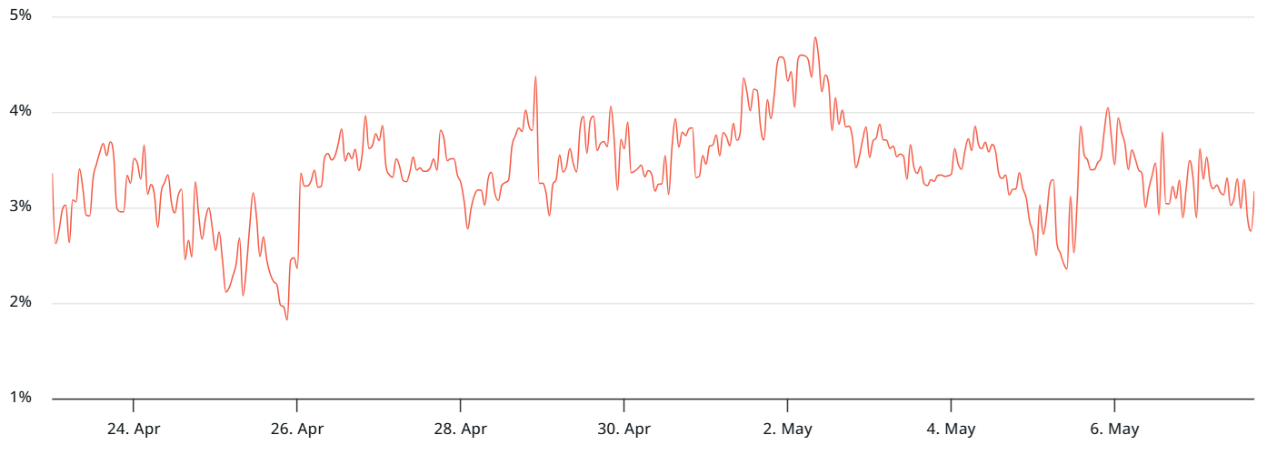
 ETH 30 -day futures annualized premium. Source: Laevitas.ch

The ETH futures premium has been below the neutral threshold of 5%, indicating a lack of interest from leveraged longs. More importantly, after the Pectra upgrade, this indicator remained unchanged at 3%, indicating that traders did not adjust their positions despite the successful deployment of the upgrade.

The muted market reaction is partly due to investors’ focus on macroeconomic issues as uncertainty over global trade disputes heightens the risk of a recession. But traders’ lack of interest in ether predates the recent deterioration in risk aversion. In fact, in the first three months of 2025, ETH underperformed the overall cryptocurrency market cap by 28%.

The muted reaction can be attributed in part to investors’ focus on macroeconomic issues, as the risk of a recession is growing amid uncertainty over global trade disputes. But traders’ lack of interest in ETH predates the recent rise in risk aversion. In fact, in the first three months of 2025, ETH underperformed the overall cryptocurrency market cap by 28%.

Pectra’s lackluster price performance following the upgrade reflects a general discontent in the market as other blockchains have shown some momentum.
Ethereum Pectra upgrade adds new features. When will ETH be able to return to $2,000?

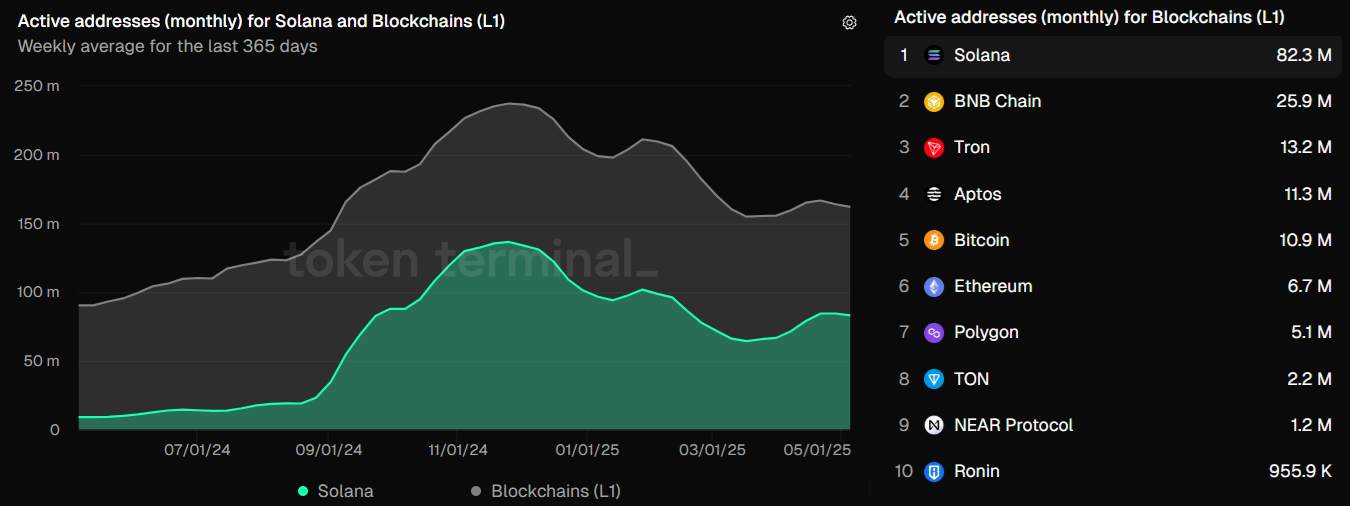
 Solana monthly active addresses compared to L1 competitors. Source: Token Terminal

Historically, high Ethereum base layer fees may have limited network activity, but since mid-February, these fees have fallen below $1. In addition, according to Token Terminal data, Ethereum's leading L2 solution Base currently has 10.3 million monthly active users, far less than Solana's 82.2 million and BNB Chain's 25.9 million.

Ethereum lags in DApp interoperability — will this affect ETH’s price?

Solana has dominated the DEX space by providing an integrated user experience, especially in token issuance. Similarly, Hyperliquid has outperformed expectations in perpetual contract trading, indicating that traders' main concerns are not necessarily on Ethereum's decentralization and security. Meanwhile, Tron has made significant progress in the stablecoin market.
Ethereum Pectra upgrade adds new features. When will ETH be able to return to $2,000?

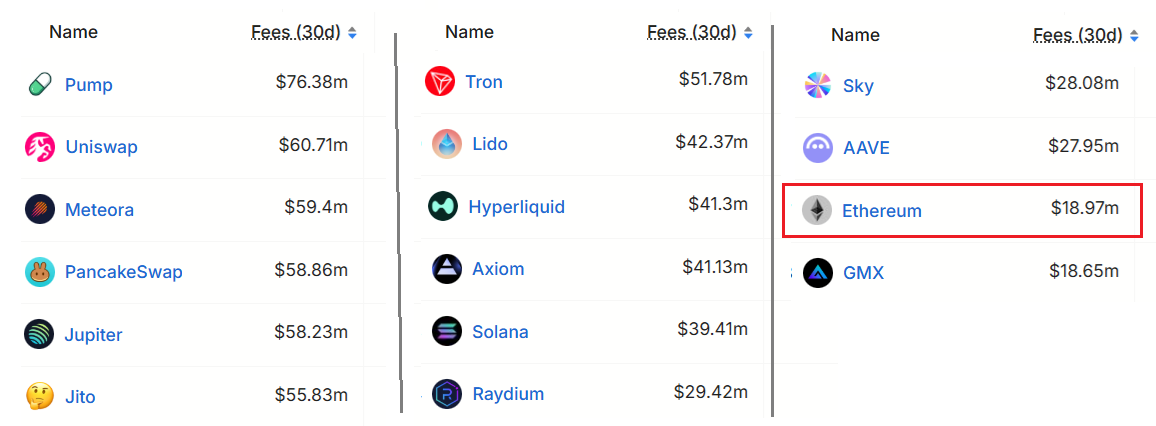
 Blockchain and DApps 30 -day fees (in USD). Source: DefiLlama

Ethereum still leads in terms of total locked value (TVL) at $53.7 billion. However, this has not brought much benefit to ETH holders. According to DefiLlama data, Ethereum network fees have been relatively low at only $19 million in the past 30 days. In comparison, Tron has accumulated fees of $51.8 million in the same period, while Solana has accumulated fees of $39.4 million.
Ethereum Pectra upgrade adds new features. When will ETH be able to return to $2,000?

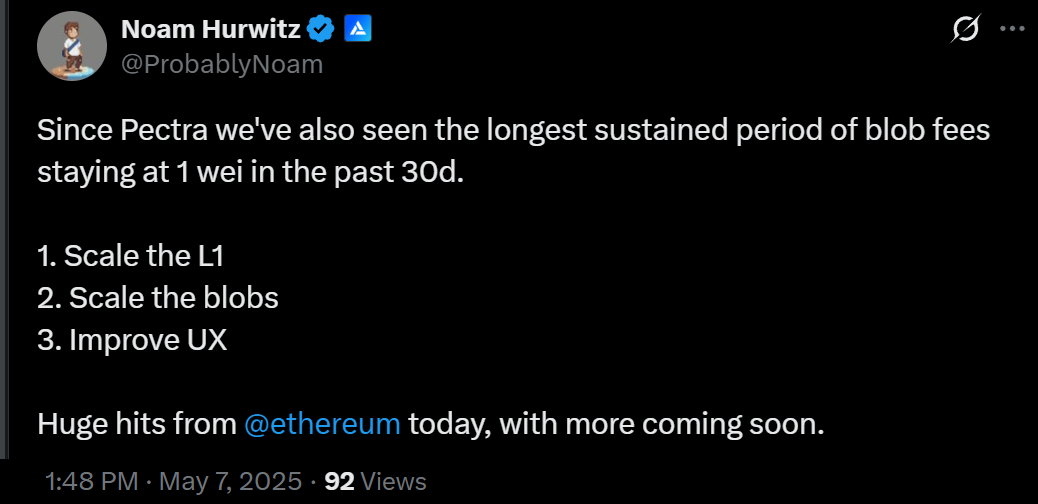
 Source: X/ProbablyNoam

Noam Hurwitz, Alchemy’s head of engineering, noted that Ethereum’s blob fees have dropped to their lowest levels since the Pectra upgrade. For Hurwitz, ETH’s success depends on the scalability of the base layer, including further improvements to the Rollup mechanism, and ultimately a more seamless user experience.

The interoperability of assets and data in the Ethereum L2 ecosystem has long been a problem, while users on the Solana and BNB chains can easily switch between multiple decentralized applications (DApps). Although the Pectra upgrade is a step in the right direction, it still does not solve this problem, which also explains why ETH has not been able to return to the $2,200 level in early March.

For the price of ETH to rise 22% from its current $1,810, investors will likely need assurance that progress on the network (whether through deposits or L2 growth) translates into noticeable returns. Ultimately, higher staking yields or stronger incentives will be needed to drive wider adoption of DApps, which in turn will increase demand for ETH within the ecosystem.

Related reading: Dialogue with the Ethereum Foundation: After the Pectra upgrade, the three core strategies for the future are explained in detail


Market Opportunity
Ethereum Logo
Ethereum Price(ETH)
$2,228.85
$2,228.85$2,228.85
-3.22%
USD
Ethereum (ETH) Live Price Chart
Disclaimer: The articles reposted on this site are sourced from public platforms and are provided for informational purposes only. They do not necessarily reflect the views of MEXC. All rights remain with the original authors. If you believe any content infringes on third-party rights, please contact service@support.mexc.com for removal. MEXC makes no guarantees regarding the accuracy, completeness, or timeliness of the content and is not responsible for any actions taken based on the information provided. The content does not constitute financial, legal, or other professional advice, nor should it be considered a recommendation or endorsement by MEXC.

You May Also Like

Ethereum unveils roadmap focusing on scaling, interoperability, and security at Japan Dev Conference

Ethereum unveils roadmap focusing on scaling, interoperability, and security at Japan Dev Conference

The post Ethereum unveils roadmap focusing on scaling, interoperability, and security at Japan Dev Conference appeared on BitcoinEthereumNews.com. Key Takeaways Ethereum’s new roadmap was presented by Vitalik Buterin at the Japan Dev Conference. Short-term priorities include Layer 1 scaling and raising gas limits to enhance transaction throughput. Vitalik Buterin presented Ethereum’s development roadmap at the Japan Dev Conference today, outlining the blockchain platform’s priorities across multiple timeframes. The short-term goals focus on scaling solutions and increasing Layer 1 gas limits to improve transaction capacity. Mid-term objectives target enhanced cross-Layer 2 interoperability and faster network responsiveness to create a more seamless user experience across different scaling solutions. The long-term vision emphasizes building a secure, simple, quantum-resistant, and formally verified minimalist Ethereum network. This approach aims to future-proof the platform against emerging technological threats while maintaining its core functionality. The roadmap presentation comes as Ethereum continues to compete with other blockchain platforms for market share in the smart contract and decentralized application space. Source: https://cryptobriefing.com/ethereum-roadmap-scaling-interoperability-security-japan/
Share
BitcoinEthereumNews2025/09/18 00:25
Here’s How Consumers May Benefit From Lower Interest Rates

Here’s How Consumers May Benefit From Lower Interest Rates

The post Here’s How Consumers May Benefit From Lower Interest Rates appeared on BitcoinEthereumNews.com. Topline The Federal Reserve on Wednesday opted to ease interest rates for the first time in months, leading the way for potentially lower mortgage rates, bond yields and a likely boost to cryptocurrency over the coming weeks. Average long-term mortgage rates dropped to their lowest levels in months ahead of the central bank’s policy shift. Copyright{2018} The Associated Press. All rights reserved. Key Facts The central bank’s policymaking panel voted this week to lower interest rates, which have sat between 4.25% and 4.5% since December, to a new range of 4% and 4.25%. How Will Lower Interest Rates Impact Mortgage Rates? Mortgage rates tend to fall before and during a period of interest rate cuts: The average 30-year fixed-rate mortgage dropped to 6.35% from 6.5% last week, the lowest level since October 2024, mortgage buyer Freddie Mac reported. Borrowing costs on 15-year fixed-rate mortgages also dropped to 5.5% from 5.6% as they neared the year-ago rate of 5.27%. When the Federal Reserve lowered the funds rate to between 0% and 0.25% during the pandemic, 30-year mortgage rates hit record lows between 2.7% and 3% by the end of 2020, according to data published by Freddie Mac. Consumers who refinanced their mortgages in 2020 saved about $5.3 billion annually as rates dropped, according to the Consumer Financial Protection Bureau. Similarly, mortgage rates spiked around 7% as interest rates were hiked in 2022 and 2023, though mortgage rates appeared to react within weeks of the Fed opting to cut or raise rates. How Do Treasury Bonds Respond To Lower Interest Rates? Long-term Treasury yields are more directly influenced by interest rates, as lower rates tend to result in lower yields. When the Fed pushed rates to near zero during the pandemic, 10-year Treasury yields fell to an all-time low of 0.5%. As…
Share
BitcoinEthereumNews2025/09/18 05:59
The Giants Are Stumbling: Why BlockDAG’s 20-Exchange Launch is the Market’s New Safe Haven

The Giants Are Stumbling: Why BlockDAG’s 20-Exchange Launch is the Market’s New Safe Haven

The cryptocurrency market seems to have caught headwinds entering February. Portfolios across the globe are flashing red as the flash crash of February 2nd wreaks
Share
Captainaltcoin2026/02/04 02:30