AI is more efficient, more accessible and more affordable; in addition, Asians are more optimistic about AI.AI is more efficient, more accessible and more affordable; in addition, Asians are more optimistic about AI.

Highlights of Stanford HAI's 2025 Artificial Intelligence Index Report

2025/04/14 16:25
4 min read

Author: Stanford HAI (Stanford Artificial Intelligence Institute)

Compiled by: Felix, PANews

Stanford HAI recently released the 456-page "Artificial Intelligence Index Report 2025". Here are some key points about artificial intelligence trends:

1. AI is becoming much more powerful than imagined

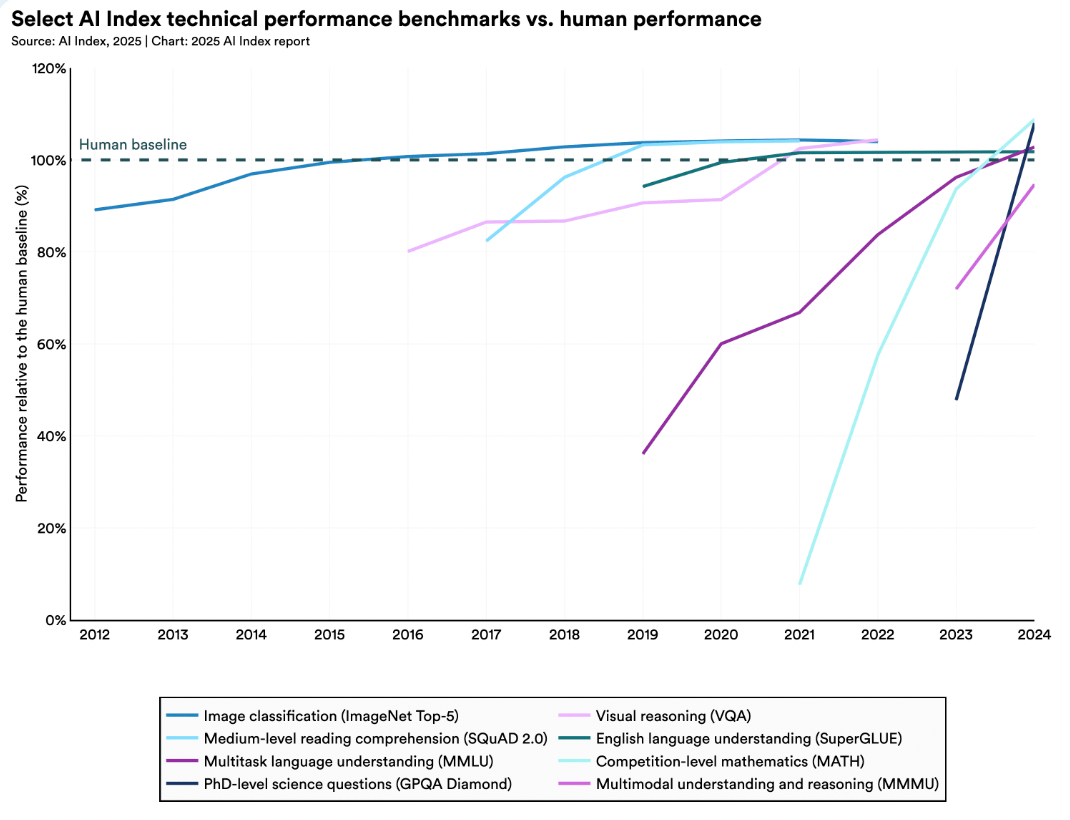
In the new benchmarks MMMU, GPQA, and SWE-bench, AI performance improved significantly: scores increased by 18.8%, 48.9%, and 67.3%, respectively. In addition to the benchmarks, AI systems made significant progress in generating high-quality videos, and in some cases, large language models (LLMs) even surpassed humans in timed programming tasks.

Note:

MMMU is a novel, carefully designed benchmark for multi-disciplinary multimodal understanding and reasoning at the university level, aiming to evaluate the expert-level multimodal understanding capabilities of underlying models on a wide range of tasks.

GPQA is a challenging dataset consisting of 448 high-quality and difficult multiple-choice questions written by experts in different fields. Experts who hold or are pursuing a PhD in the corresponding field achieve only 65% accuracy, while highly skilled non-expert verifiers achieve only 34% accuracy despite spending an average of more than 30 minutes and having unlimited access to the Internet.

SWE-bench is a benchmark for evaluating the performance of Large Language Models (LLMs) on real-world software questions collected from GitHub.
Highlights of Stanford HAI's 2025 Artificial Intelligence Index Report

2. AI is more efficient, accessible, and affordable

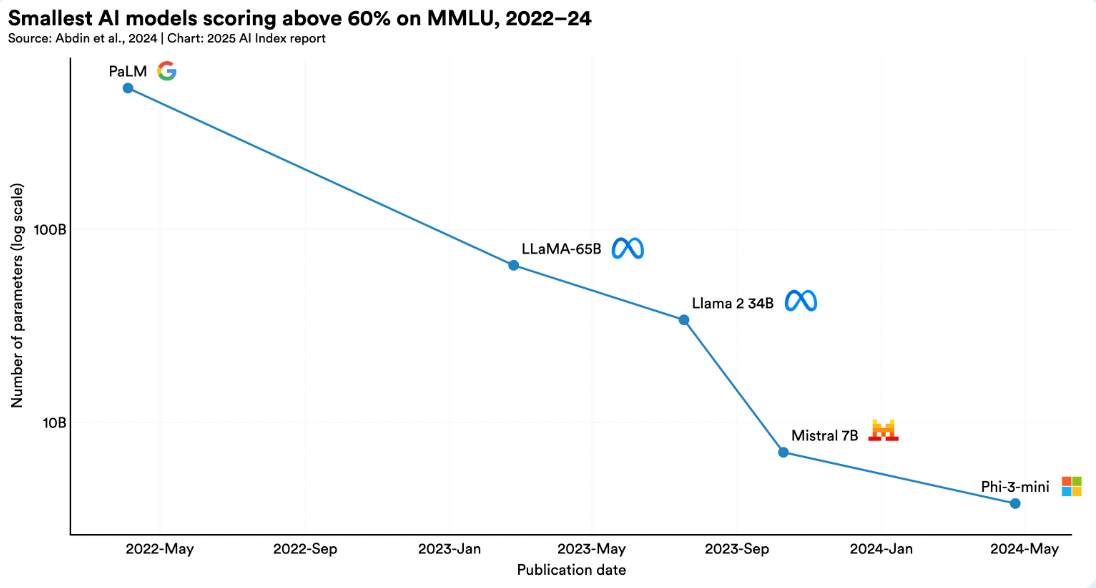
Smaller AI models with fewer parameters are becoming increasingly powerful: in just two years, the number of parameters has been reduced by about 100 times, while still scoring over 60% on the Massive Multi-Task Language Understanding (MMLU) test.

The gap between open source and closed source models is also narrowing, with the performance gap falling from 8% to just 1.7% in some benchmarks.
Highlights of Stanford HAI's 2025 Artificial Intelligence Index Report

Furthermore, the cost of inference for systems reaching the level of GPT-3.5 dropped by more than 280 times from November 2022 to October 2024. At the hardware level, costs dropped by 30% per year, while energy efficiency improved by 40% per year.

The threshold for advanced AI is rapidly decreasing. Not to mention the development of sparse models like DeepSeek, where only relevant parameters are activated to answer the user’s query under the Mixture of Experts (MoE) structure, making the whole thing more efficient.

Indeed, as smaller but more powerful AI models continue to emerge, the requirements for AI model training have been reduced, and cost-effective distributed training is expected to become mainstream in the next decade. There are currently some top projects conducting related research based on different theoretical frameworks.

3. AI is increasingly integrated into everyday life

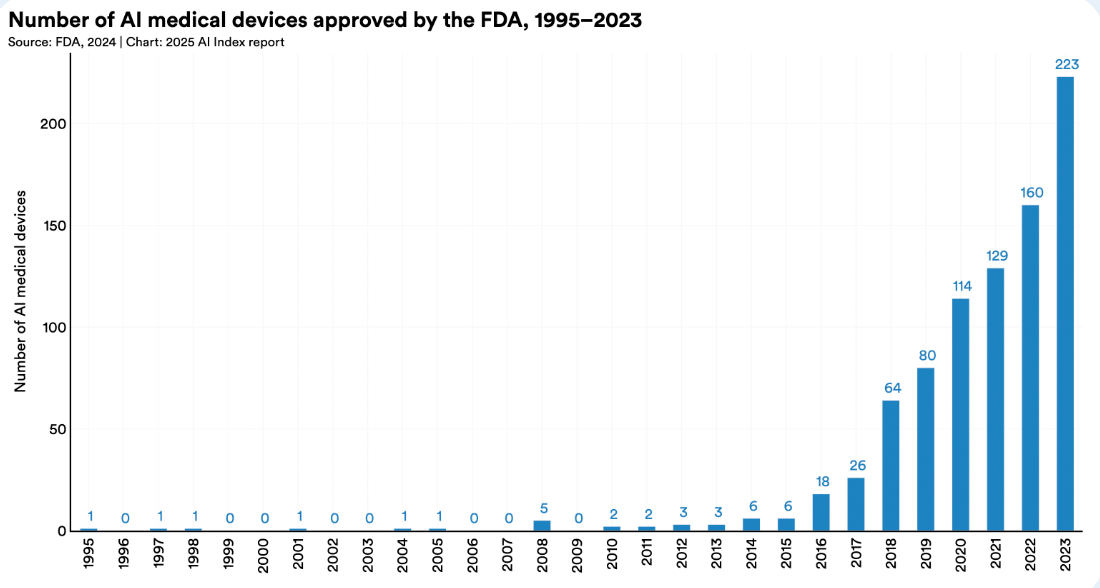
In 2023, the U.S. Food and Drug Administration (FDA) approved 223 AI-assisted medical devices, up from just six in 2015. On the roads, self-driving cars are no longer experiments: Waymo, one of the largest operators in the U.S., provides more than 150,000 self-driving rides per week, and Baidu’s Apollo Go fleet of driverless taxis is now operational in several Chinese cities.
Highlights of Stanford HAI's 2025 Artificial Intelligence Index Report

4. Corporate investment in AI has increased significantly, driving record investments and adoption

The adoption of AI in business is also accelerating: 78% of organizations are using AI in 2024, up from 55% the year before. At the same time, a growing body of research confirms that AI can increase productivity and help close skills gaps across the workforce.

In fact, product-market fit breakdowns will occur more frequently as AI causes customer expectations to grow exponentially, making existing solutions obsolete overnight, leaving incumbents with no chance to adapt.

5. Despite rising optimism about AI globally, Asians are more optimistic about AI

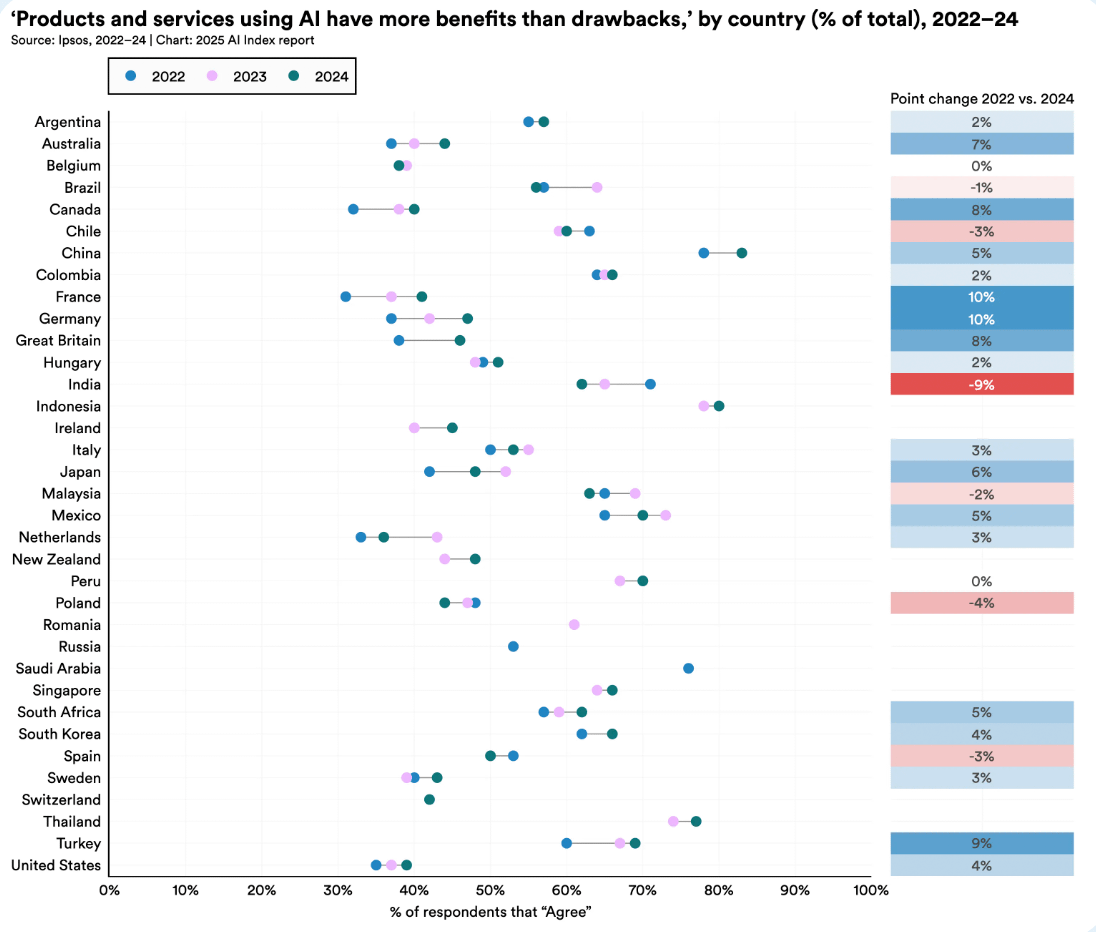
In countries such as China (83%), Indonesia (80%) and Thailand (77%), the majority believe that the benefits of AI products and services outweigh the risks. In contrast, optimism remains far lower in places such as Canada (40%), the United States (39%) and the Netherlands (36%).

However, this attitude is changing: since 2022, optimism has grown significantly in a number of previously skeptical countries, including Germany (up 10%), France (up 10%), Canada (up 8%), the United Kingdom (up 8%) and the United States (up 4%).
Highlights of Stanford HAI's 2025 Artificial Intelligence Index Report

6. The influence of artificial intelligence in scientific research is increasing, and it has become an important driving force for scientific progress

The growing importance of AI is reflected in major scientific prizes: two Nobel Prizes were awarded for research into deep learning (physics) and its application to protein folding (chemistry), while the Turing Award recognized groundbreaking contributions to reinforcement learning.

Clearly, AI is advancing at an exponential and unexpected pace, which is significant to most people. As a result, AI security is becoming increasingly important. While AI makes forgery easier, cryptography makes it more difficult. Look forward to crypto projects that can leverage the native properties of blockchain (verifiability and transparency) to build practical solutions in this area.

Related reading: Interview with Chris Dixon, founder of a16z: The intersection of artificial intelligence and encryption technology


Market Opportunity
Moonveil Logo
Moonveil Price(MORE)
$0.0007978
$0.0007978$0.0007978
-11.55%
USD
Moonveil (MORE) Live Price Chart
Disclaimer: The articles reposted on this site are sourced from public platforms and are provided for informational purposes only. They do not necessarily reflect the views of MEXC. All rights remain with the original authors. If you believe any content infringes on third-party rights, please contact service@support.mexc.com for removal. MEXC makes no guarantees regarding the accuracy, completeness, or timeliness of the content and is not responsible for any actions taken based on the information provided. The content does not constitute financial, legal, or other professional advice, nor should it be considered a recommendation or endorsement by MEXC.

You May Also Like

Victra Named 2025 Recipient of Verizon’s Best Build Compliance Award

Victra Named 2025 Recipient of Verizon’s Best Build Compliance Award

Verizon Recognizes Victra for Industry-Leading Excellence in Store Design and Brand Compliance. RALEIGH, N.C., Feb. 3, 2026 /PRNewswire/ — Verizon has named Victra
Share
AI Journal2026/02/03 20:49
Stablecoins could face yield compression after Fed’s rate cut

Stablecoins could face yield compression after Fed’s rate cut

The post Stablecoins could face yield compression after Fed’s rate cut appeared on BitcoinEthereumNews.com. The Federal Reserve reduced its policy rate by 25 basis points to 4.00%–4.25%, the first rate cut this year. The move, framed as a response to weakening labor data, signals the start of a cautious easing cycle. Projections show two more cuts possible before year-end, with further reductions likely in 2026. Inflation remains above target, but Chairman Jerome Powell emphasized risk management over immediate price control, prioritizing stability in employment conditions. Stablecoins will be quickly affected by this. Issuers like Tether and Circle have generated large profits by holding reserves in short-term Treasuries during the high-rate environment of the past two years. That income stream now begins to erode. DeFi protocols that offered tokenized Treasury exposure face the same squeeze, with returns set to fall further if the Fed continues cutting into next year. A multi-cut easing cycle could substantially reduce stablecoin profitability, forcing issuers and protocols to adapt. The decline in dollar yields also alters the balance between holding stablecoins passively and seeking higher returns in risk assets. Bitcoin benefits most from this reallocation. As nominal rates move lower and inflation remains sticky, real yields decline, making non-yielding assets more attractive. The weaker dollar and improving risk appetite amplify the effect, positioning Bitcoin as a relative winner of the Fed’s shift. The September cut is modest, but it could bring significant changes to the crypto market. Stablecoin models built on Treasury income face structural headwinds after the rate cut, while Bitcoin and other high-beta assets stand to gain from falling real yields and increased liquidity. The Fed has opened an easing cycle, and crypto’s internal capital flows will move with it. The post Stablecoins could face yield compression after Fed’s rate cut appeared first on CryptoSlate. Source: https://cryptoslate.com/insights/stablecoins-could-face-yield-compression-after-feds-rate-cut/
Share
BitcoinEthereumNews2025/09/18 19:31
Wormhole Jumps 11% on Revised Tokenomics and Reserve Initiative

Wormhole Jumps 11% on Revised Tokenomics and Reserve Initiative

The post Wormhole Jumps 11% on Revised Tokenomics and Reserve Initiative appeared on BitcoinEthereumNews.com. Cross-chain bridge Wormhole plans to launch a reserve funded by both on-chain and off-chain revenues. Wormhole, a cross-chain bridge connecting over 40 blockchain networks, unveiled a tokenomics overhaul on Wednesday, hinting at updated staking incentives, a strategic reserve for the W token, and a smoother unlock schedule. The price of W jumped 11% on the news to $0.096, though the token is still down 92% since its debut in April 2024. W Chart In a blog post, Wormhole said it’s planning to set up a “Wormhole Reserve” that will accumulate on-chain and off-chain revenues “to support the growth of the Wormhole ecosystem.” The protocol also said it plans to target a 4% base yield for governance stakers, replacing the current variable APY system, noting that “yield will come from a combination of the existing token supply and protocol revenues.” It’s unclear whether Wormhole will draw from the reserve to fund this target. Wormhole did not immediately respond to The Defiant’s request for comment. Wormhole emphasized that the maximum supply of 10 billion W tokens will remain the same, while large annual token unlocks will be replaced by a bi-weekly distribution beginning Oct. 3 to eliminate “moments of concentrated market pressure.” Data from CoinGecko shows there are over 4.7 billion W tokens in circulation, meaning that more than half the supply is yet to be unlocked, with portions of that supply to be released over the next 4.5 years. Source: https://thedefiant.io/news/defi/wormhole-jumps-11-on-revised-tokenomics-and-reserve-initiative
Share
BitcoinEthereumNews2025/09/18 01:31