

Bittensor (TAO) Price: The AI Network Everyone Is Watching — But Should You Buy TAO?
TLDR
- TAO has a hard cap of 21 million tokens and follows a halving model, with its first halving cutting daily emissions from 7,200 to 3,600 TAO in December 2025.
- Bittensor had no premine and no ICO, making its launch cleaner than most crypto AI projects.
- TAO’s fully diluted valuation sits above $6.6 billion, meaning the market already prices in a lot of future success.
- The network is split into subnets that act as individual AI service markets, but whether TAO captures the value those markets create remains unclear.
- Emissions continue after the halving, meaning dilution has not stopped — it has only slowed.
Bittensor is not a simple AI token. It is a network of subnets, each running its own AI-related market covering inference, storage, and data. TAO is the token that powers it all.
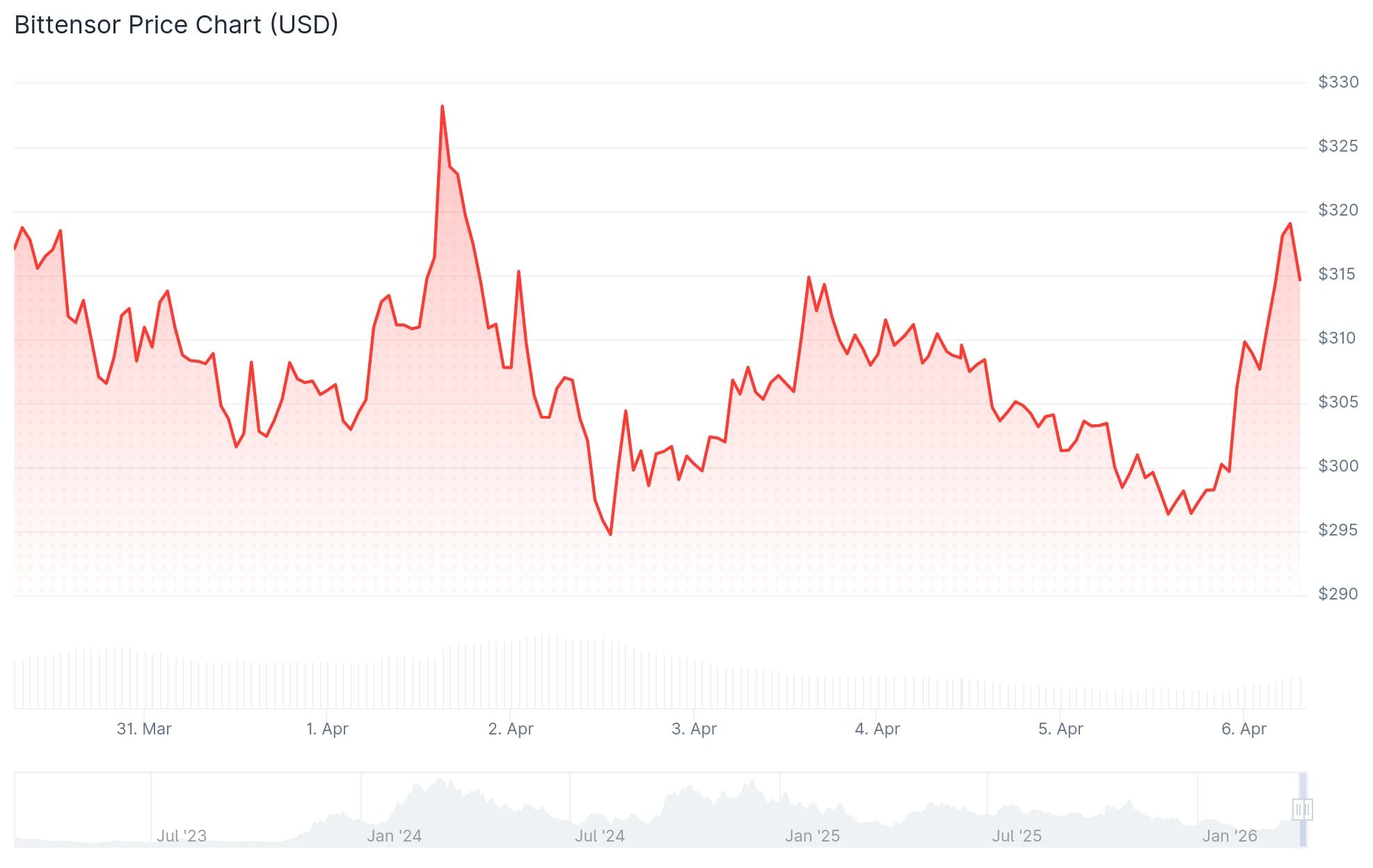 Bittensor (TAO) Price
The project has attracted a serious following. But a strong product vision and a strong investment case are two different things.
TAO’s tokenomics stand out from most crypto AI projects. There is a hard cap of 21 million tokens, matching Bitcoin’s supply ceiling. The Opentensor Foundation confirmed there was no premine and no ICO, which removes one of the most common risks seen in early-stage token launches.
Bittensor also follows a halving schedule. The first halving landed in mid-December 2025, cutting daily emissions from around 7,200 TAO to 3,600 TAO, according to Grayscale.
Supply Is Cleaner, But Dilution Continues
Even at the lower emission rate, new tokens enter the market every day. That means existing holders still face ongoing dilution, just at a slower pace.
CoinGecko data shows TAO’s fully diluted valuation above $6.6 billion. Many investors look at circulating supply and miss the bigger number. With TAO, the full supply picture still matters.
A capped supply does not automatically mean a token is fairly priced. It means the ceiling is known.
Does TAO Actually Capture Value?
This is the central question. Bittensor may build active AI markets inside its subnet system, but that does not mean TAO absorbs the economic value those markets produce.
TAO is used for staking and network incentives. That gives it a functional role. But functional roles inside a network are different from strong external demand that drives price on fundamentals rather than speculation.
In many crypto networks, activity can grow while the token still trades mostly on sentiment. Bittensor faces that same structural problem.
The subnet model is also complex. That complexity makes it harder for regular investors to track what is actually happening on the network and whether growth is real or emission-driven.
Grayscale noted that emissions can inflate activity numbers, making a network look more used than it truly is.
TAO’s first halving took place in December 2025, reducing the daily token supply entering the market by half.
Final Thoughts
Bittensor is one of the more serious projects in the crypto AI space. The tokenomics are cleaner than most, the launch was fair, and the subnet model is genuinely interesting. But TAO is already valued in the billions, dilution continues, and the token’s ability to capture real economic value from its own network is still an open question.
The post Bittensor (TAO) Price: The AI Network Everyone Is Watching — But Should You Buy TAO? appeared first on CoinCentral.


You May Also Like

Vitalik Buterin Proposes Self-Sovereign AI Stack To Protect Users From Risks Of AI Agents

Trader Linked to Whale now down $128 million after ETH wipeout

Fed Governor Calls For Strong Stablecoin Oversight As CLARITY Act’s Final Text Gets Delayed



