Bitcoin regularly trades at prices that make people wonder: why is Bitcoin so expensive? A single Bitcoin can cost tens of thousands of dollars, making it a significant financial asset. This articleBitcoin regularly trades at prices that make people wonder: why is Bitcoin so expensive? A single Bitcoin can cost tens of thousands of dollars, making it a significant financial asset. This article
Learn/Cryptocurrency Knowledge/Hot Concepts/Why Is Bitc...BTC's Price

Why Is Bitcoin So Expensive? The Real Reasons Behind BTC's Price

Intermediate
Feb 11, 2026MEXC
0m
Bitcoin
BTC$66,415.96+2.01%
ConstitutionDAO
PEOPLE$0.005336+0.56%
SCARCITY
SCARCITY$0.007255-0.30%
Bitcoin regularly trades at prices that make people wonder: why is Bitcoin so expensive?
A single Bitcoin can cost tens of thousands of dollars, making it a significant financial asset. This article explains the economic forces behind Bitcoin's high price, from its programmed scarcity to growing institutional demand.
You'll understand why investors willingly pay premium prices for this digital currency and what drives its market value.
  1. For a complete Bitcoin overview, see our ultimate guide to Bitcoin (BTC) for beginners.

Key Takeaways
  • Bitcoin's fixed supply of 21 million coins creates programmed scarcity similar to precious metals like gold.
  • Growing institutional demand from major companies and ETF approvals have brought billions in new capital to Bitcoin markets.
  • Mining costs create a natural price floor by ensuring new supply only enters circulation when prices justify production expenses.
  • Bitcoin's decentralized nature means no single authority can freeze accounts, censor transactions, or manipulate the money supply.
  • Many investors view Bitcoin as "digital gold," using it as a hedge against inflation and for portfolio diversification.
  • The halving mechanism reduces new Bitcoin production by 50% every four years, intensifying scarcity over time.

Bitcoin's Fixed Supply: Why Scarcity Makes Bitcoin Expensive

Bitcoin's creator programmed a hard limit of 21 million coins into its code, making it fundamentally scarce.
Unlike traditional currencies that central banks can print endlessly, no one can create additional Bitcoin beyond this cap. Nearly 19 million coins have already been mined, leaving roughly 2 million left to enter circulation over the coming decades.
This scarcity works like precious metals. Gold maintains value partly because we can't manufacture unlimited amounts. Bitcoin applies the same principle digitally through code rather than geology.
Every four years, Bitcoin undergoes "halving," cutting new coin production by 50%. This programmed reduction intensifies scarcity over time, creating predictable supply constraints that support higher prices when demand increases.


Why Is Bitcoin So Expensive? Market Demand Drives High Prices


1. Growing Investor Demand Makes Bitcoin Expensive


The simple answer to why Bitcoin is so expensive lies in supply and demand economics.
When millions of people want to buy from a limited supply of 21 million coins, prices naturally rise. Bitcoin's user base has expanded from early tech enthusiasts to mainstream investors, creating sustained buying pressure against fixed supply.
Network effects amplify this dynamic. As more people use Bitcoin, it becomes more valuable to everyone else in the network, similar to how telephone systems or social media platforms gain utility with each new user.


2. Institutional Money Entered the Market


Major financial institutions transformed Bitcoin from a speculative experiment into a recognized asset class.
Companies like MicroStrategy have added Bitcoin to their corporate treasuries, while others like Tesla have experimented with BTC holdings. Spot Bitcoin ETFs launched, allowing traditional investors to gain exposure without directly holding coins. These developments brought billions in institutional capital, pushing prices higher.
When hedge funds, pension funds, and wealth managers allocate even small percentages of portfolios to Bitcoin, the resulting demand significantly impacts price. Institutional adoption validates Bitcoin's legitimacy while removing available supply from markets.


3. Limited Bitcoin Supply Pushes Prices Higher


Many long-term Bitcoin holders remove their coins from exchanges, storing them in private wallets.
This "HODLing" behavior reduces the actual supply available for trading. When new buyers arrive seeking to purchase Bitcoin, they compete for increasingly scarce exchange inventory, driving prices upward through basic market mechanics.


Mining Costs and Bitcoin's Price Floor

Bitcoin mining requires substantial investment in specialized hardware and electricity consumption.
Miners compete globally to validate transactions through proof-of-work, spending real resources to secure the network. These production costs create a natural price floor—if Bitcoin's price falls too low, mining becomes unprofitable and miners shut down equipment.
Mining difficulty adjusts every two weeks based on total network computing power. When Bitcoin's price drops, less efficient miners exit, reducing difficulty until profitability rebounds. This self-regulating mechanism links mining economics to market price.
Energy costs vary by region, but competitive mining requires accessing cheap electricity and investing in latest-generation hardware. These barriers to entry support Bitcoin's value by ensuring new supply enters circulation only when market prices justify production expenses.


Bitcoin's Decentralized Value: Trust Without Banks

Bitcoin operates without central banks, governments, or financial intermediaries controlling it.
This decentralization means no single authority can freeze accounts, censor transactions, or manipulate the money supply. The blockchain provides transparent, immutable records that anyone can verify, creating trust through mathematics rather than institutions.
People in countries experiencing currency instability or banking restrictions find particular value in Bitcoin's permissionless nature. Anyone with internet access can send or receive Bitcoin globally without needing approval from banks or governments.
The network's security comes from thousands of miners worldwide, making it extremely difficult and expensive to attack. Over a decade of unbroken operation has demonstrated Bitcoin's resilience, building confidence that supports its high market price.


Why Bitcoin Is Expensive as a Store of Value

Many investors view Bitcoin as "digital gold," a hedge against inflation and economic uncertainty.
Traditional currencies lose purchasing power when governments print excessive money. Bitcoin's fixed 21 million supply protects against monetary inflation from supply expansion, attracting those seeking to preserve wealth long-term.
Portfolio managers increasingly allocate small percentages to Bitcoin for diversification. Some investors use Bitcoin for portfolio diversification, seeking potential protection when traditional markets decline. This institutional embrace as a portfolio component supports sustained demand at high price levels.
Volatility remains high compared to stable assets, yet Bitcoin has appreciated substantially over multi-year periods. Investors willing to accept short-term price swings pay premium prices for potential long-term gains and inflation protection that traditional savings accounts cannot provide.


FAQ

Is Bitcoin backed by anything physical?
Bitcoin isn't backed by gold or government promises, but by its fixed supply, blockchain security, and global network of users.


Can Bitcoin's price go to zero?
While theoretically possible, Bitcoin's established network, institutional adoption, and proven utility make complete value loss highly unlikely.


Why is 1 Bitcoin so expensive compared to other cryptocurrencies?
Bitcoin's first-mover advantage, largest network, strongest security, and widest institutional acceptance command premium pricing over alternatives.


Who decides Bitcoin's price?
No single entity controls Bitcoin's price; global market forces of supply and demand across exchanges determine value minute-by-minute.


Conclusion

Understanding why is Bitcoin so expensive requires examining multiple interconnected factors working together.
Fixed supply scarcity, growing institutional demand, mining production costs, decentralized trust, and store-of-value properties all contribute to Bitcoin's premium pricing. While volatility persists, these fundamental characteristics have sustained Bitcoin's value through multiple market cycles.
If you're ready to explore Bitcoin trading, MEXC offers a user-friendly platform to buy, sell, and trade BTC with competitive fees and robust security features.
  1. Want to learn more? Read our comprehensive What is Bitcoin (BTC) guide for the full picture.
Market Opportunity
Bitcoin Logo
Bitcoin Price(BTC)
$66,399.98
$66,399.98$66,399.98
-0.43%
USD
Bitcoin (BTC) Live Price Chart
This article is provided by MEXC for informational purposes only and does not constitute financial or investment advice. Cryptocurrency markets involve significant risk. Please conduct independent research or consult a qualified professional before making any investment decisions. The views expressed do not necessarily represent those of MEXC or its affiliates.

Popular Articles

View More
What Does BTC Mean in Text? We Read All 56 Slang Entries. "Because They Can" Isn't One.

What Does BTC Mean in Text? We Read All 56 Slang Entries. "Because They Can" Isn't One.

Search "what does BTC mean in text" and the same answer comes back from site after site: "Because They Can." There is no record of anyone ever saying that. Two of them are the ones you'll actually

MEXC On-chain Daily Report:Russia’s State Duma will review a cryptocurrency regulation bill

MEXC On-chain Daily Report:Russia’s State Duma will review a cryptocurrency regulation bill

Updated: July 21, 2026, 9:30 (UTC+8)|Author: MEXC Headlines Russia’s State Duma will review a cryptocurrency regulation bill. Superseed is abandoning its Layer2 and requiring users to migrate assets

MEXC Alpha Trader Research Weekly | ETF Outflows End After 8 Weeks, but a $425M Sell-Off Raises the Question: Who Is Driving BTC?

MEXC Alpha Trader Research Weekly | ETF Outflows End After 8 Weeks, but a $425M Sell-Off Raises the Question: Who Is Driving BTC?

Week 2 of July 2026 Statistical Period: July 8, 2026 – July 14, 2026 Data Cutoff: July 14, 2026 Core Narrative Over the past week, the crypto market experienced a dramatic reversal, shifting from a

MEXC Alpha Trader Research Weekly | NFP Sparks a Rebound, but ETF Outflow Pressure Lingers: Can BTC Hold $63,000?

MEXC Alpha Trader Research Weekly | NFP Sparks a Rebound, but ETF Outflow Pressure Lingers: Can BTC Hold $63,000?

Week 1, July 2026 Reporting Period: July 1–7, 2026 Data Cutoff: July 7, 2026 Core Narrative Over the past week, the crypto market experienced a dramatic reversal, falling first before staging a

Hot Crypto Updates

View More

Bitcoin Price Eyes $65,000 as Standard Chartered Backs $100,000 Target: Is the Bottom In?

Bitcoin Price Eyes $65,000 as Standard Chartered Backs $100,000 Target: Is the Bottom In?

Key Takeaways Bitcoin (BTC) has rallied from about $61,400 on July 6 to an intraday high of $64,653 on July 10 and trades near $63,800 at the time of writing, as risk appetite returns across crypto.
Why Is Crypto Down Today? Bitcoin Slides Toward $62,000 as US-Iran Ceasefire Collapses

Why Is Crypto Down Today? Bitcoin Slides Toward $62,000 as US-Iran Ceasefire Collapses

Key Takeaways Bitcoin (BTC) fell more than 2% to around $62,000 on July 8, 2026 after US President Donald Trump declared the ceasefire with Iran over at the NATO summit in Ankara. More than $450

Will Nonfarm Payroll Move Bitcoin Tonight?

Will Nonfarm Payroll Move Bitcoin Tonight?

Overview The U.S. June nonfarm payrolls report will be released at 8:30 a.m. ET on July 2, 2026. According to the U.S. Bureau of Labor Statistics release schedule, this report is coming on Thursday

BTC Just Broke $60K Again - And Prediction Markets Are Bracing for Worse

BTC Just Broke $60K Again - And Prediction Markets Are Bracing for Worse

Overview Bitcoin fell below the $60,000 mark again in June 2026, briefly touching the $59,100 to $60,200 range and hitting its lowest level since late 2024. This is not an isolated dip. Over the

Trending News

View More
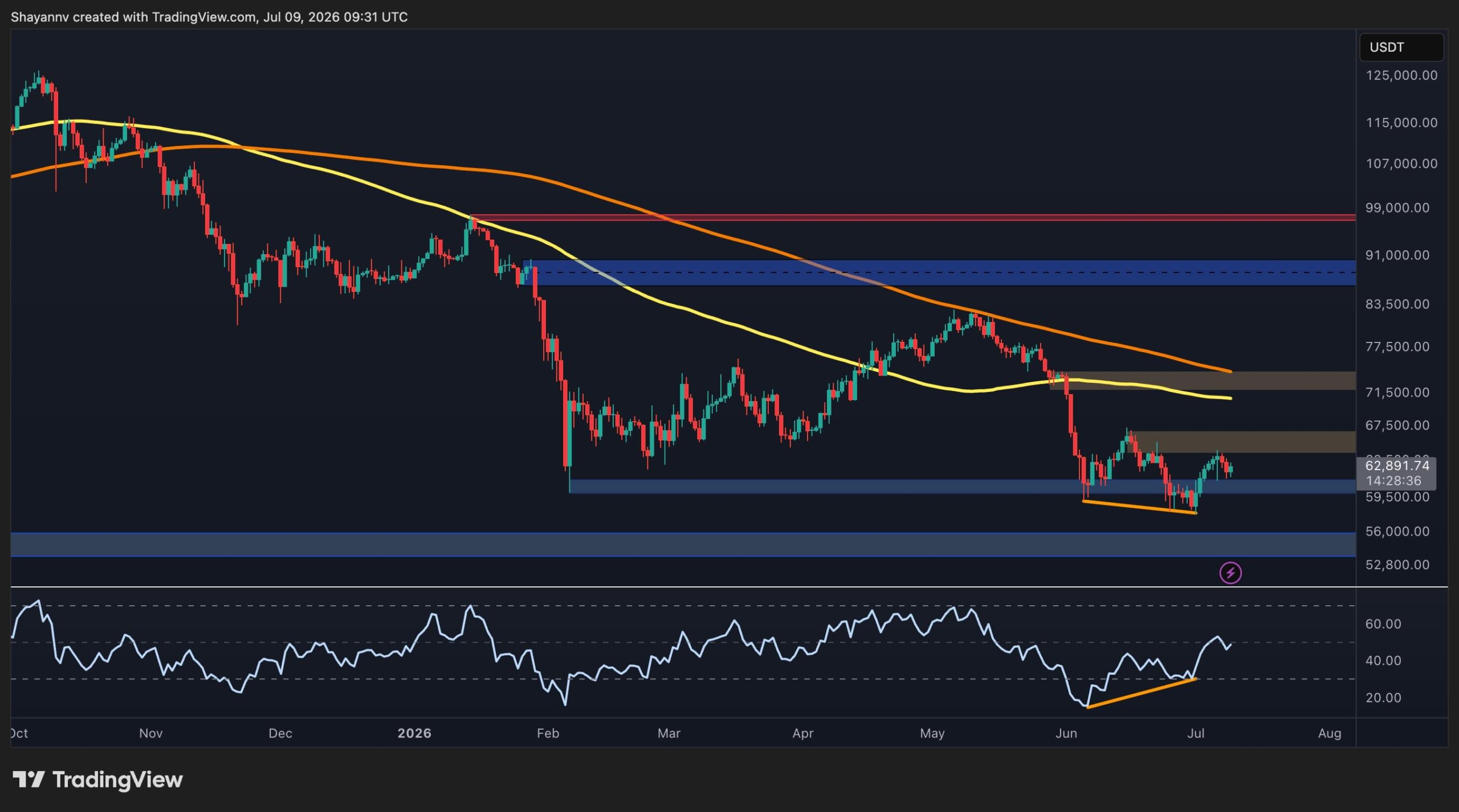
Bitcoin Price Analysis: Has BTC Cleared the Danger Zone After $64K Surge?

Bitcoin Price Analysis: Has BTC Cleared the Danger Zone After $64K Surge?

Despite showing signs of short-term stabilization above a major support zone, Bitcoin’s downtrend might not be over yet. While momentum has improved on lower timeframes
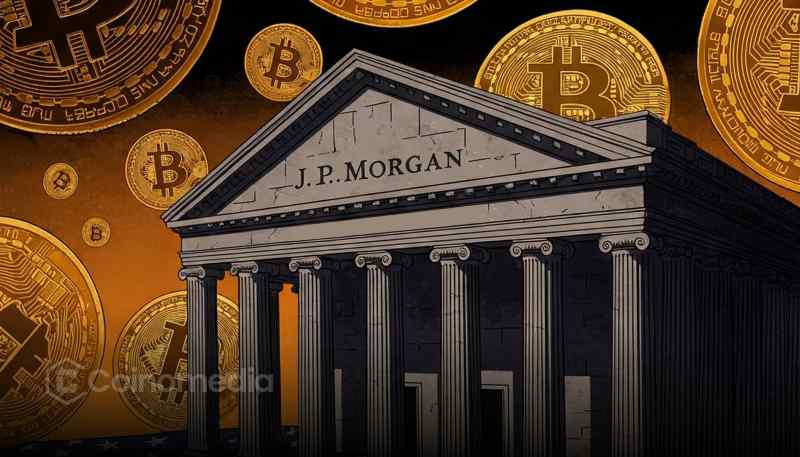
JPMorgan Says Bitcoin’s Bigger Risk Is Permissioned Blockchains

JPMorgan Says Bitcoin’s Bigger Risk Is Permissioned Blockchains

JPMorgan says Bitcoin's biggest long-term risk isn't Strategy selling BTC—it's the rise of permissioned blockchains that could bypass public chains and crypto
JPMorgan Warns: Private Bank Blockchains Threaten Bitcoin (BTC) More Than Strategy Sales

JPMorgan Warns: Private Bank Blockchains Threaten Bitcoin (BTC) More Than Strategy Sales

JPMorgan warns private blockchains adopted by banks present a more serious long-term threat to Bitcoin (BTC) than Strategy's selling program. The post JPMorgan

JPMorgan: Private Blockchains Pose Greater Risk to Bitcoin Than Strategy’s BTC Sales

JPMorgan: Private Blockchains Pose Greater Risk to Bitcoin Than Strategy’s BTC Sales

TLDR JPMorgan analysts say Strategy’s bitcoin sales are not the main structural risk to bitcoin The bigger threat is blockchain adoption that bypasses public networks

Related Articles

View More
Solana Price History: What the SOL Chart Shows and What It Leaves Out

Solana Price History: What the SOL Chart Shows and What It Leaves Out

Solana has two all-time highs, and they have almost nothing in common.The first, near $260 in November 2021, was driven by NFT and DeFi activity. The second, around $294 in January 2025, was driven by

What Does BTC Mean in Text? We Read All 56 Slang Entries. "Because They Can" Isn't One.

What Does BTC Mean in Text? We Read All 56 Slang Entries. "Because They Can" Isn't One.

Search "what does BTC mean in text" and the same answer comes back from site after site: "Because They Can."There is no record of anyone ever saying that.Two of them are the ones you'll actually hit i

Is Polkadot Dead? Polkadot Fixed Its Two Biggest Problems and DOT Fell Anyway

Is Polkadot Dead? Polkadot Fixed Its Two Biggest Problems and DOT Fell Anyway

Polkadot is not dead.Its governance still passes major reforms and delivers them on the date it promised, including a supply cap that ended five years of uncapped issuance.But the ecosystem built on t

How Many XRP Are There? Max Supply, Total Supply, Circulating Supply

How Many XRP Are There? Max Supply, Total Supply, Circulating Supply

How many XRP are there? There are exactly 100 billion — every one created in 2012, with no way to ever make more. More than 60 billion of those circulate today. The rest sits locked in on-ledger escro

Sign Up on MEXC
Sign Up & Receive Up to 10,000 USDT Bonus
Is Your Stablecoin Truly Safe?
Is Your Stablecoin Truly Safe?Is Your Stablecoin Truly Safe?
Know the risks of USDT, USDC, OpenUSD & USD1