XRP Ledger Gets AI Security Upgrade As Ripple Prepares For Bigger Growth
Ripple says it is overhauling how security is handled on the XRP Ledger, adding AI-assisted testing, a dedicated red team, stricter amendment review standards, and a broader push to modernize parts of the codebase. Notably, Ripple is explicitly tying XRPL’s next phase of security work to its ambitions in global payments, tokenized assets, and institutional financial infrastructure.
In its March 26 blog post, Ripple framed the initiative less as a narrow tooling upgrade and more as a structural shift in how XRPL is maintained. Senior Director of Engineering at RippleX Ayo Akinyele wrote that XRPL has been running since 2012 and, over that period, has processed more than 100 million ledgers, facilitated over 3 billion transactions, and secured billions in value transfer. That operating history, Ripple argued, is both a strength and a complication: a long-lived production codebase carries legacy assumptions, older design decisions, and engineering patterns that may no longer match the demands of a larger, more complex network.
The company’s core argument is that AI changes the security equation by making it easier to explore edge cases and hidden failure modes at scale. “AI allows us to shift from reactive debugging to proactive, systematic discovery of vulnerabilities, strengthening the ledger faster and with greater confidence than ever before,” Akinyele wrote. He added that for XRPL, resilience “must be continuous: not a one-time validation, but an ongoing process of hardening, testing and improving as XRPL evolves.”
Ripple broke the plan into several layers. It said AI is being integrated across the software development lifecycle through adversarial code scanning, AI-assisted reviews on every pull request, threat modeling, attack-surface mapping, and simulations of edge cases and stress scenarios that would be difficult to generate manually. The company also said it has established a dedicated AI-assisted red team focused on how XRPL features interact in real-world conditions, especially where legacy logic meets newer functionality.
That red-team effort is already producing findings, according to Ripple and developers involved in the initiative. In the blog post, Ripple said the team has uncovered “10+ bugs,” with only low-severity issues disclosed publicly so far and all findings being prioritized for fixes. In a separate X post, Mayukha Vadari said the effort had already been “incredibly fruitful,” adding that the team had found “a number of bugs across a range of severities.” She described the project as “exactly the kind of continuous, adversarial push XRPL needs as it continues to grow.”
Ripple is also using the moment to address broader code quality issues that sit above any single bug. The post says many problems in long-lived systems stem from structural weaknesses such as limited type safety, inconsistent feature interactions, weak invariant enforcement, and assumptions that are either undocumented or not enforced. The implication is that Ripple is not only trying to catch vulnerabilities earlier, but to reduce the conditions that allow classes of vulnerabilities to recur.
Another major part of the announcement is governance around amendments. Ripple said significant changes will face multiple independent security audits, expanded bug bounty incentives, more attackathons, and clearer readiness criteria before activation. It also said those criteria will be defined and published with the XRPL Foundation, signaling an attempt to formalize the security bar for network changes rather than evaluate them on a looser, case-by-case basis.
Notably, Ripple also highlighted that the next XRPL release will focus on bug fixes and improvements without introducing new features, a choice that suggests hardening the stack is taking priority over shipping more functionality. As XRPL pushes deeper into tokenized assets, payments, and institutional DeFi, Ripple is making the case that the next stage of growth depends less on novelty and more on whether the ledger can keep raising its reliability threshold in public.
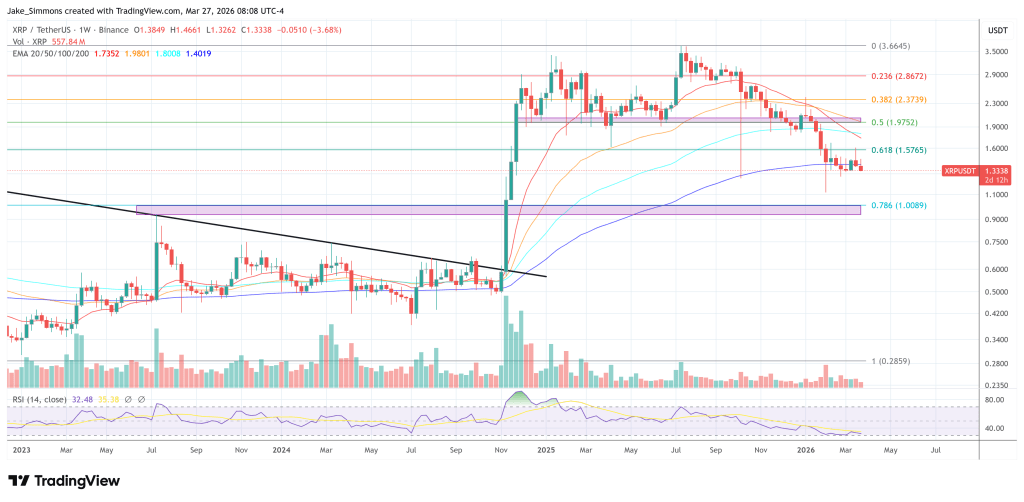
At press time, XRP traded at $1.33.
추천 콘텐츠

XRP Price Eyes April Rally: Will History Spark a Breakout?

BlockchainFX or Based Eggman $GGs Presale: Which 2025 Crypto Presale Is Traders’ Top Pick?