iLink Digital at FabCon: Moving Enterprise AI from Ambition to Execution The presence of iLink Digital at FabCon Atlanta 2026 reflects a decisive inflection pointiLink Digital at FabCon: Moving Enterprise AI from Ambition to Execution The presence of iLink Digital at FabCon Atlanta 2026 reflects a decisive inflection point

iLink Digital at FabCon Signals Shift to Real-Time AI Execution

2026/03/30 22:33
5 min read
For feedback or concerns regarding this content, please contact us at crypto.news@mexc.com

iLink Digital at FabCon: Moving Enterprise AI from Ambition to Execution

The presence of iLink Digital at FabCon Atlanta 2026 reflects a decisive inflection point in enterprise AI adoption. What was once framed as a long-term innovation agenda is now being repositioned as an immediate operational imperative. At a conference centered on Microsoft Fabric and next-generation data architectures, the emphasis was not on experimentation, but on execution—specifically, how to compress the journey from data to decision to action.

This shift matters because enterprises are no longer constrained by a lack of AI capability. Instead, they are constrained by their inability to operationalize it at scale, within acceptable timeframes.


The Changing Nature of Customer Expectations

Customer expectations have evolved from responsiveness to anticipation. Today’s customers expect enterprises to understand context, predict needs, and respond in real time across channels. This expectation does not limit to digital-native sectors—it is now pervasive across industries including banking, retail, healthcare, and telecom.

However, most enterprise systems remain architecturally misaligned with these expectations. Data has often fragment across multiple systems, analytics operate in delayed cycles, and decision-making still relies on human intervention.

The narrative emerging from iLink Digital at FabCon directly addresses this gap. By emphasizing real-time intelligence and unified data platforms, the company is aligning with a broader industry shift toward continuous, event-driven decisioning.


Strategic Positioning: From Capability to Execution

The strategic signal behind iLink Digital at FabCon is clear: repositioning from a technology services provider to an AI execution enabler. This is not a superficial branding shift—it reflects a deeper alignment with how enterprise demand is evolving.

As highlighted by Sree Balaji, Co-Founder & Group CEO, enterprises are no longer asking whether to adopt AI; they are asking how to deploy it effectively and immediately. This shift in demand creates an opportunity for providers that can bridge the gap between architecture and execution.

The emphasis on “days, not months” is particularly significant. It targets one of the most persistent barriers in enterprise transformation: prolonged implementation cycles that delay value realization.

This positioning is both offensive and transformational, enabling iLink to differentiate itself in a market where many players still focus on advisory or integration roles.


Technology Architecture: From Data to Autonomous Action

At the core of iLink Digital at FabCon is an architectural approach that integrates data platforms, semantic intelligence, and AI-driven execution into a cohesive system.

Traditionally, enterprises have treated these components as separate layers:

  • Data platforms for storage and processing
  • Analytics tools for insight generation
  • Operational systems for execution

This separation introduces latency and friction. Insights generate, but not acted upon in real time.

The architecture demonstrated at FabCon addresses this by creating a closed-loop system:

  1. Data is ingested and unified within Microsoft Fabric
  2. Semantic models provide contextual understanding
  3. Agentic AI systems execute decisions autonomously

This approach effectively transforms AI from an advisory tool into an operational engine.

The use of pre-built accelerators further reduces complexity, enabling enterprises to bypass lengthy development cycles and move directly into production environments.


CX Impact: Translating Architecture into Experience

The real significance of iLink Digital at FabCon lies in its implications for customer experience.

First, speed becomes a defining factor. Real-time data processing allows enterprises to respond instantly to customer actions, reducing wait times and improving satisfaction.

Second, contextual accuracy improves. Semantic AI enables systems to interpret intent, not just data points, resulting in more relevant and personalized interactions.

Third, proactive engagement becomes viable. Instead of reacting to customer issues, systems can anticipate and resolve them before they escalate.

These capabilities translate into measurable CX outcomes:

  • Reduced friction across customer journeys
  • Greater consistency across channels
  • Improved reliability in service delivery
  • Enhanced trust through predictable interactions

The shift is from reactive service models to autonomous, continuously optimizing experience systems.


Industry Implications: A Structural Transformation

The developments highlighted by iLink Digital at FabCon are indicative of a broader structural shift in enterprise technology.

The industry is moving away from fragmented, tool-based ecosystems toward integrated, platform-centric architectures. This shift is being driven by the need to align data, analytics, and execution within a single operational framework.

For competitors, this raises the bar significantly. Incremental improvements or isolated AI use cases will no longer be sufficient. Enterprises will increasingly demand solutions that deliver end-to-end transformation, from data integration to autonomous execution.

This also signals a transition in how value is measured. The focus is shifting from capability to outcomes, from potential to performance.
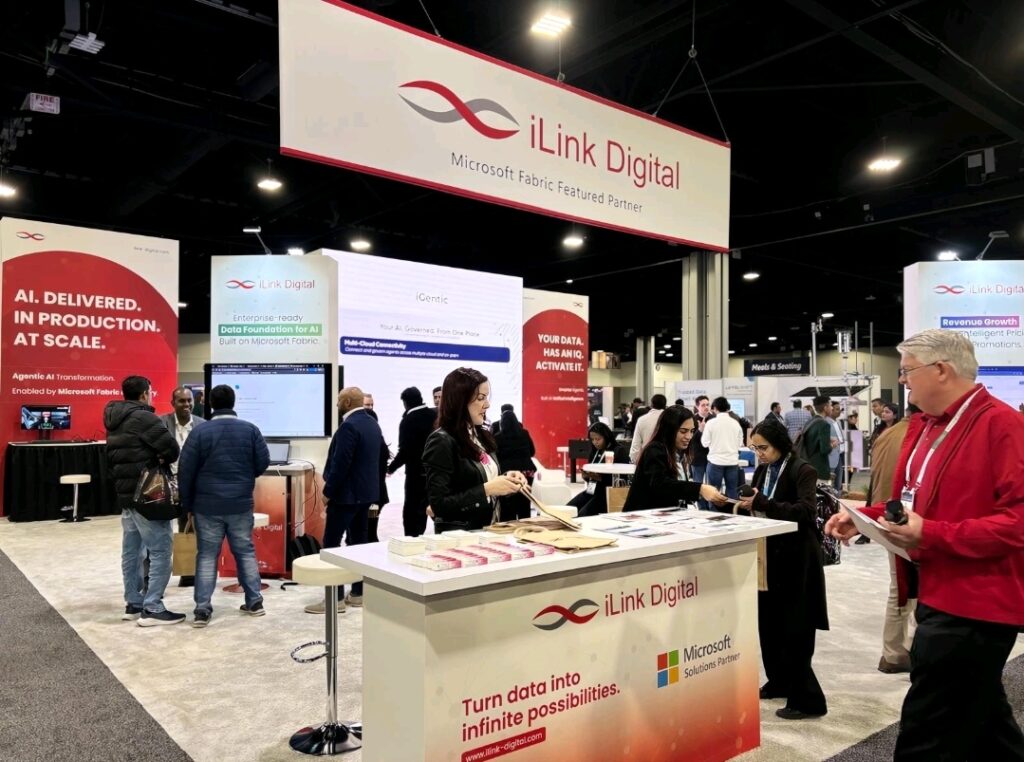

iLink Digital at FabCon Signals Shift to Real-Time AI Execution

Future Outlook: Toward Autonomous Enterprises

Looking ahead, the trajectory is clear. The convergence of unified data platforms, semantic intelligence, and agentic AI will lead to the emergence of autonomous enterprises—organizations capable of self-optimizing in real time.

The emphasis seen in iLink Digital at FabCon—particularly on ontology-driven architectures and AI execution layers—provides a blueprint for this evolution.

However, this transition will introduce new challenges. As systems become more autonomous, issues of governance, transparency, and accountability will become increasingly critical. CX leaders will need to ensure that automation enhances trust, rather than undermines it.

Ultimately, the organizations that succeed will be those that can integrate technology, strategy, and customer experience into a unified execution model—one where decisions are made and acted upon continuously.


🔷 KEY TAKEAWAYS

  • Execution is the new AI benchmark: Competitive advantage now depends on how quickly AI can be deployed and operationalized at scale.
  • Real-time data defines CX quality: Customer experience is increasingly determined by the speed and relevance of decision-making.
  • Semantic intelligence is critical: Context-aware AI systems enable more accurate, personalized, and effective customer interactions.
  • Agentic AI enables proactive CX: Autonomous systems shift service models from reactive problem-solving to anticipatory engagement.
  • Platform convergence is accelerating: Unified data and AI platforms are replacing fragmented architectures, enabling seamless execution.

The post iLink Digital at FabCon Signals Shift to Real-Time AI Execution appeared first on CX Quest.

Market Opportunity
Belong Logo
Belong Price(LONG)
$0.001559
$0.001559$0.001559
+0.32%
USD
Belong (LONG) Live Price Chart
Disclaimer: The articles reposted on this site are sourced from public platforms and are provided for informational purposes only. They do not necessarily reflect the views of MEXC. All rights remain with the original authors. If you believe any content infringes on third-party rights, please contact crypto.news@mexc.com for removal. MEXC makes no guarantees regarding the accuracy, completeness, or timeliness of the content and is not responsible for any actions taken based on the information provided. The content does not constitute financial, legal, or other professional advice, nor should it be considered a recommendation or endorsement by MEXC.
Tags:

You May Also Like

Why This New Trending Meme Coin Is Being Dubbed The New PEPE After Record Presale

Why This New Trending Meme Coin Is Being Dubbed The New PEPE After Record Presale

The post Why This New Trending Meme Coin Is Being Dubbed The New PEPE After Record Presale appeared on BitcoinEthereumNews.com. Crypto News 17 September 2025 | 20:13 The meme coin market is heating up once again as traders look for the next breakout token. While Shiba Inu (SHIB) continues to build its ecosystem and PEPE holds onto its viral roots, a new contender, Layer Brett (LBRETT), is gaining attention after raising more than $3.7 million in its presale. With a live staking system, fast-growing community, and real tech backing, some analysts are already calling it “the next PEPE.” Here’s the latest on the Shiba Inu price forecast, what’s going on with PEPE, and why Layer Brett is drawing in new investors fast. Shiba Inu price forecast: Ecosystem builds, but retail looks elsewhere Shiba Inu (SHIB) continues to develop its broader ecosystem with Shibarium, the project’s Layer 2 network built to improve speed and lower gas fees. While the community remains strong, the price hasn’t followed suit lately. SHIB is currently trading around $0.00001298, and while that’s a decent jump from its earlier lows, it still falls short of triggering any major excitement across the market. The project includes additional tokens like BONE and LEASH, and also has ongoing initiatives in DeFi and NFTs. However, even with all this development, many investors feel the hype that once surrounded SHIB has shifted elsewhere, particularly toward newer, more dynamic meme coins offering better entry points and incentives. PEPE: Can it rebound or is the momentum gone? PEPE saw a parabolic rise during the last meme coin surge, catching fire on social media and delivering massive short-term gains for early adopters. However, like most meme tokens driven largely by hype, it has since cooled off. PEPE is currently trading around $0.00001076, down significantly from its peak. While the token still enjoys a loyal community, analysts believe its best days may be behind it unless…
Share
BitcoinEthereumNews2025/09/18 02:50
USD/JPY Intervention: How Verbal Warnings Dramatically Slowed the Japanese Yen’s Slide

USD/JPY Intervention: How Verbal Warnings Dramatically Slowed the Japanese Yen’s Slide

BitcoinWorld USD/JPY Intervention: How Verbal Warnings Dramatically Slowed the Japanese Yen’s Slide TOKYO, March 2025 – Japanese authorities’ carefully calibrated

Share
bitcoinworld2026/03/30 23:25
USDH Power Struggle Ignites Stablecoin “Bidding Wars” Across DeFi: Bloomberg

USDH Power Struggle Ignites Stablecoin “Bidding Wars” Across DeFi: Bloomberg

A heated contest for control over a new dollar-pegged token has set the stage for what analysts say could define the next phase of the stablecoin industry. According to Bloomberg, a bidding war unfolded on Hyperliquid, one of crypto’s fastest-growing trading platforms, with the prize being the right to issue USDH, its native stablecoin. The competition drew some of the sector’s most prominent names, including Paxos, Sky, and Ethena, who later withdrew their bid, alongside the lesser-known Native Markets, a startup backed by Stripe stablecoin subsidiary Bridge. Hyperliquid Stablecoin Race Shows Branding and Partnerships Matter as Much as Tech Over the weekend, Hyperliquid’s validators, the contributors who secure the network and vote on key decisions, awarded the USDH contract to Native Markets over the weekend. Despite its relatively new status, the firm’s connection with Stripe helped it outpace more established rivals. Stablecoins underpin decentralized finance by providing a dollar-backed medium for collateral, settlement, and payments across applications. What began as a grassroots, community-led sector has evolved into a battleground for institutions and payment companies seeking revenue from interest on reserves. Circle, for example, shares proceeds from its USDC with Coinbase under a partnership designed to stabilize earnings during market swings. The Hyperliquid contest offered a rare glimpse into just how intense competition has become. Paxos pledged to take no revenue until USDH surpassed $1 billion in circulation. Agora offered to share 100% of net revenue with Hyperliquid, while Ethena put forward 95%. All were outbid by Native Markets, whose ties to Stripe’s $1.1 billion acquisition of Bridge and subsequent rollout of the Tempo blockchain positioned it as a strong contender. “Every stablecoin issuer is extremely desperate for supply,” said Zaheer Ebtikar, co-founder of Split Capital. “They are willing to publicly announce how much they are willing to offer. It just shows it’s a very tough business for stablecoin issuers.” While USDC remains dominant on Hyperliquid with more than $5.6 billion in deposits, the arrival of USDH could shift flows and revenue dynamics. Paxos co-founder Bhau Kotecha said the firm sees the exchange’s growth as an important opportunity, while Agora’s co-founder Nick van Eck warned that awarding the contract to a vertically integrated issuer risked undermining decentralization. Regulatory positioning also factored into the debate. Paxos operates under a New York trust charter and is seeking a federal license, while Bridge holds money transmitter approvals in 30 states. Native Markets, in a blog post, cited regulatory flexibility and deployment speed as reasons for its selection. Hyperliquid said the strong engagement from its community validated the process. Circle CEO Jeremy Allaire dismissed concerns over USDC’s status, noting on X that competition benefits the ecosystem. Analysts suggested that fears of centralization may be exaggerated, noting that Hyperliquid is likely to remain neutral and support multiple stablecoins. Still, the contest over USDH highlighted a new reality for stablecoins: branding, partnerships, and business strategy are becoming as decisive as technology. Native Markets Secures USDH Stablecoin Mandate on Hyperliquid Hyperliquid has concluded its governance vote for the USDH stablecoin, awarding the mandate to Native Markets after a closely watched process that drew weeks of community debate and rival proposals. USDH, described by Hyperliquid as a “Hyperliquid-first, compliant, and natively minted” dollar-backed token, is intended to reduce the platform’s dependence on USDC and strengthen its spot markets. Validators on the decentralized exchange voted in favor of Native Markets, a relatively new player backed by Stripe’s Bridge subsidiary, over established contenders including Paxos and Ethena. The outcome followed a string of proposals offering aggressive revenue-sharing terms to win validator support, underscoring the scale of incentives attached to controlling USDH. Hyperliquid’s exchange has become a critical hub for stablecoin liquidity, with $5.7 billion in USDC, around 8% of its total supply, currently held on the network. At prevailing treasury yields, that translates to an estimated $200 million to $220 million in annual revenue for Circle, underlining why a native alternative could be transformative. Hyperliquid’s validators, who secure the network and vote on key decisions, selected Native Markets following an on-chain governance process that concluded September 15. Native Markets has laid out a phased rollout for USDH, beginning with capped minting and redemption trials before expanding into spot markets. Its reserves will be managed in cash and treasuries by BlackRock, with on-chain tokenization through Superstate and Bridge. Yield from those reserves will be split between Hyperliquid’s Assistance Fund and ecosystem development. The launch of USDH comes as Hyperliquid records record profits from perpetual futures trading, with $106 million in revenue in August alone, and prepares to slash spot trading fees by 80% to bolster liquidity. Analysts say the move positions Hyperliquid to capture more of the stablecoin economics internally, marking a significant step in its bid to rival the largest players in decentralized finance
Share
CryptoNews2025/09/18 00:48