

Samsung’s Record Profit Can’t Stop KOSPI’s 5% Plunge Amid AI Stock Concerns
Key Takeaways
- South Korea’s benchmark KOSPI index plummeted 4.9%, activating circuit breakers for the sixth occasion in 2025
- Samsung projected a 19-fold surge in Q2 operating profit, yet its stock price declined nearly 7%
- Market experts suggest AI-related earnings projections have become unsustainably elevated
- Individual traders capitalized on the downturn, snapping up 3.2 trillion won worth of stocks
- SK Hynix unveiled a $28 billion American share offering, attracting preliminary investor attention
Tuesday proved turbulent for South Korea’s equity markets. The KOSPI benchmark concluded trading down 4.9%, settling at 7,656.31. During intraday trading, the index had plummeted more than 8%.
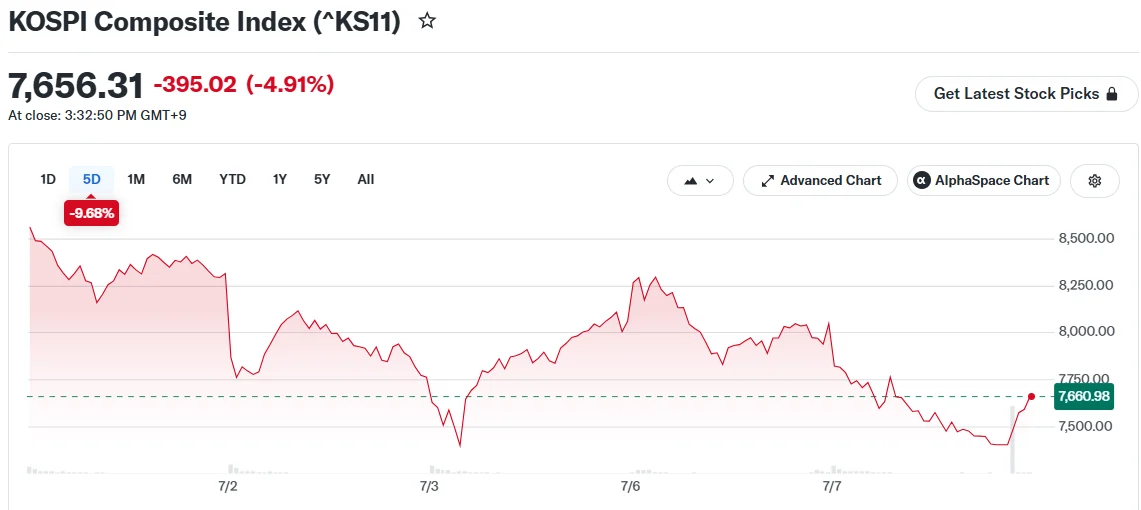 KOSPI Composite Index (^KS11)
Trading halts were activated through circuit breaker mechanisms. This marked the sixth such interruption in 2025 amid semiconductor stock turbulence.
Record Samsung Results Meet Market Skepticism
Samsung Electronics found itself in the eye of the storm. The tech giant projected second-quarter operating profit at 89.4 trillion won, approximately $58 billion. This represents a nineteen-fold expansion compared to last year’s corresponding quarter and marks its third consecutive record-breaking period.
Yet Samsung’s shares tumbled nearly 7% during the session. Intraday declines exceeded 10% at their worst.
Competitor SK Hynix declined 6.1%. Japan’s memory chip manufacturer Kioxia experienced losses surpassing 10%.
The KOSPI had more than doubled year-to-date before reaching an all-time peak in late June. Since that milestone, approximately 20% has evaporated.
Changing Dynamics in AI Investment Sentiment
The market’s response indicates a transformation in investor attitudes toward artificial intelligence stocks. Throughout recent months, semiconductor companies enjoyed rewards merely for exceeding earnings projections. That pattern now appears to be evolving.
Albert Yong from Petra Capital Management suggested the sharp decline reflects investor attention shifting toward the memory cycle’s long-term trajectory rather than immediate quarterly results.
International investors offloaded 2.9 trillion won in Korean equities Tuesday. Domestic retail traders countered by purchasing 3.2 trillion won, moderating the index’s early steep losses.
AI Investment Activity Continues Despite Volatility
Not every development suggested retreat from artificial intelligence exposure. SK Hynix initiated an American share issuance targeting approximately $28 billion, generating initial enthusiasm from significant institutional investors.
Broadcom extended its semiconductor supply agreement with Apple through 2031, alleviating worries that Apple might internalize additional chip production.
Wall Street advanced overnight. The Dow increased 0.29%, the S&P 500 rose 0.72%, and the Nasdaq gained 1.12%, buoyed by optimism surrounding AI-powered earnings performance.
Additional Market Developments
LG Energy Solution fell 6.4% following its projection of a 77% operating profit decline attributed to softening electric vehicle demand.
Hanwha Ocean crashed 22.7% after Canada selected German submarines over South Korean alternatives.
Crude oil prices advanced following a tanker incident near the Strait of Hormuz. US crude climbed to $68.92 while Brent reached $72.34.
Investors remain attentive to the upcoming Federal Reserve meeting minutes release, the inaugural publication under new Fed Chair Kevin Warsh.
The post Samsung’s Record Profit Can’t Stop KOSPI’s 5% Plunge Amid AI Stock Concerns appeared first on Blockonomi.


You May Also Like

Ethereum News: Vitalik Puzzle Solved, ETH UTXOs and Bitmine Updates

Cango Inc. Completes $65M Investment and Secures $10M Convertible Note Financing

New SummerFi DeFi exploit shows AI automation now sits above smart contract risk



