The post SBI VC Trade Adds Litecoin to Japanese Lending Program appeared on BitcoinEthereumNews.com. SBI VC Trade added Litecoin to its regulated lending programThe post SBI VC Trade Adds Litecoin to Japanese Lending Program appeared on BitcoinEthereumNews.com. SBI VC Trade added Litecoin to its regulated lending program

SBI VC Trade Adds Litecoin to Japanese Lending Program

3 min read
  • SBI VC Trade added Litecoin to its regulated lending program for Japanese users. 
  • LTC holders can earn yield through fixed-term lending on a fully FSA-licensed exchange.
  • LTC price sits near long-term support, eyeing a breakout of the broader market rallies.

SBI VC Trade, the crypto exchange arm of Japan’s SBI Holdings, has added Litecoin to its lending service. Applications opened on January 29, 2026, at 8:00 p.m. JST under the platform’s “Lending Coin” program.

Notably, Japanese users can now lend LTC and earn interest directly through a fully licensed domestic exchange.

The service is available only to verified users in Japan. Repayment is made in LTC, including earned fees. Early termination is not allowed, and any hard forks during the lending period do not result in additional token payouts.

How the Lending Program Works

SBI VC Trade operates under Japan’s Financial Services Agency and offers spot trading, staking, and lending. The lending program supports more than 30 cryptocurrencies, including BTC, ETH, XRP, LTC, BCH, DOT, LINK, ADA, DOGE, and SHIB.

Assets are lent for fixed terms, typically between 7 and 28 days. Interest is calculated using a fixed formula based on the amount lent, the annual rate, and the lending period.

Annual rates vary by asset and term and can reach up to 20% for certain offerings. Lending income is treated as miscellaneous income under Japanese tax law.

Litecoin launched in 2011 as a faster payment-focused network with lower fees than Bitcoin. As of February 3, LTC trades near $59, with a market capitalization of about $4.57 billion and daily volume around $462 million.

LTC Price Structure on the Weekly Chart

LTC trades near the $58 to $60 zone after failing to hold above $90 earlier in the cycle. The weekly chart shows price moving back into a long-term demand area between $50 and $55. This zone has acted as support multiple times since 2022.

Momentum indicators are weak but stabilizing. RSI sits below the midpoint, and the next resistance sits near $80, followed by a broader supply zone between $110 and $135, where price was rejected in 2024 and 2025.

If the $50 support holds, LTC could attempt a rebound toward $80. A weekly close above that level would open room toward $110 and $135. In a stronger market cycle, extension targets stretch toward $190, $236, and $260.

The bearish case remains a breakdown below $50. That would expose downside toward $42 and then $35. However, a move into those levels would signal broader market weakness rather than a Litecoin-specific failure.

Related: Litecoin’s 2027 Halving Is Coming: What History Says About LTC Price Moves

Disclaimer: The information presented in this article is for informational and educational purposes only. The article does not constitute financial advice or advice of any kind. Coin Edition is not responsible for any losses incurred as a result of the utilization of content, products, or services mentioned. Readers are advised to exercise caution before taking any action related to the company.

Source: https://coinedition.com/sbi-vc-trade-adds-litecoin-to-japanese-lending-program/

Disclaimer: The articles reposted on this site are sourced from public platforms and are provided for informational purposes only. They do not necessarily reflect the views of MEXC. All rights remain with the original authors. If you believe any content infringes on third-party rights, please contact service@support.mexc.com for removal. MEXC makes no guarantees regarding the accuracy, completeness, or timeliness of the content and is not responsible for any actions taken based on the information provided. The content does not constitute financial, legal, or other professional advice, nor should it be considered a recommendation or endorsement by MEXC.

You May Also Like

Victra Named 2025 Recipient of Verizon’s Best Build Compliance Award

Victra Named 2025 Recipient of Verizon’s Best Build Compliance Award

Verizon Recognizes Victra for Industry-Leading Excellence in Store Design and Brand Compliance. RALEIGH, N.C., Feb. 3, 2026 /PRNewswire/ — Verizon has named Victra
Share
AI Journal2026/02/03 20:49
Stablecoins could face yield compression after Fed’s rate cut

Stablecoins could face yield compression after Fed’s rate cut

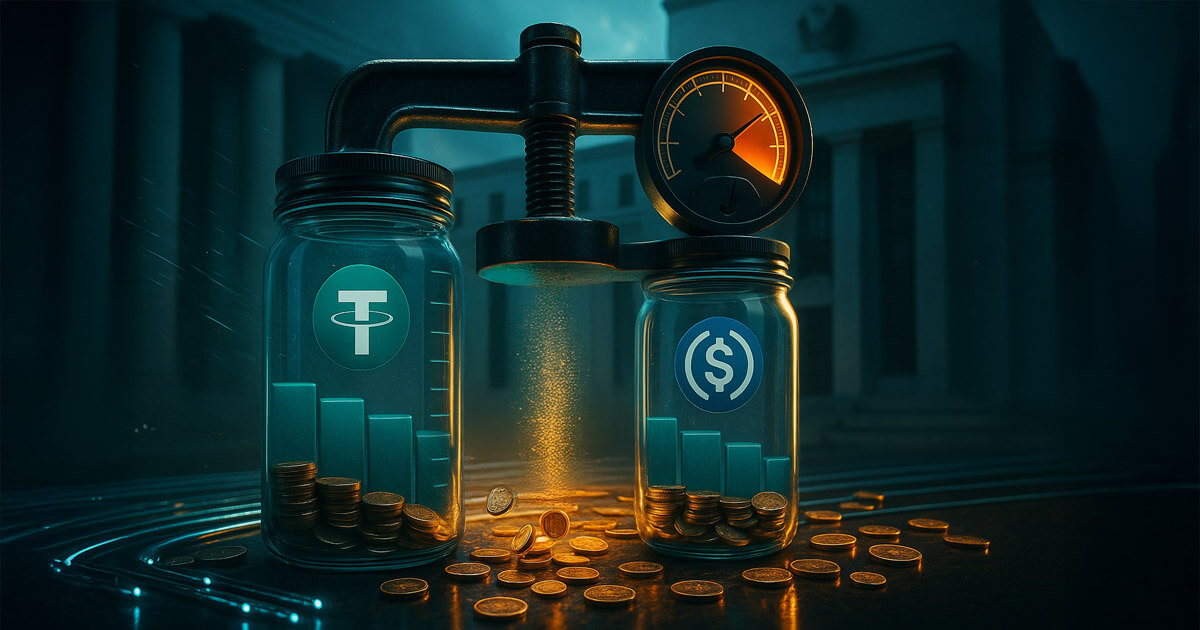
The post Stablecoins could face yield compression after Fed’s rate cut appeared on BitcoinEthereumNews.com. The Federal Reserve reduced its policy rate by 25 basis points to 4.00%–4.25%, the first rate cut this year. The move, framed as a response to weakening labor data, signals the start of a cautious easing cycle. Projections show two more cuts possible before year-end, with further reductions likely in 2026. Inflation remains above target, but Chairman Jerome Powell emphasized risk management over immediate price control, prioritizing stability in employment conditions. Stablecoins will be quickly affected by this. Issuers like Tether and Circle have generated large profits by holding reserves in short-term Treasuries during the high-rate environment of the past two years. That income stream now begins to erode. DeFi protocols that offered tokenized Treasury exposure face the same squeeze, with returns set to fall further if the Fed continues cutting into next year. A multi-cut easing cycle could substantially reduce stablecoin profitability, forcing issuers and protocols to adapt. The decline in dollar yields also alters the balance between holding stablecoins passively and seeking higher returns in risk assets. Bitcoin benefits most from this reallocation. As nominal rates move lower and inflation remains sticky, real yields decline, making non-yielding assets more attractive. The weaker dollar and improving risk appetite amplify the effect, positioning Bitcoin as a relative winner of the Fed’s shift. The September cut is modest, but it could bring significant changes to the crypto market. Stablecoin models built on Treasury income face structural headwinds after the rate cut, while Bitcoin and other high-beta assets stand to gain from falling real yields and increased liquidity. The Fed has opened an easing cycle, and crypto’s internal capital flows will move with it. The post Stablecoins could face yield compression after Fed’s rate cut appeared first on CryptoSlate. Source: https://cryptoslate.com/insights/stablecoins-could-face-yield-compression-after-feds-rate-cut/
Share
BitcoinEthereumNews2025/09/18 19:31
Wormhole Jumps 11% on Revised Tokenomics and Reserve Initiative

Wormhole Jumps 11% on Revised Tokenomics and Reserve Initiative

The post Wormhole Jumps 11% on Revised Tokenomics and Reserve Initiative appeared on BitcoinEthereumNews.com. Cross-chain bridge Wormhole plans to launch a reserve funded by both on-chain and off-chain revenues. Wormhole, a cross-chain bridge connecting over 40 blockchain networks, unveiled a tokenomics overhaul on Wednesday, hinting at updated staking incentives, a strategic reserve for the W token, and a smoother unlock schedule. The price of W jumped 11% on the news to $0.096, though the token is still down 92% since its debut in April 2024. W Chart In a blog post, Wormhole said it’s planning to set up a “Wormhole Reserve” that will accumulate on-chain and off-chain revenues “to support the growth of the Wormhole ecosystem.” The protocol also said it plans to target a 4% base yield for governance stakers, replacing the current variable APY system, noting that “yield will come from a combination of the existing token supply and protocol revenues.” It’s unclear whether Wormhole will draw from the reserve to fund this target. Wormhole did not immediately respond to The Defiant’s request for comment. Wormhole emphasized that the maximum supply of 10 billion W tokens will remain the same, while large annual token unlocks will be replaced by a bi-weekly distribution beginning Oct. 3 to eliminate “moments of concentrated market pressure.” Data from CoinGecko shows there are over 4.7 billion W tokens in circulation, meaning that more than half the supply is yet to be unlocked, with portions of that supply to be released over the next 4.5 years. Source: https://thedefiant.io/news/defi/wormhole-jumps-11-on-revised-tokenomics-and-reserve-initiative
Share
BitcoinEthereumNews2025/09/18 01:31