

Trump to Pick Kevin Warsh as Next Fed Chair: Report
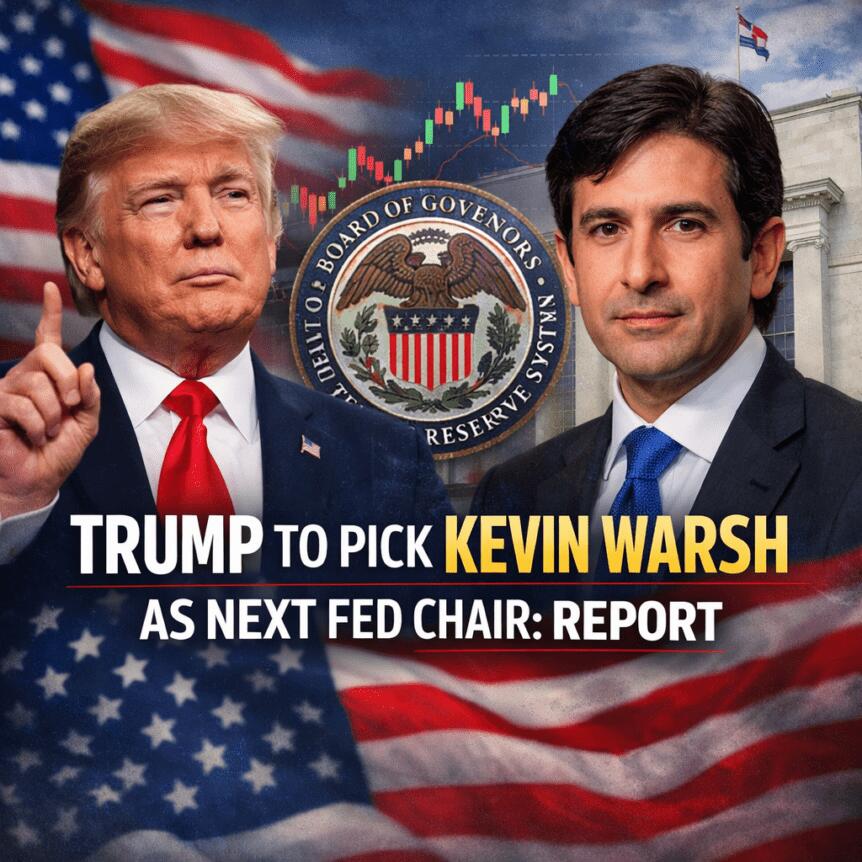
US President Donald Trump is poised to nominate Bitcoin-friendly Kevin Warsh as the next chair of the Federal Reserve, according to reports circulating ahead of an official Friday announcement. The White House is set to nominate a successor to Jerome Powell, whose term as chair ends in May. Warsh’s background includes a stint as a Fed governor from 2006 to 2011, a period during which he developed a reputation for rigorous monetary thinking. Multiple outlets, including Bloomberg, The Wall Street Journal, and The New York Times, have cited imminent action and described Warsh as the leading candidate. Reuters also noted that Warsh met with Trump on Thursday, and the discussion appeared to leave a strong impression on the president. The broader market reaction has reflected the unusual political attention on the Fed chair race, with prediction markets showing shifting bets as the nomination nears.
Warsh’s potential nomination has already sparked debates about the balance of hawkish policy and financial innovation. Prediction markets such as Polymarket had shown Warsh’s odds climbing from about 30% to as high as 95% after the discussions, while the former frontrunner, BlackRock’s Rick Rieder, faded to roughly 3.4% in some gauges. Kalshi’s market also tracked strong odds in Warsh’s favor, signaling a unified market view that the former Fed governor would steer policy toward greater restraint and a recalibration away from expansive asset purchases. The implications extend beyond monetary policy alone, prompting investors and policymakers to weigh how a Warsh-led Fed might interact with growing mainstream interest in digital assets and the digital economy.
Bitcoin and the broader crypto narrative have featured prominently in the discourse around Warsh. Warsh has been described as notably more Bitcoin-friendly than Powell, who has tended to emphasize traditional macro levers over the cryptocurrency’s role in the economy. In a notable past interview with the Hoover Institution, Warsh described Bitcoin as having a potential governance utility: not a threat to monetary policy, but a market signal that can inform policymakers about the economy’s health and the efficacy of policy tools. He was quoted as saying, “Bitcoin doesn’t trouble me. I think of it as an important asset that can help inform policymakers when they’re doing things right and wrong,” and he added that it could serve as a “policeman for policy.”
Markets have also watched how the nomination process could affect policy direction on inflation, balance sheet normalization, and the pace of rate moves. The headline sentiment focuses on a potential pivot toward fiscal restraint and a more cautious stance on quantitative easing, a shift that some analysts see as aligning with a stronger emphasis on price stability and debt management. The immediate market response to the nomination chatter has included a rise in the U.S. dollar index and higher Treasury yields, as traders reassess risk premia and the likely trajectory of interest-rate policy in a Warsh-led era. These moves underscore how sensitive Fed leadership transitions can be to risk sentiment, liquidity, and the cost of capital, all of which feed into crypto markets as well as traditional assets.
Bitcoin can police policymakers: Warsh
Warsh’s nuanced view of Bitcoin has been a focal point for crypto watchers. He has framed BTC as a potentially constructive element in the policy dialogue, rather than a shadowy disruptor, suggesting that digital assets could function as a disciplining mechanism for policy missteps. He has argued that the cryptocurrency ecosystem can offer signals about market expectations and the effectiveness of policy steps. In the broader context, BTC is often discussed as a test case for how regulatory and macro developments intersect with financial innovation. This perspective contrasts with some earlier commentary from Fed officials who some say have dismissed the asset’s relevance to the U.S. economy. Warsh’s stance, if implemented as policy, could influence how the Fed communicates with markets about risk, inflation, and stability in a digital-age financial system.
As discussions around the nomination progressed, the dialogue extended into how a Hawkish Fed chair might affect liquidity conditions, the appetite for riskier assets, and the pace at which policymakers would consider tapering asset purchases. The evolving discourse emphasizes that the Fed’s policy signal—whether from a Warsh-led framework or another nominee—will likely shape the incentives for crypto markets, including volatility patterns and hedging behavior. The stakes extend to institutional investors who watch the Fed’s guidance on inflation expectations and the credibility of the central bank’s mandate to maintain price stability while supporting sustainable growth.
Market chatter around the nomination also touched on the broader regulatory conversation that has intensified in recent years. The push and pull between monetary policy and financial innovation remains a central theme for crypto stakeholders, with regulators seeking to balance investor protection, market integrity, and the expansion of legitimate digital-asset activities. In this context, a Fed chair who acknowledges the reality of digital assets without demonizing them could influence the tempo of policy communications, the framing of regulatory proposals, and the tempo of any future policy actions that could affect crypto liquidity, funding costs, and the broader risk landscape.
The narrative surrounding Warsh’s nomination has thus become a microcosm of the ongoing debate about how traditional financial architecture and crypto markets will co-evolve. If Warsh ascends to the chair, observers will be watching not only for his stance on inflation, unemployment, and growth but also for how his administration addresses the role of digital assets in the financial system. The balance between safeguarding financial stability and fostering innovation could define a new era for both monetary policy and the digital asset economy.
The Wednesday-to-Friday arc of reporting, market bets, and policy expectations illustrates how intertwined federal policy and crypto dynamics have become. As investors await Friday’s formal nomination, the narrative continues to evolve around whether Bitcoin and other digital assets will be treated more as market signals, store-of-value considerations, or potential regulatory targets. The next steps—the nomination’s formal announcement, potential confirmation considerations, and subsequent policy communications—will shape not only the Fed’s credibility but also the broader macro environment in which digital assets operate.
What to watch next
- Friday nomination announcement and formal U.S. Senate confirmation process for Warsh as Fed chair.
- Any policy statements or congressional testimonies outlining Warsh’s approach to inflation, balance-sheet normalization, and asset purchases.
- Market reactions in the wake of the nomination, including changes in the U.S. dollar, Treasury yields, and crypto liquidity conditions.
- Subsequent commentary on Bitcoin’s role in policy discussions and the central bank’s communications strategy under a Warsh-led framework.
- Developments in capital markets that influence risk sentiment, ETF flows, and institutional exposure to digital assets.
Sources & verification
- Bloomberg: coverage on the nomination timeline and Friday announcement expectations. https://www.bloomberg.com/news/articles/2026-01-30/trump-administration-prepares-for-warsh-fed-chair-nomination
- The Wall Street Journal: reporting on Trump’s Friday announcement plan. https://www.wsj.com/economy/central-banking/trump-to-announce-fed-chair-pick-on-friday-11d4b8c9
- The New York Times: article about Warsh potentially becoming Fed chair. https://www.nytimes.com/2026/01/29/business/trump-expected-to-announce-kevin-warsh-as-fed-chair.html
- Reuters: reportage on Warsh meeting with Trump. https://www.reuters.com/world/us/former-fed-governor-warsh-met-with-trump-thursday-2026-01-30/
- Polymarket: odds on Warsh nomination. https://polymarket.com/event/who-will-trump-nominate-as-fed-chair
- Kalshi: odds on Warsh nomination. https://kalshi.com/markets/kxfedchairnom/fed-chair-nominee/kxfedchairnom-29
- Hoover Institution interview excerpts referencing Warsh’s view on Bitcoin as a policy signal.
- Cointelegraph references used for context on Bitcoin’s policy discourse (for background visualization, not directly quoted). https://cointelegraph.com/news/bitcoin-price-fails-follow-gold-hits-5-3k-record-high
Market context
Market context: The nomination dynamics arrive amid a broader backdrop of macro volatility, liquidity management by central banks, and evolving regulatory attention on digital assets. As investors weigh the implications of a potentially hawkish Fed leadership, crypto markets monitor how policy signals could influence risk appetite, funding costs, and the overall risk-off or risk-on sentiment that shapes liquidity in digital-asset markets.
Why it matters
The potential appointment of Kevin Warsh as chair would place a Fed leader with a track record of rigorous monetary analysis at the helm during a period when inflation dynamics and the trajectory of quantitative easing remain of central concern. His perceived Bitcoin-friendly stance could affect how the central bank communicates about digital assets, potentially influencing investor expectations and the regulatory dialogue surrounding crypto markets. For traders and developers in the crypto space, a Warsh-led administration could recalibrate the balance between price stability goals and the pace at which the Fed considers experimenting with or tapering asset purchases, all of which reverberates through risk premia and liquidity across digital markets.
From a policy perspective, Warsh’s approach might prioritize market discipline and transparency, potentially aligning with calls for clearer regulatory guardrails on digital-asset issuance and trading. The existence of a policymaker who acknowledges Bitcoin’s informational value without endorsing it as a monetary policy tool could shift the tone of official commentary, setting expectations for how the Fed handles policy communication in a rapidly evolving financial ecosystem. In practical terms, crypto traders could see shifts in the supportive or adverse factors that influence Bitcoin and other assets, including the cost of capital, hedging activities, and cross-asset correlations during periods of quantitative tightening or inflation surprises.
For the crypto industry, the stakes are not solely about price moves. They include the degree to which central-bank rhetoric acknowledges the role of digital assets in market structure, risk transfer mechanisms, and the broader acceptance of crypto as part of a diverse financial system. While no policy moves are guaranteed until official confirmations, the trajectory of Warsh’s leadership would likely influence the tone of regulatory proposals, market surveillance measures, and the ongoing dialogue about how digital assets should be integrated into mainstream financial infrastructure.
What to watch next
- Friday nomination announcement and any subsequent statements outlining Warsh’s policy priorities.
- Confirmation hearings and committee deliberations that detail his stance on inflation, balance-sheet normalization, and crypto regulation.
- Market reactions in the days following the announcement, particularly in the U.S. dollar index, Treasury yields, and crypto liquidity.
- Any policy communications that specify a timeline for tapering asset purchases or adjusting quantitative easing programs.
Tickers mentioned: $BTC
Sentiment: Neutral
Price impact: Negative. A stronger dollar and higher yields tied to expectations of a hawkish Fed could weigh on risk assets, including Bitcoin.
This article was originally published as Trump to Pick Kevin Warsh as Next Fed Chair: Report on Crypto Breaking News – your trusted source for crypto news, Bitcoin news, and blockchain updates.
You May Also Like

Shiba Inu to Encrypt All Transactions by Q2 2026 as Privacy Era Takes Hold
The Economics of Self-Isolation: A Game-Theoretic Analysis of Contagion in a Free Economy
