

Pet Insurance Industry Statistics 2026: Growth, Costs, and Coverage
In recent years, pets have truly become family members, with owners willing to go to great lengths to protect their health. From regular check-ups to emergency procedures, veterinary expenses have risen dramatically, mirroring the growth of healthcare costs for humans. As a result, pet insurance has gained popularity as a financial safety net for unexpected veterinary bills, giving pet owners peace of mind and allowing them to prioritize their pets’ well-being without financial hesitation.
But what does the current landscape of pet insurance look like, and where is it headed today? This article dives into key statistics and trends to paint a comprehensive picture of the pet insurance industry.
Editor’s Choice
- North America and Europe together account for roughly 70–75% of global pet insurance premium volume as of the mid‑2020s
- Accident and illness policies remain dominant, representing about 80%+ of active pet insurance policies worldwide.
- Dogs make up roughly 80% of insured pets versus around 20% for cats in key reported markets.
- U.S. pet insurance penetration is estimated at around 3.9% of all dogs and cats, with dog penetration near 5.46% and cat penetration about 2.04%.
- As of early 2026, average monthly accident and illness premiums in the U.S. are about $43 for dogs and $23 for cats.
Recent Developments
- 21% of U.S. employers now offer pet insurance as an employee benefit, up from 19% in 2025 and 16% in 2022.
- Insurers piloting blockchain in health and pet insurance reduce fraud losses by up to 33% and cut claim handling time by 42%.
- The AI in animal health market will reach $2.06 billion in 2026, growing at a 19.5% CAGR as analytics tools expand.
- Major retailers like Amazon and Walmart now reach tens of millions of pet owners through bundled pet services and insurance-linked offerings.
- Leading insurers are expanding vet-direct pay options, allowing pet owners to pay only deductibles and copays at participating clinics.
- The global pet wellness services market reached about $53.8 billion in 2025 and is expected to approach $60–65 billion by 2026 as preventive care demand grows.
Global Pet Healthcare Market Growth
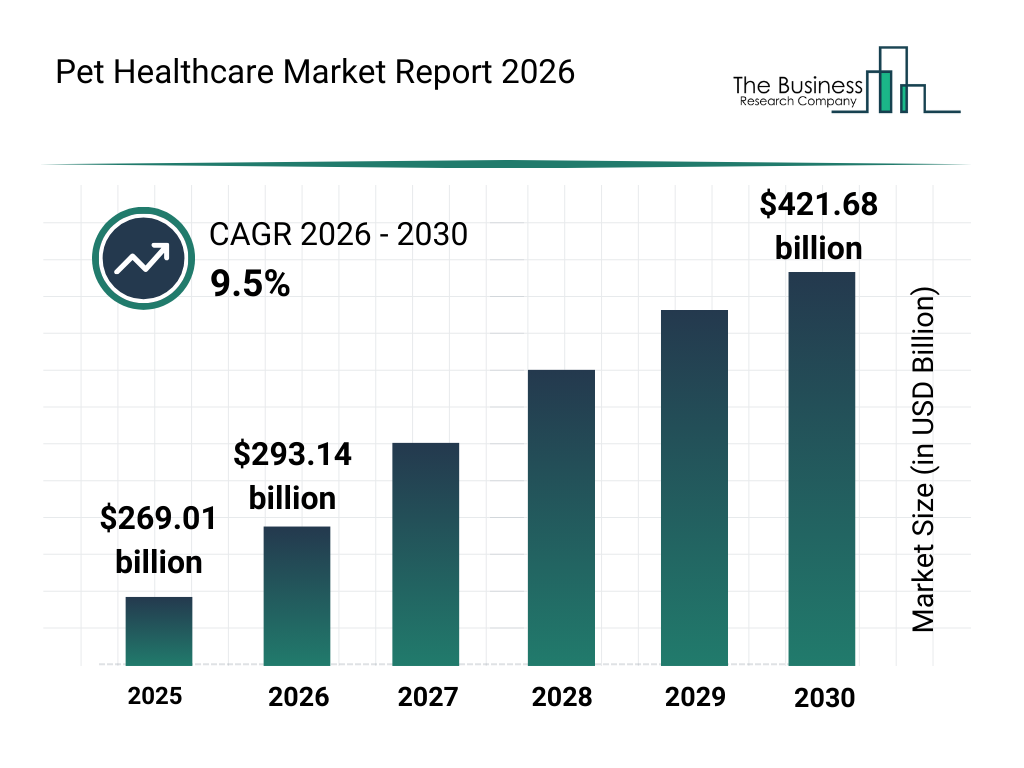
- The global pet healthcare market will grow to $293.14 billion in 2026, reflecting strong demand for improved pet medical treatment and insurance coverage.
- Rising pet ownership and veterinary costs will drive the market to $320.99 billion by 2027.
- Increasing investment in preventive care and advanced treatments will expand the market to $351.48 billion in 2028.
- Growth in pet insurance and digital veterinary services will push the market to about $384.87 billion in 2029.
- The global pet healthcare market will reach $421.68 billion by 2030, highlighting rapid industry expansion.
- Overall, the market will grow at a 9.5% CAGR between 2026 and 2030, indicating steady long-term growth.
 (Reference: The Business Research Company)
Regional Insights
- North America holds over 40% of global pet insurance revenue and dominates with 58.4% incremental growth.
- Asia-Pacific pet insurance market worth $11.41 billion in 2026, growing at 17.82% CAGR to $25.94 billion by 2031.
- Latin America pet insurance market projected to reach $1.27 billion by 2030 at 16.4% CAGR, led by Brazil.
- Middle East and Africa pet insurance market is valued at $405.67 million in 2024, reaching $801.54 million by 2030 at 12% CAGR.
- Sweden maintains a high adoption near 90%, while the UK pet insurance penetration stands at 25–30%.
- Urban areas show 12.6% insurance coverage vs 1.5% in rural China.
Most Common Causes of Death in Cats and Dogs
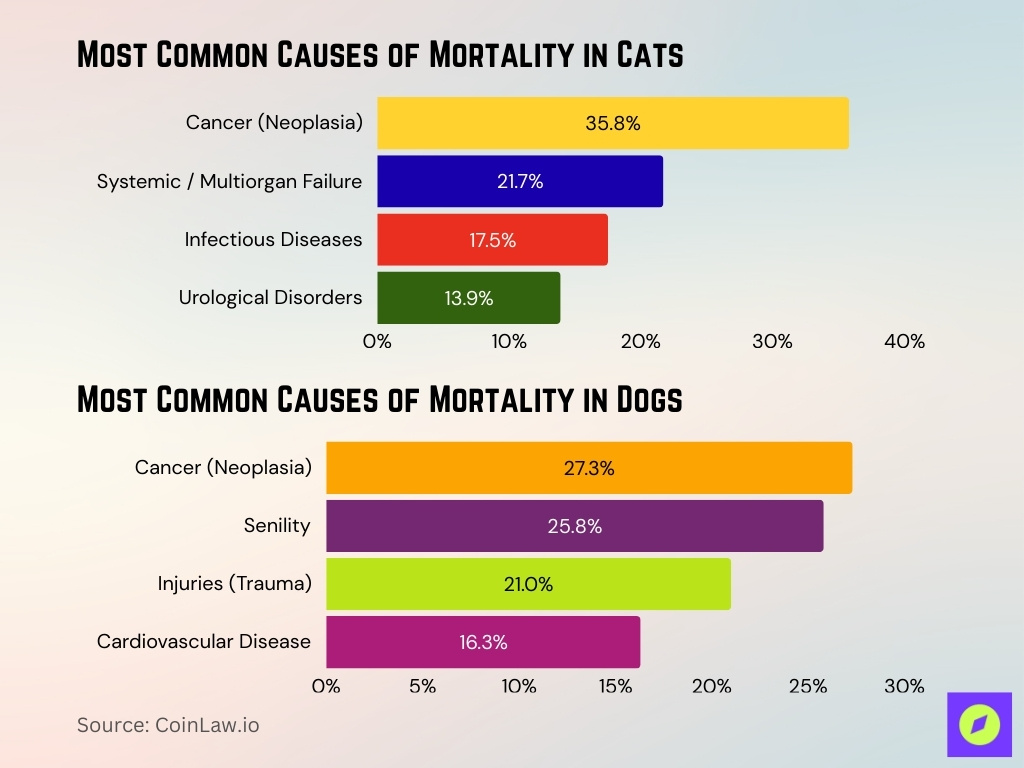
- Cancer (neoplasia) is the leading cause of death in cats, responsible for 35.8% of reported cases. This makes cancer the most serious health threat for cats.
- Systemic or multiorgan failure accounts for 21.7% of cat deaths, making it the second most common cause of mortality in cats.
- Infectious diseases contribute to about 17.5% of deaths in cats, showing the ongoing impact of viruses and bacterial infections.
- Urological disorders, including urinary tract and kidney issues, cause 13.9% of cat deaths, highlighting the importance of early diagnosis and treatment.
- In dogs, cancer (neoplasia) is also the top cause of death, responsible for 27.3% of cases.
- Senility, which refers to age-related decline, causes 25.8% of dog deaths, making it the second most common cause.
- Injuries or trauma account for 21% of deaths in dogs, showing the risks from accidents and physical harm.
- Cardiovascular disease contributes to 16.3% of dog deaths, reflecting the role of heart-related health issues in aging pets.
 (Reference: Feather)
Animal Insights
- In the U.S., dogs account for 80.1% of insured pets, while cats make up 19.9%.
- Average monthly premiums are $43 for dogs and $23 for cats as of March 2026.
- Annual premiums average $516 for dogs and $276 for cats.
- Policies for non-native pets like birds, reptiles, and small mammals remain under 1% of the total pet insurance market.
- Horse insurance market is valued at $0.92 billion globally.
- Senior pet plans for dogs 8+ show premiums rising to $1,145–$1,255/year for 12-year-olds in top Australian-style policies.
- Genetic testing integration in dog policies aids breed-specific risk prediction, with mixed breeds comprising 16.6% of insured populations.
Coverage Insights
- Accident-only coverage averages around $16 per month for dogs and $9 per month for cats.
- Accident and illness plans average around $43 per month for dogs and $23 per month for cats in the U.S.
- Wellness add-ons are available from major providers like Spot at $25/month with up to $450 annual limits.
- Hereditary and congenital coverage is now standard in expanded plans from insurers like Pets Best, available in 29 states with limits up to $20,000 annually.
- Behavioral therapy coverage is included in comprehensive policies from providers like Embrace and Figo as part of alternative therapies.
- Alternative therapies like acupuncture and hydrotherapy are covered in 30%+ of comprehensive plans from Embrace, Figo, and HealthyPaws.
Most Popular Pets in U.S. Households
- 67.8 million U.S. households own dogs, making them the most popular pets.
- 48.2 million households own cats, placing them second in popularity.
- 11.5 million households keep freshwater fish, ranking them third.
- 7.1 million households own small animals such as hamsters, rabbits, and guinea pigs.
- 6.3 million households own birds.
- 6.4 million households keep reptiles.
- 2.5 million households own horses.
- 2.4 million households also keep saltwater fish.
Why Dog Owners Avoid Buying Pet Insurance
- 42% of dog owners say pet insurance is too expensive, the biggest barrier.
- 19% believe they don’t need it.
- 89% of dog owners overestimate insurance cost, with 76% overestimating by at least 3x.
- 41.6% of cat and dog owners cite high cost as a reason for no insurance.
- 8% don’t know why they haven’t got a policy.
- 36% of pet owners lack insurance amid rising costs.
- Many assume premiums are too expensive or claims are complicated, due to market challenges.
Sales Channel Insights
- Direct sales channels account for 42.3% of the global pet insurance market.
- Direct sales dominate due to digital adoption, with leading insurers leveraging online platforms for instant policy issuance.
- Veterinary clinics see 10%+ of patients insured, with 1 in 5 vets reporting over 10% insured patients.
- In-store promotions via retailers like Petco and PetSmart are expanding through partnerships with Healthy Paws and Spot.
- Employer benefits programs have reached 64% of companies offering pet insurance.
- Social media and influencer campaigns drive engagement, with influencers needing 10,000+ followers for major expos.
- Mobile apps and digital platforms contribute significantly, with 55.34% of APAC new policies via direct-to-consumer online routes.
- Intermediated channels hold 48.66% market share globally.
Industry Trends
- About 30% of pet insurance policies include virtual vet consultations as telemedicine adoption grows.
- The global pet wearable market is projected to reach $4.72 billion in 2026.
- Pet owners demand customized plans for breeds, ages, and health conditions with flexible coverage options.
- Preventive care features like dental cleanings, vaccines, and flea/tick protection are standard in wellness add-ons up to $450 annually.
- AI-powered claims automation reduces processing times drastically through NLP and image recognition validation.
- Digital platforms enable faster reimbursements with AI handling partial claims processing accurately.
- Providers adopt paperless billing, digital records, and email invoices to reduce environmental impact.
Pet Ownership by Generation
- Millennials comprise 33% of pet owners, the largest share.
- Gen Z accounts for 20% of pet-owning households.
- Generation X makes up 25% of pet owners.
- Baby Boomers represent 24–27% of the pet-owning population.
- 70% of Gen Z pet owners have two or more pets.
- Gen Z leads pet insurance adoption at 32%, insuring all pets, and Millennials at 36%.
- 52% more Gen Z are likely to choose eco-friendly pet insurance options.
Pet Ownership by Type of Pet
- Dogs make up 80–82% of insured pets in the U.S.
- Cats account for 18–20% of insured pets in the U.S.
- Non-native pets like birds, reptiles, and small mammals remain under 1% of the market.
- North America’s pet insurance premiums exceed $5.2 billion, with equine as a niche segment.
- Rabbits lead small insured non-natives, with premiums around $39/month for Holland Lops.
- Fish insurance is a niche, focused on high-value aquarium species with minimal market share.
Frequently Asked Questions (FAQs)
Trupanion leads with over 12% market share, and the top 5 hold 40% collectively.
Policy owners submit an average of 3.07 claims per policy.
North America accounts for over 58% of incremental growth in the pet insurance market.
Dog accident and illness policies average $43/month, while cat policies average $23/month.
Conclusion
As pets become integral parts of households, pet insurance continues to evolve to meet the changing needs of pet owners. The industry is marked by growth, innovation, and an increased focus on digital solutions that cater to younger, tech-savvy pet owners. The adoption of pet insurance is expected to keep rising as veterinary costs increase and pet owners prioritize financial security for their furry family members.
With the introduction of flexible, comprehensive policies and new technologies like telemedicine, wearable health devices, and AI-driven claims processing, the pet insurance industry is well-positioned for future growth. Ultimately, pet insurance not only helps protect pets but also offers peace of mind to owners, allowing them to focus on providing the best possible care.
The post Pet Insurance Industry Statistics 2026: Growth, Costs, and Coverage appeared first on CoinLaw.
You May Also Like

Whales Withdraw $15M in TRUMP Tokens From Binance

Vitalik Buterin Unveils What He Did With 500 Trillion SHIB Donated by Ryoshi in 2021
