

👨🏿🚀TechCabal Daily – Monie moves to Kenya
TGIF. 
One useless piece of information I am now burdened to share with you for no real reason: octopuses have three hearts and, under stress, one of them literally stops beating.
Take that as your cue. Once you’re done working today, let your laptop be the one that flatlines: close it, log off, and give your own heart a proper weekend rest.
—Emmanuel
- Quick Fire
 with Ashley Immanuel
 - Moniepoint acquires majority stake in Sumac
- Quidax cuts jobs
- Who secured the bag?

- World Wide Web 3
- Events
features
Quick Fire with Ashley Immanuel
 Image: Ashley Immanuel, COO, Semicolon.
Ashley Immanuel is the co-founder and Chief Operating Officer (COO) of Semicolon, a company that is enabling Africa’s digital transformation by building tech-focused talent and businesses. Immanuel coordinates Semicolon’s delivery of innovative solutions related to education, talent management, digital advisory/implementation services, and venture-building.
Immanuel started her career in management consulting with IBM Global Business Services. Before joining Semicolon, she was chief executive officer of EFInA (Enhancing Financial Innovation & Access), an organisation that drives inclusive finance in Nigeria through research, advocacy, capacity building, and innovation.
- Explain what you do to a 5-year-old.
Semicolon builds technology solutions, which are things like the apps on your parents’ phones. We also teach people how to build these tech solutions, and we help companies hire and train people.
- What does a bad tech training programme look like in practice, and what separates one that produces employable talent from one that doesn’t?
A “bad” tech training programme does not deliver on its stated outcomes. Often the curriculum and delivery is too shallow short-term to really deliver results. We also see some programmes that purport to be designed for job-readiness but are significantly misaligned with industry needs.
To use a medical industry metaphor, if the healthcare industry said they needed more doctors and nurses, the answer wouldn’t be to quickly train a million people in cardiopulmonary resuscitation (CPR) and taking vitals. Yes, those skills are useful, but the hospitals would still need the doctors.
I think the training misalignment is often driven by market pressure to reduce costs. Many people are looking for opportunities, but don’t have the money to pay for in-depth, high-quality education.
- When companies say “there’s a talent gap,” where is the gap actually coming from: training, expectations, or the companies themselves?
The gap comes from significant and longstanding under-investment in human capital. Building human capital starts long before people start thinking about job applications or career-specific training.
In fact, it even starts before birth: adequate nutrition in the first 1,000 days of a child’s life, starting from conception, sets the stage for cognitive capacity. We need to ultimately build systems that support health, education and holistic development of our future talent from day one.
- What is deeply lacking in Africa’s edtech sector today, and what steps are you taking to bridge it?
To some extent, I think what is lacking in Africa’s edtech sector is Africa’s edtech sector. What I mean by that is that I wonder if we even have sufficient activity and coordination to merit the label of “sector.”
Some committed people are doing very interesting work to drive learning outcomes, but there are too many unaddressed gaps. I would love to see more people really tackling tough education challenges in deep, committed, and innovative ways.
Fincra is now licenced in Canada.

Fincra has secured a PSP licence in Canada, adding a regulated connection between Africa and one of the world’s most trusted financial systems. See what this means for your business.
companies
Moniepoint enters Kenya with Sumac acquisition
 Image Source:Tenor
Moniepoint, a Nigerian fintech unicorn, has acquired a 78% majority stake in Sumac Microfinance Bank, a tier-3 Kenyan lender, giving the Visa-backed fintech a foothold to launch its credit product in East Africa’s largest economy.
What is Moniepoint inheriting? Sumac operates across seven branches in Kenya, offering loans, insurance financing, deposits, and foreign exchange conversion services to its customers. The lender has KES 1.05 billion ($8.1 million) in assets and 43,800 active loan accounts, accounting for 2.8% of the country’s microfinance market.
It’s been a long time coming: Moniepoint has been eyeing Kenya since 2023, as it showed interest in Kopo Kopo, a Kenyan payment service company. However, the registration and licencing of fintech startups have been on hold since the Central Bank of Kenya (CBK) introduced the National Payment Systems Act of 2011.
Moniepoint tried to do what many companies do to bypass licence applications in entering new markets: an acquisition.
While the unicorn payments company received approval from the Competition Authority of Kenya (CA) to acquire Kopo Kopo in 2023, that deal ultimately stalled. Refusing to be bogged down by the stalled deal, Moniepoint went hunting and eventually found Sumac, which matched the scale and setup it needed for its credit-first play. In 2025, the Competition Authority of Kenya (CAK) approved the Sumac deal.
What comes next: In March 2026, Moniepoint acquired the Nigerian operations of Orda, a restaurant management infrastructure provider that also operates in Kenya. That acquisition will allow Moniepoint to see, in real-time, how restaurant food-chain businesses run their operations end-to-end. The Orda leverage (pun intended) will also enable the fintech payments company to mine data of these businesses and layer lending as a product to clients.
Kenya is also Moniepoint’s first African expansion; Sumac’s reach and the velocity of the banking-aware population of Kenya could be key levers for doing business in the country. With competitors, it’ll be a game of speed (if Moniepoint chooses to introduce some of that technology) or ticket size (credit); none of which the likes of Safaricom-owned M-PESA lacks, for example. Yet, it’s an interesting match-up for the ages.
Companies
Quidax cuts jobs amid push into B2B products
 Image Source: Tenor
Quidax, a Nigerian crypto startup, has axed the jobs of several staff across marketing and sales, operations, and design.
On March 2, several (now former) employees woke up to the reality that they no longer worked at the company, with some of them expressing the shock that came with the announcement.
This kind of cut is not random. Marketing and design are usually the first to go when a startup decides that selling to a lot of individual users is no longer worth the burn. Operations, too, start to look bloated if the business is shifting (or deepening its play) from chasing thousands of retail customers to servicing a handful of corporate ones.
That is the direction a few African crypto startups are now facing: away from splashy consumer products and toward business-to-business (B2B), where revenues are more predictable. While Quidax is not leaving its retail business, it has long shown signs of moving towards enterprise crypto products.
Broadly, B2B also fits the current climate. Enablers and investors are asking tougher questions about profitability and engineering it. Startups, which have to answer, are finding ways to make it predictable. Several fintech startups layer on infrastructure products that they can sell to banks, payment companies, and other startups. For a crypto business, that infrastructure looks like liquidity, custody, white-label wallets, compliance, and on-ramp (fiat to crypto) and off-ramp (crypto to fiat) rails.
While job cuts are always a messy situation for everyone involved, it’s sadly a necessary feature of capitalism. Quidax has also told its employees that it is not under any financial pressure, and simply wants to run a clean ship. Its next few moves will inevitably tell where the company’s strategy is taking it next.
Insights
Funding Tracker
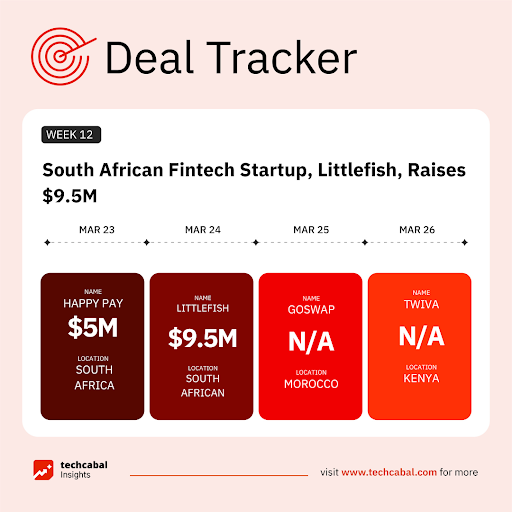 Image Source: Imgflip/TechCabal
Littlefish, a South African fintech startup, secured $9.5 million in a Series A round from Partech. (Mar 24)
Here are the other deals for the week:
- Happy Pay, a South African fintech startup, raised $5 million in seed funding. The round was led by Partech, with participation from Futuregrowth Asset Management, 4Di Capital, E4E Africa, Equitable Ventures, and Felix Strategic Investments. (Mar 23)
- GoSwap, a Moroccan e-mobility startup, raised an undisclosed amount in funding from Azur Innovation Fund. (Mar 25)
- Twiva, a Kenyan social commerce startup, raised an undisclosed amount of funding from Jobtech Alliance. (Mar 26)
Follow us on Twitter, Instagram, and LinkedIn for more funding announcements. Before you go, discover why investment in African climate tech reached a record $1.18B in 2025
CRYPTO TRACKER
The World Wide Web3
Source:

|
Coin Name |
Current Value |
Day |
Month |
|---|---|---|---|
| Bitcoin | $68,584 |
– 3.89% |
+ 6.91% |
| Ether | $2,059 |
– 5.04% |
+ 11.10% |
| BNB | $628 |
– 2.92% |
+ 7.61% |
| Solana | $86.35 |
– 5.96% |
+ 9.02% |
* Data as of 06.05 AM WAT, March 27, 2026.
Events
 The voices shaping Africa’s digital future are taking the stage. From AI and IoT to cloud, connectivity and smart infrastructure, IOT West Africa | Data Centre & Cloud Expo Africa 2026 brings together the leaders building the continent’s next digital chapter. This is where the ecosystem meets, and we’ll see you there. The event kicks off on April 28–30 at the Landmark Centre, Victoria Island, Lagos. Register here to attend.
- All roads lead to Nairobi on 7 May 7, 2026. Senior leaders from across Africa’s fintech and payments ecosystem will gather for a day of meaningful connections, market insights, and cross-border collaboration. With less than two months to go, the focus of the Africa Fintech Live event is on driving real engagement, bringing together industry leaders, and emerging innovators to spark strategic conversations that will shape the future of finance on the continent. Secure your early bird ticket now at 50% off.
- Delve into AI: Why being polite to AI might be hurting your results
- Stablecoin issuers in Kenya face $3.85 million minimum capital under new draft rules
- Scale partners with Mastercard to simplify card issuance across five African markets
Written by: Emmanuel Nwosu and Opeyemi Kareem
Edited by: Emmanuel Nwosu
Want more of TechCabal?
Sign up for our insightful newsletters on the business and economy of tech in Africa.
- The Next Wave: futuristic analysis of the business of tech in Africa.
- Francophone Weekly by TechCabal: insider insights and analysis of Francophone’s tech ecosystem
P:S If you’re often missing TC Daily in your inbox, check your Promotions folder and move any edition of TC Daily from “Promotions” to your “Main” or “Primary” folder and TC Daily will always come to you.

You May Also Like

Won-pegged stablecoin KRW1 launches in South Korea on Avalanche

WOW Activities Centre Emerges as Bintan’s Premier Family Destination


