The post Why BitDelta’s Winter WonderTrade Stands Out appeared on BitcoinEthereumNews.com. Crypto Projects As the crypto market widens in scope and participationThe post Why BitDelta’s Winter WonderTrade Stands Out appeared on BitcoinEthereumNews.com. Crypto Projects As the crypto market widens in scope and participation

Why BitDelta’s Winter WonderTrade Stands Out

Crypto Projects

As the crypto market widens in scope and participation, exchanges are increasingly turning to seasonal campaigns to engage traders globally.

The closing of the year, particularly December 2025, spotlights how these promotions have evolved into more structured and transparent initiatives. Year-end trading campaigns have supported significant volume increases, and BitDelta’s Winter WonderTrade Festival serves as one of the clear examples of how this model is being refined for today’s market.

The timing mirrors a well-established pattern in market behavior. The end of the year brings a heightened market interest from the holiday period and routine portfolio adjustments by the traders. What distinguishes this year’s campaign is their focus on accessibility, with a motive to involve a wider range of traders rather than a select few.

A $1 Million Trading Festival, $250,000 Weekly

The Winter WonderTrade Festival on BitDelta runs across four weeks in December, featuring a $1 million USDT prize pool distributed throughout the month. Each week, the platform rewards 50 traders with $250,000 allocated per weekly cycle. This out-of-the-box structure sets BitDelta apart from traditional seasonal campaigns run by other exchanges.

The weekly reset mechanism further differentiates the campaign by ensuring that the traders who miss earlier weeks or join later in the month are not excluded from winning the reward. Instead, participants can enter at any stage trade in high volatility tokens, leverage up to and compete on equal footing in the ongoing weekly cycle.

Eligibility for the campaign is set at a relatively modest level, requiring a $100 deposit and $75,000 in weekly derivatives trading with leverage of up to 100x. These thresholds widen participation beyond institution-sized traders. The rankings are displayed through a live volume-based leaderboard offering a degree of transparency rarely seen in similar competitions.

The Backbone of a Competitive Trading Campaign

Strong infrastructure is what separates effective seasonal campaigns from surface-level promotions. BitDelta’s cross-platform reliability ensures traders can monitor standing and place trades seamlessly across mobile, desktop, and web. With volume-based rankings updating instantly, even minor execution delays can impact competitiveness.

Equally important is usability. A smooth, intuitive interface allows traders to follow weekly volume check rankings and refine strategies without friction. Over four weeks of continuous participation, this level of design clarity helps maintain focus and engagement.

The Lucky Draw Gaining Attention

Alongside its weekly leaderboard rewards, BitDelta is also offering a $50,000 Lucky Draw scheduled for January 1, 2026. Unlike volume-ranking contests that tend to favour high frequency or professional traders, this draw opens the door to a wider group of participants.

Any trader who meets the basic deposit and trading requirements is automatically entered, with 50 winners selected at random. By distributing $1,000 to each winner, the campaign ensures that participation, not just top performance, has a real chance of being rewarded.

Why Seasonal Campaigns Work

The shift toward seasonal campaigns reflects broader changes in crypto trader behaviour. Rather than one-off promotions that spike activity briefly, extended festivals encourage sustained platform engagement. Traders develop familiarity with derivatives offerings, explore different trading pairs, and build patterns that often continue beyond the campaign period.

The weekly reset structure specifically targets the psychological challenges of month-long competitions. Traditional formats can demoralize participants who fall behind early; weekly cycles maintain momentum and provide fresh starts. This design choice acknowledges that engagement sustainability matters more than generating a single week of extreme volume.

Join the Competition

As exchanges compete for trader attention in 2025’s final month, campaign design has become a key differentiator. BitDelta’s Winter WonderTrade demonstrates that successful seasonal promotions balance accessibility with meaningful rewards, supported by platform infrastructure that makes sustained participation viable rather than exhausting.

The four-week festival is up and running through December, with registration and participation open to both existing users and new sign-ups. Whether the model proves successful enough to become the template for 2026 campaigns remains to be seen, but the emphasis on weekly opportunities and dual reward pathways suggests the industry is moving away from winner-takes-all structures toward broader engagement strategies.

Join the Bitdelta competition today


This publication is sponsored and written by a third party. Coindoo does not endorse or assume responsibility for the content, accuracy, quality, advertising, products, or any other materials on this page. Readers are encouraged to conduct their own research before engaging in any cryptocurrency-related actions. Coindoo will not be liable, directly or indirectly, for any damages or losses resulting from the use of or reliance on any content, goods, or services mentioned.

Author

Krasimir Rusev is a journalist with many years of experience in covering cryptocurrencies and financial markets. He specializes in analysis, news, and forecasts for digital assets, providing readers with in-depth and reliable information on the latest market trends. His expertise and professionalism make him a valuable source of information for investors, traders, and anyone who follows the dynamics of the crypto world.

Next article

Source: https://coindoo.com/the-rise-of-seasonal-trading-campaigns-why-bitdeltas-winter-wondertrade-stands-out/
Market Opportunity
WHY Logo
WHY Price(WHY)
$0,00000001515
$0,00000001515$0,00000001515
0,00%
USD
WHY (WHY) Live Price Chart
Disclaimer: The articles reposted on this site are sourced from public platforms and are provided for informational purposes only. They do not necessarily reflect the views of MEXC. All rights remain with the original authors. If you believe any content infringes on third-party rights, please contact service@support.mexc.com for removal. MEXC makes no guarantees regarding the accuracy, completeness, or timeliness of the content and is not responsible for any actions taken based on the information provided. The content does not constitute financial, legal, or other professional advice, nor should it be considered a recommendation or endorsement by MEXC.

You May Also Like

Building a DEXScreener Clone: A Step-by-Step Guide

Building a DEXScreener Clone: A Step-by-Step Guide

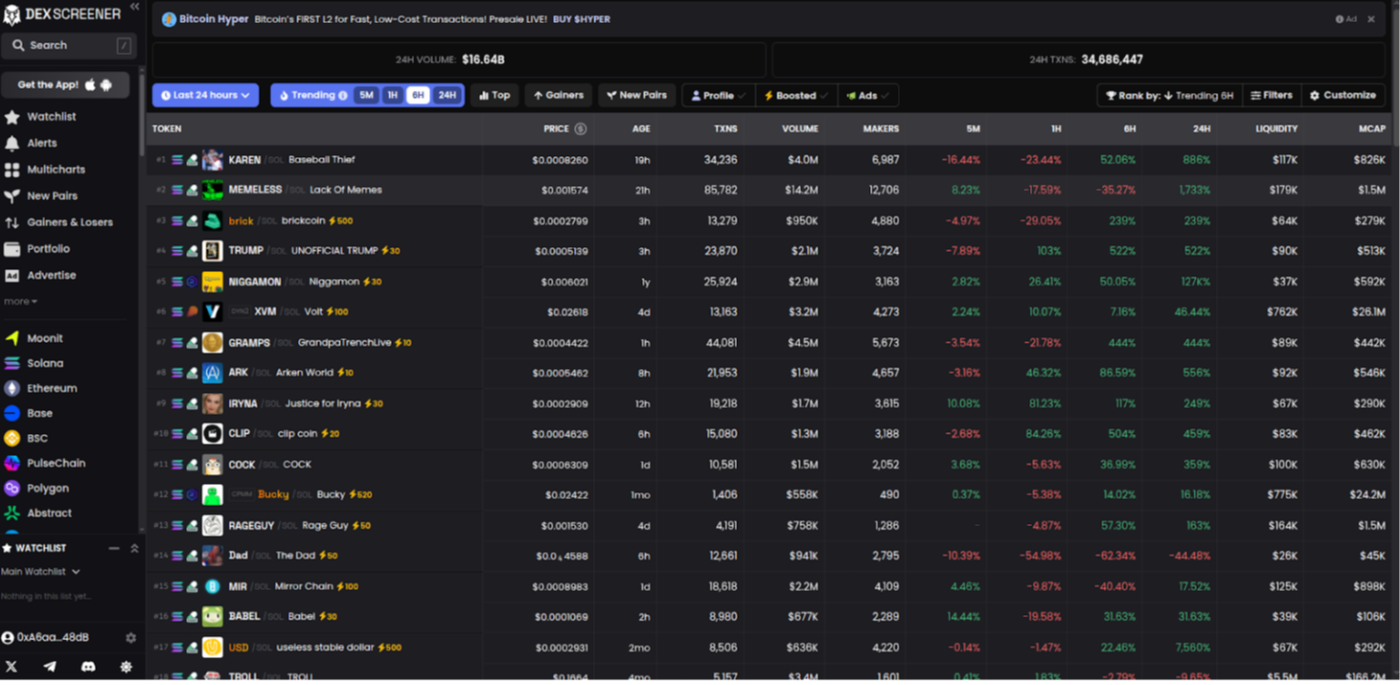
DEX Screener is used by crypto traders who need access to on-chain data like trading volumes, liquidity, and token prices. This information allows them to analyze trends, monitor new listings, and make informed investment decisions. In this tutorial, I will build a DEXScreener clone from scratch, covering everything from the initial design to a functional app. We will use Streamlit, a Python framework for building full-stack apps.
Share
Hackernoon2025/09/18 15:05
Which DOGE? Musk's Cryptic Post Explodes Confusion

Which DOGE? Musk's Cryptic Post Explodes Confusion

A viral chart documenting a sharp decline in U.S. federal employment during President Trump's second term has sparked unexpected confusion in cryptocurrency markets
Share
Coinstats2025/12/20 01:13
Google's AP2 protocol has been released. Does encrypted AI still have a chance?

Google's AP2 protocol has been released. Does encrypted AI still have a chance?

Following the MCP and A2A protocols, the AI Agent market has seen another blockbuster arrival: the Agent Payments Protocol (AP2), developed by Google. This will clearly further enhance AI Agents' autonomous multi-tasking capabilities, but the unfortunate reality is that it has little to do with web3AI. Let's take a closer look: What problem does AP2 solve? Simply put, the MCP protocol is like a universal hook, enabling AI agents to connect to various external tools and data sources; A2A is a team collaboration communication protocol that allows multiple AI agents to cooperate with each other to complete complex tasks; AP2 completes the last piece of the puzzle - payment capability. In other words, MCP opens up connectivity, A2A promotes collaboration efficiency, and AP2 achieves value exchange. The arrival of AP2 truly injects "soul" into the autonomous collaboration and task execution of Multi-Agents. Imagine AI Agents connecting Qunar, Meituan, and Didi to complete the booking of flights, hotels, and car rentals, but then getting stuck at the point of "self-payment." What's the point of all that multitasking? So, remember this: AP2 is an extension of MCP+A2A, solving the last mile problem of AI Agent automated execution. What are the technical highlights of AP2? The core innovation of AP2 is the Mandates mechanism, which is divided into real-time authorization mode and delegated authorization mode. Real-time authorization is easy to understand. The AI Agent finds the product and shows it to you. The operation can only be performed after the user signs. Delegated authorization requires the user to set rules in advance, such as only buying the iPhone 17 when the price drops to 5,000. The AI Agent monitors the trigger conditions and executes automatically. The implementation logic is cryptographically signed using Verifiable Credentials (VCs). Users can set complex commission conditions, including price ranges, time limits, and payment method priorities, forming a tamper-proof digital contract. Once signed, the AI Agent executes according to the conditions, with VCs ensuring auditability and security at every step. Of particular note is the "A2A x402" extension, a technical component developed by Google specifically for crypto payments, developed in collaboration with Coinbase and the Ethereum Foundation. This extension enables AI Agents to seamlessly process stablecoins, ETH, and other blockchain assets, supporting native payment scenarios within the Web3 ecosystem. What kind of imagination space can AP2 bring? After analyzing the technical principles, do you think that's it? Yes, in fact, the AP2 is boring when it is disassembled alone. Its real charm lies in connecting and opening up the "MCP+A2A+AP2" technology stack, completely opening up the complete link of AI Agent's autonomous analysis+execution+payment. From now on, AI Agents can open up many application scenarios. For example, AI Agents for stock investment and financial management can help us monitor the market 24/7 and conduct independent transactions. Enterprise procurement AI Agents can automatically replenish and renew without human intervention. AP2's complementary payment capabilities will further expand the penetration of the Agent-to-Agent economy into more scenarios. Google obviously understands that after the technical framework is established, the ecological implementation must be relied upon, so it has brought in more than 60 partners to develop it, almost covering the entire payment and business ecosystem. Interestingly, it also involves major Crypto players such as Ethereum, Coinbase, MetaMask, and Sui. Combined with the current trend of currency and stock integration, the imagination space has been doubled. Is web3 AI really dead? Not entirely. Google's AP2 looks complete, but it only achieves technical compatibility with Crypto payments. It can only be regarded as an extension of the traditional authorization framework and belongs to the category of automated execution. There is a "paradigm" difference between it and the autonomous asset management pursued by pure Crypto native solutions. The Crypto-native solutions under exploration are taking the "decentralized custody + on-chain verification" route, including AI Agent autonomous asset management, AI Agent autonomous transactions (DeFAI), AI Agent digital identity and on-chain reputation system (ERC-8004...), AI Agent on-chain governance DAO framework, AI Agent NPC and digital avatars, and many other interesting and fun directions. Ultimately, once users get used to AI Agent payments in traditional fields, their acceptance of AI Agents autonomously owning digital assets will also increase. And for those scenarios that AP2 cannot reach, such as anonymous transactions, censorship-resistant payments, and decentralized asset management, there will always be a time for crypto-native solutions to show their strength? The two are more likely to be complementary rather than competitive, but to be honest, the key technological advancements behind AI Agents currently all come from web2AI, and web3AI still needs to keep up the good work!
Share
PANews2025/09/18 07:00