ACX, the native token of Across Protocol, has dropped sharply following serious allegations of insider self-dealing involving $23 million in decentralized autonomous organization funds. The token is trading at $0.1342, down 10% in the past 24 hours and over 40%…ACX, the native token of Across Protocol, has dropped sharply following serious allegations of insider self-dealing involving $23 million in decentralized autonomous organization funds. The token is trading at $0.1342, down 10% in the past 24 hours and over 40%…

Across Protocol token plunges amid allegations of $23M misappropriation by team

ACX, the native token of Across Protocol, has dropped sharply following serious allegations of insider self-dealing involving $23 million in decentralized autonomous organization funds.

The token is trading at $0.1342, down 10% in the past 24 hours and over 40% in the past month. It’s now 91% below its all-time high of $1.69 set in December 2024.

The allegations were made public on June 27 by Ogle, the pseudonymous founder of Layer 1 project Glue and advisor to World Liberty Financial. In a detailed post on X, Ogle accused the Across Protocol team, particularly project lead Kevin Chan and chief executive officer Hart Lambur, of orchestrating two secretive proposals that directly benefited their own company using undisclosed wallets.

These proposals, made to appear as having community support, transferred 150 million ACX tokens worth about $23 million at current prices to Risk Labs over two separate governance votes. The first vote in October 2023 granted 100 million ACX under the pretense of future development support, with claims that the tokens would not be sold for two years.

But soon after, Risk Labs allegedly began selling token option agreements to external investors  A second vote, for “retroactive funding” of 50 million ACX, passed primarily due to insider-controlled wallets. Without those votes, it would not have reached quorum.

The report argues that such actions run counter to DAO governance principles and create significant future sell pressure, especially harmful to ACX holders unaware of the conflicts of interest behind these decisions. Across Protocol has not publicly responded to the allegations at the time of writing.

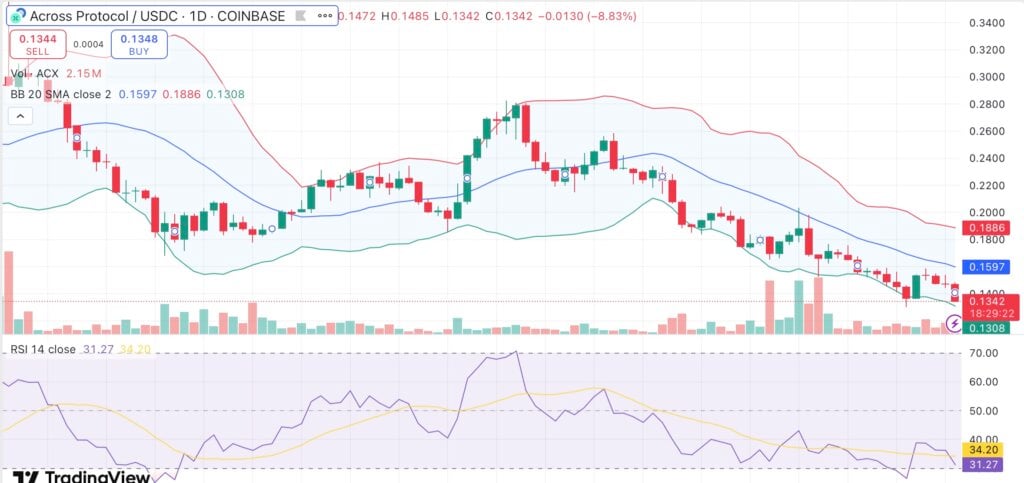
Looking at the technical picture, the chart shows clear downward pressure. The token is currently hugging the lower Bollinger Band at $0.1308 and trading below its 20-day simple moving average of $0.1597. At 31.27, the relative streghth index, which is trending downwards, is close to oversold territory.
Across Protocol token plunges amid allegations of $23M misappropriation by team - 1

More declines may occur if the price breaks through the $0.13 support zone. Some investors may watching for a bounce move back toward the mid-Bollinger band despite the sell-off. However, in the short term, upward momentum might be limited due to deteriorating sentiment and eroded trust in the team.

Market Opportunity
TokenFi Logo
TokenFi Price(TOKEN)
$0.002655
$0.002655$0.002655
+0.41%
USD
TokenFi (TOKEN) Live Price Chart
Disclaimer: The articles reposted on this site are sourced from public platforms and are provided for informational purposes only. They do not necessarily reflect the views of MEXC. All rights remain with the original authors. If you believe any content infringes on third-party rights, please contact service@support.mexc.com for removal. MEXC makes no guarantees regarding the accuracy, completeness, or timeliness of the content and is not responsible for any actions taken based on the information provided. The content does not constitute financial, legal, or other professional advice, nor should it be considered a recommendation or endorsement by MEXC.

You May Also Like

Trump’s Crypto Gains Risk Backlash Post-Presidency, Ethereum Veteran Advises Urgency

Trump’s Crypto Gains Risk Backlash Post-Presidency, Ethereum Veteran Advises Urgency

The post Trump’s Crypto Gains Risk Backlash Post-Presidency, Ethereum Veteran Advises Urgency appeared on BitcoinEthereumNews.com. President Trump’s administration
Share
BitcoinEthereumNews2025/12/21 01:29
China Blocks Nvidia’s RTX Pro 6000D as Local Chips Rise

China Blocks Nvidia’s RTX Pro 6000D as Local Chips Rise

The post China Blocks Nvidia’s RTX Pro 6000D as Local Chips Rise appeared on BitcoinEthereumNews.com. China Blocks Nvidia’s RTX Pro 6000D as Local Chips Rise China’s internet regulator has ordered the country’s biggest technology firms, including Alibaba and ByteDance, to stop purchasing Nvidia’s RTX Pro 6000D GPUs. According to the Financial Times, the move shuts down the last major channel for mass supplies of American chips to the Chinese market. Why Beijing Halted Nvidia Purchases Chinese companies had planned to buy tens of thousands of RTX Pro 6000D accelerators and had already begun testing them in servers. But regulators intervened, halting the purchases and signaling stricter controls than earlier measures placed on Nvidia’s H20 chip. Image: Nvidia An audit compared Huawei and Cambricon processors, along with chips developed by Alibaba and Baidu, against Nvidia’s export-approved products. Regulators concluded that Chinese chips had reached performance levels comparable to the restricted U.S. models. This assessment pushed authorities to advise firms to rely more heavily on domestic processors, further tightening Nvidia’s already limited position in China. China’s Drive Toward Tech Independence The decision highlights Beijing’s focus on import substitution — developing self-sufficient chip production to reduce reliance on U.S. supplies. “The signal is now clear: all attention is focused on building a domestic ecosystem,” said a representative of a leading Chinese tech company. Nvidia had unveiled the RTX Pro 6000D in July 2025 during CEO Jensen Huang’s visit to Beijing, in an attempt to keep a foothold in China after Washington restricted exports of its most advanced chips. But momentum is shifting. Industry sources told the Financial Times that Chinese manufacturers plan to triple AI chip production next year to meet growing demand. They believe “domestic supply will now be sufficient without Nvidia.” What It Means for the Future With Huawei, Cambricon, Alibaba, and Baidu stepping up, China is positioning itself for long-term technological independence. Nvidia, meanwhile, faces…
Share
BitcoinEthereumNews2025/09/18 01:37
Academic Publishing and Fairness: A Game-Theoretic Model of Peer-Review Bias

Academic Publishing and Fairness: A Game-Theoretic Model of Peer-Review Bias

Exploring how biases in the peer-review system impact researchers' choices, showing how principles of fairness relate to the production of scientific knowledge based on topic importance and hardness.
Share
Hackernoon2025/09/17 23:15