

UK Lawmakers Consider Making Crypto Donations Ban Permanent After Farage Scandal
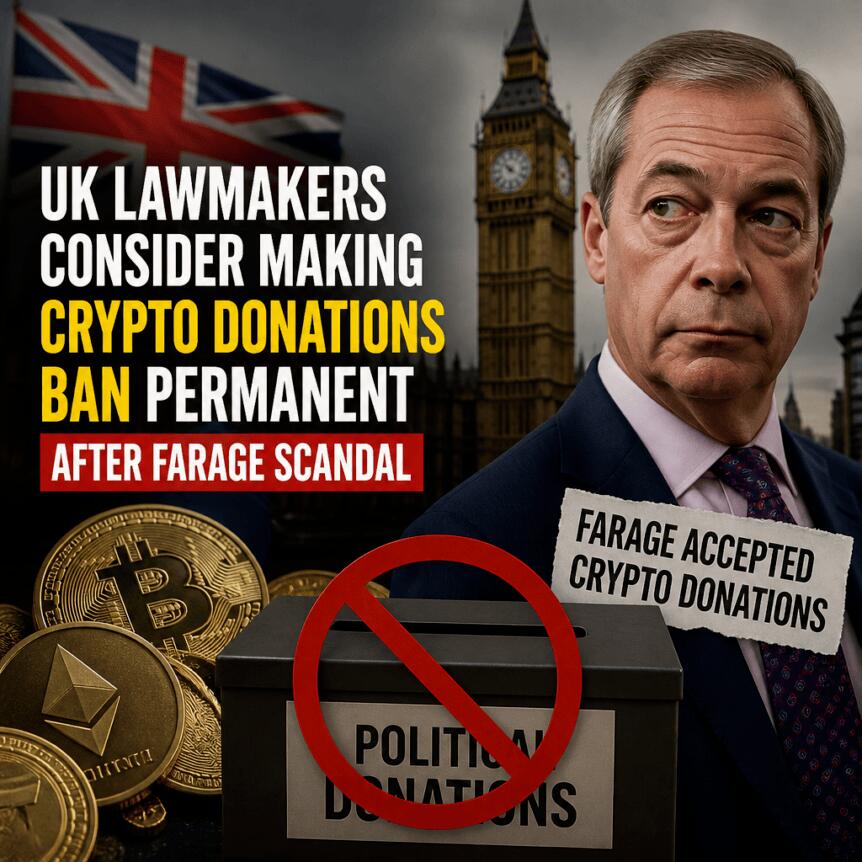
UK Labour MPs are preparing to push for a permanent ban on crypto donations to political parties and candidates, arguing that recent allegations around Nigel Farage’s funding have underscored risks of undue influence in British politics.
According to The Guardian, the party is looking to overhaul existing donation rules after a March moratorium on crypto contributions was introduced and then prompted further scrutiny. The renewed push is linked to Farage’s resignation from Parliament and reporting that he received large “gifts” connected to the digital-asset industry.
Key takeaways
- Labour MPs are considering making the March crypto-donation moratorium permanent, moving from temporary restraint to a lasting rule change.
- The push follows Farage’s resignation and claims that he accepted millions in donations described as “gifts” from crypto-linked figures.
- UK lawmakers plan to review proposed amendments next week, potentially tightening political funding limits for digital assets.
- A by-election in Farage’s constituency will be triggered, but major parties reportedly plan not to run candidates, leaving the contest to voters.
A temporary ban becomes a permanent proposal
The legislative debate centres on the March moratorium on crypto donations, which was announced by the UK government as part of a broader effort to protect democratic processes. The government’s move included a cap on donations from overseas electors and a ban on crypto donations, framed explicitly around safeguarding the integrity of elections.
Labour now wants that crypto restriction to be extended beyond its initial window. The Guardian reports that MPs have tabled amendments aimed at turning the moratorium into a permanent measure.
Liam Byrne, a Labour MP for Birmingham Hodge Hill and Solihull North and chair of the business select committee, is among the figures backing the changes. He argued that the scale of the alleged inflows—cited in the report as “$268 million”—could fuel a wider political media ecosystem that benefits populist movements.
In a post on X, Byrne reiterated his view that stronger donation safeguards are needed, linking the current push to evidence of how crypto-related money could intersect with political influence.
Farage’s resignation reignites the funding controversy
Farage announced his resignation on Tuesday, following reporting about contributions he accepted while serving as MP for Clacton. He said the UK parliamentary standards commissioner was investigating the donations, while maintaining that he “did nothing wrong.”
The allegations described in the reporting include a $6.7 million “gift” from crypto billionaire Christopher Harborne and additional support—such as staff, security, transport, and accommodation—linked to George Cottrell, described as a convicted fraudster connected to a crypto casino.
Earlier coverage from Cointelegraph noted Farage’s resignation was tied to the controversy over crypto donations and gifts. That resignation is expected to keep the issue at the top of the UK political agenda, particularly as Labour seeks to lock in lasting limits.
What Labour MPs want to change—And why it matters
Under the reported plan, Labour lawmakers intend to consider amendments to the representation of the people measures next week. If adopted, a permanent crypto donation ban would represent a significant tightening of rules around how digital-asset wealth can flow into electoral politics.
For investors and builders in the crypto economy, the practical implication is straightforward: policy risk around political funding could shift from a temporary, trial-like restriction to a durable compliance requirement—one that may influence how crypto-linked businesses think about political engagement in the UK.
It also changes the timeline for uncertainty. A moratorium implies a watch-and-review period; a permanent ban implies long-term regulatory expectations. Market participants typically price in policy duration, and longer-lived restrictions tend to reduce the odds of sudden rule reversals—either tightening further or reversing course.
There is also a governance angle. Labour’s framing, as reported, focuses on democracy-protection rather than market conduct. That means the next step for observers is not just how the crypto donation ban is written, but how enforcement is handled and whether standards investigations evolve into broader election-law reforms.
By-election dynamics and the leadership question
Farage’s resignation automatically triggers a by-election in Clacton. He told constituents that “the people of Clacton should be the judges of my actions,” according to the reported coverage. However, the major party landscape is expected to be unusual: The Guardian reports that Labour, Conservatives, Liberal Democrats, and Greens will reportedly not field candidates.
UK Prime Minister Keir Starmer has described Farage’s move as a “desperate stunt,” a characterization that signals the political conflict around the donation allegations is likely to remain sharply contested.
Separately, a potential political leadership transition could affect how quickly Labour pushes the crypto donation issue through parliament. Earlier this week, a week-long window reportedly opened for Labour MPs to nominate candidates for the party’s next leader, who would also become prime minister if Labour wins.
Cointelegraph previously noted that Andy Burnham—a Labour MP and former mayor of Greater Manchester—has been positioned as a contender following Starmer’s resignation. As mayor, Burnham backed the idea of making the city a “Web3 powerhouse” and supported using digital technology for economic development.
If Burnham secures enough support to win the leadership contest, he may face immediate pressure to address both the proposed crypto donation ban and broader questions about how UK regulators oversee crypto activity, including the Financial Conduct Authority’s role.
What to watch next
Next week’s consideration of Labour’s proposed amendments will be the key milestone. Observers should watch whether the party’s push results in a permanent statutory ban on crypto donations and, equally important, how any enforcement mechanisms and parliamentary standards findings develop around the Farage-linked allegations.
This article was originally published as UK Lawmakers Consider Making Crypto Donations Ban Permanent After Farage Scandal on Crypto Breaking News – your trusted source for crypto news, Bitcoin news, and blockchain updates.


You May Also Like

The Chemistry of UV Resistance: How Titanium Dioxide Protects Against the California Sun

Avalanche Treasury Firm AVAX One Reclaims Nasdaq Compliance After Reverse Stock Split

With SEC fight over, Coinbase's top legal exec Grewal moves on, and others reassigned



