

Seagate Stock Fell 12% in a Day. Here’s Where the Stock Could Go in 2026
Key Stats for Seagate Stock
- Current Price: $899.90
- Target Price (Mid): ~$1,955
- Street Target: ~$898
- Potential Total Return: ~117%
- Annualized IRR: ~21% / year
- Earnings Reaction: +11.10% (April 28, 2026)
Now Live: Discover how much upside your favorite stocks could have using TIKR’s new Valuation Model (It’s free) >>>
What Happened?
Seagate Technology Holdings (STX) just lost 12% in a single session, and the reason had almost nothing to do with Seagate. The stock closed June 26 at $899.90, down 12.24% on the day and sharply lower from the $1,055 it touched only ten days earlier. For a stock up more than 230% in 2026, a drawdown of this size lands hard. The question pulling investors in two directions is simple. Did something break, or did a crowded trade just shake loose?
The trigger was a report that South Korea’s SK Hynix is slowing its high-bandwidth memory expansion, a headline that rattled the entire AI-chip complex. High-bandwidth memory (HBM), the fast memory bolted onto Nvidia’s AI accelerators, is the kind of thing that makes traders flinch when anyone says “slowing.” The reflex was to sell anything tied to AI infrastructure. Seagate got caught in that net. So did the broader storage group, with Western Digital and SanDisk falling alongside it.
Here is the disconnect. Seagate does not make HBM. It makes hard disk drives (HDDs), the high-capacity drives that store the data AI systems generate. The SK Hynix story is a margin decision, not a demand collapse: the company is reportedly shifting capacity toward conventional memory where shortages have pushed pricing higher. That is a memory-pricing story. It says nothing about whether hyperscalers need fewer hard drives. The market sold first and sorted the distinction out later.
What Management Actually Said Three Weeks Ago
The selloff is harder to justify against what Seagate’s own CFO told investors in early June. Speaking at the Bank of America 2026 Global Technology Conference on June 2, EVP and CFO Gianluca Romano laid out a demand picture that looks nothing like a cooling cycle. “Every quarter, we increased revenue. Every quarter, we have improved profitability,” he said of the past 13 quarters, pointing to firm orders already covering the next four to five quarters. That visibility is unusual. As Romano put it, each order carries “a precise mix, precise exabyte volume, precise price and time to deliver.”
Why it matters: The demand fear driving the selloff is about the future, and Seagate has already sold much of that future under contract. Romano was direct that demand is running ahead of plan, not behind it: “Demand is probably higher than what we were expecting a year ago or 6 months ago.” A stock priced for a slowdown is hard to square with a CFO describing the opposite, backed by signed purchase orders rather than projections.
The fundamentals underneath the visibility are equally hard to dismiss. In its most recent quarter, reported April 28, Seagate posted revenue of $3.11 billion, up 44% year over year, and the stock jumped 11.10% that day. It was the company’s fourth straight earnings beat. Net income of $934 million in the March 2026 quarter beat the consensus estimate by 15.76%, and the operating margin for the quarter reached roughly 37%, a level Seagate had never sustained before this cycle. This is not a company stumbling into a downturn.
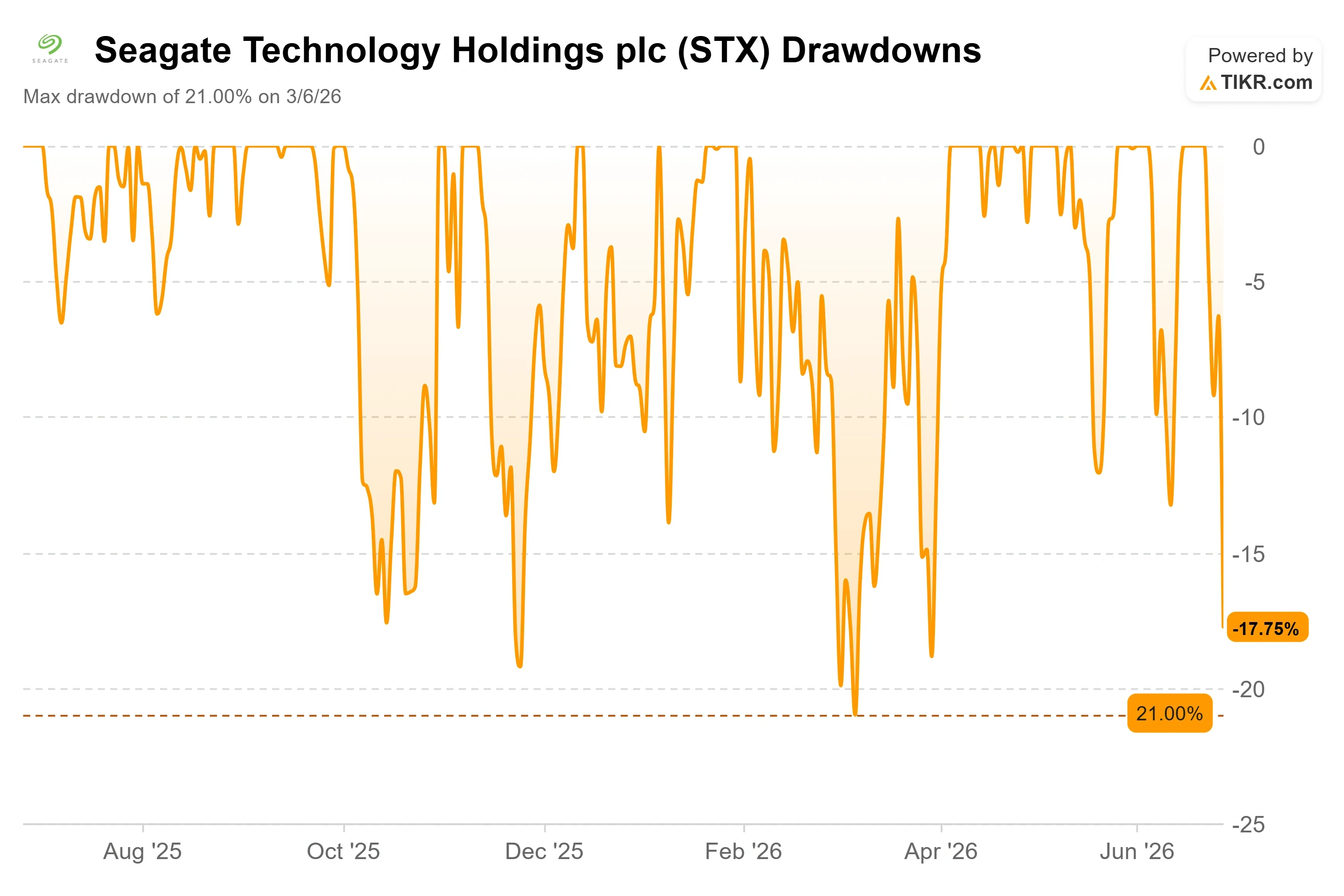 Seagate Drawdowns (TIKR)
See historical and forward estimates for Seagate stock (It’s free!) >>>
The Bear Case Has a Real Foothold
None of this makes the stock cheap, and that is the other half of the story. Even after the drop, STX trades at an NTM EV/EBITDA (next-twelve-months enterprise value to earnings before interest, taxes, depreciation, and amortization) of around 29x. That is a steep multiple for a business that the market has always treated as cyclical. The bears are not wrong that a lot of good news is priced in. Insiders have been selling into the run, another reason some on the Street see the rally as stretched.
The peer comparison sharpens the point. On NTM P/E, Seagate sits around 37x against Western Digital at around 37x, but both tower over the broader hardware group: NetApp trades near 17x, Dell near 22x, and Samsung near 6x. Western Digital is the cleanest comparison, a direct HDD competitor running at a near-identical forward multiple, which suggests the market is pricing the two storage leaders as a pair rather than singling Seagate out for excess. The premium to the rest of the group is real, and it is the entire debate: it is justified only if the AI storage cycle proves durable rather than cyclical.
Two other pressures fed the drop. A hawkish shift in Fed rate expectations under new Chair Kevin Warsh pushed market-implied odds of a second 2026 rate hike to roughly 85%, which makes debt-funded AI capital spending harder to justify. And Fox Advisors downgraded Seagate to Equal-Weight on June 22, citing an overbought chart after the run to all-time highs. Wedbush took the other side, calling the selloff a buying opportunity with enterprise demand intact. The Street is split, which is exactly what you would expect after a move this size.
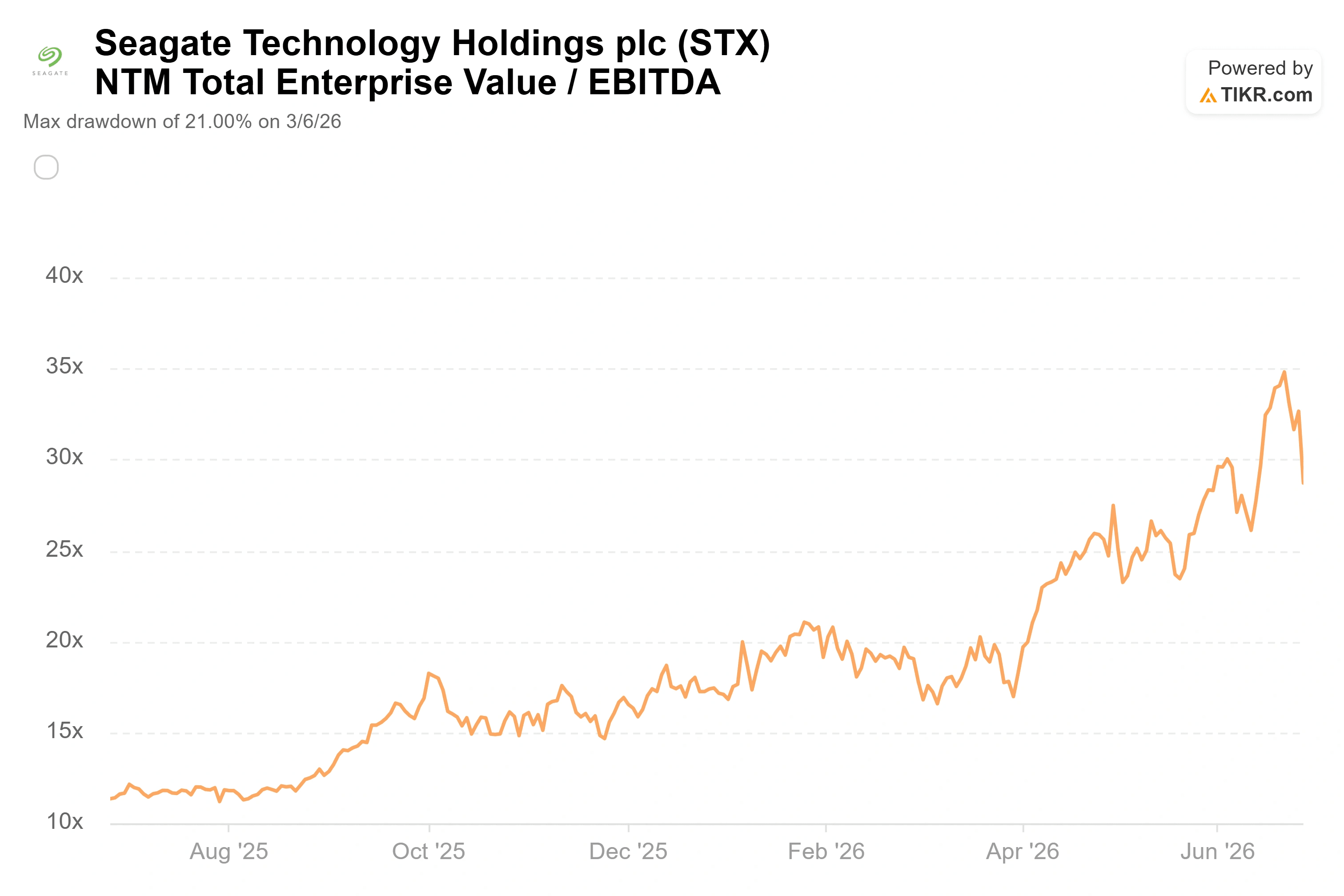 Seagate NTM EV/EBITDA (TIKR)
See how Seagate performs against its peers in TIKR (It’s free!) >>>
TIKR Advanced Model Analysis
- Current Price: $899.90
- Target Price (Mid): ~$1,955
- Potential Total Return: ~117%
- Annualized IRR: ~21% / year
 Seagate (TIKR)
See analysts’ growth forecasts and price targets for Seagate stock (It’s free!) >>>
The two revenue growth drivers are exabyte growth of around 25% per year from the HAMR roadmap (heat-assisted magnetic recording, the platform that packs more terabytes onto each drive), and pricing gains on uncommitted volume where demand runs above supply. The margin driver is operating leverage on a flat unit-cost base, which carries the mid-case net income margin toward around 43%. As Romano explained, the same number of units now generates “25% more exabyte every year,” so revenue climbs while the cost base barely moves.
The primary risk is the one Romano himself named: a macroeconomic cycle that cuts hyperscaler capital spending. He was clear that the threat is external, not structural to storage demand. The upside is that order-backed demand and density gains compound for years, and the stock grows into its premium. The downside is that AI spending plateaus, pricing discipline cracks, and a near-30x EBITDA multiple unwinds fast.
One note for investors acting on this: the TIKR model anchors to the $899.90 close on June 26. The stock has continued to trade lower since, so the live entry price may sit below the model’s reference point, which would modestly widen the implied return.
Conclusion
The next real test is Seagate’s fiscal Q4 2026 earnings, expected in late July or early August. The single number that settles the debate is the one Romano keeps pointing to: order-backed exabyte demand and the pricing it carries. If the report confirms revenue and margins still climbing sequentially, with management again describing the next four to five quarters as locked, the June selloff looks like a sentiment-driven shakeout in a stock that got ahead of itself. If guidance softens or pricing discipline shows any crack, the bears who flagged the stretched multiple will have their proof, and a stock priced near 30x EBITDA has little room to absorb disappointment. The memory scare was never really about Seagate. The earnings call will show whether the market figures that out.
See what stocks billionaire investors are buying so you can follow the smart money with TIKR.
Should You Invest in Seagate?
The only way to really know is to look at the numbers yourself. TIKR gives you free access to the same institutional-quality financial data that professional analysts use to answer exactly that question.
Pull up Seagate, and you’ll see years of historical financials, what Wall Street analysts expect for revenue and earnings in the quarters ahead, how valuation multiples have moved over time, and whether price targets are trending up or down.
You can build a free watchlist to track Seagate alongside every other stock on your radar. No credit card required. Just the data you need to decide for yourself.
Analyze Seagate on TIKR Free →
Looking for New Opportunities?
- See what stocks billionaire investors are buying so you can follow the smart money.
- Analyze stocks in as little as 5 minutes with TIKR’s all-in-one, easy-to-use platform.
- The more rocks you overturn… the more opportunities you’ll uncover. Search 100K+ global stocks, global top investor holdings, and more with TIKR.
Disclaimer:
Please note that the articles on TIKR are not intended to serve as investment or financial advice from TIKR or our content team, nor are they recommendations to buy or sell any stocks. We create our content based on TIKR Terminal’s investment data and analysts’ estimates. Our analysis might not include recent company news or important updates. TIKR has no position in any stocks mentioned. Thank you for reading, and happy investing!
You May Also Like

'I get it now': Anthony Scaramucci reveals epiphany he had thanks to 'not well' Trump
What Happens to the XRP Price if the Crypto Bear Market Gets Worse?

Solana SOL Reclaims $72, But Fading On-Chain Metrics Signal Weakening DEX Momentum

