

Best Solana API Providers for 2026
Solana is now one of the busiest chains in crypto. Block times sit near 400 milliseconds, and token launches, swaps, and DeFi positions settle in under a second. For developers, that speed is both the draw and the problem. Reading Solana data at scale is harder than it looks.
The account model is the reason. Each wallet holds a separate Associated Token Account for every SPL token, DeFi protocols store positions in custom account layouts, and parsing transactions takes program specific knowledge. Most multichain APIs treat Solana as an afterthought and miss half of that detail.
This guide focuses on the data layer: the APIs that return structured wallet balances, token prices, DeFi positions, transaction history, and analytics. We are not ranking raw RPC node providers here, since that is a separate category with its own tradeoffs. If you need to submit transactions or query raw chain state, pair one of the providers below with a dedicated RPC endpoint. For the Ethereum equivalent of this list, see our guide to the best Ethereum API providers.
At a Glance
Before the breakdowns, here is a side by side snapshot of what each provider does best on Solana.
| CoinStats API | Birdeye | Hello Moon | Shyft | Solscan | |
| Primary focus | All in one wallet, DeFi, portfolio and market data, built for apps and AI agents | Token and market data, DEX activity | Real time analytics and event streaming | Indexing, NFTs, transaction parsing | Explorer grade account, token and transaction data |
| SPL + SOL balances | Yes, pre priced in USD | Via wallet lookups | Via data and RPC | Via account queries | Yes, account endpoints |
| Token / price data | 100,000+ coins, 200+ exchanges | Deep Solana prices and OHLCV | Token events in real time | Token data via GraphQL | Token list and price endpoints |
| DeFi position resolution | Yes, per wallet across 10,000+ protocols | No | DeFi events, not per wallet positions | No, raw data | DeFi activities, not resolved positions |
| NFT data | In wallet holdings view | Limited | Yes, analytics and wash trade flags | Yes, deep metadata and collections | Yes, activities and collections |
| Transaction history | Full, USD at time, with P&L | DEX trades | Real time streams | Parsed and decoded | Yes, multi year on transfers |
| AI agent / MCP support | Yes, MCP Server | No | No | No | No |
| Free tier | Yes, 20,000 credits/mo | Yes | Yes, wallet sign in | Yes, 10 RPS | Yes, public tier |
1. CoinStats API
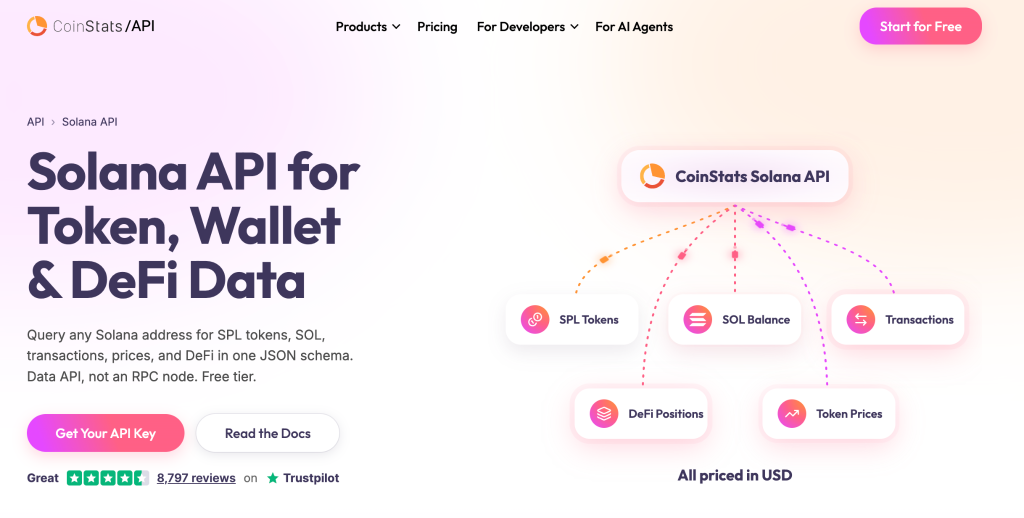
Most Solana providers specialize in either raw infrastructure or a single slice of data. CoinStats Solana API covers the whole data layer in one place. Pass any Solana address and a single call returns SPL token balances, native SOL, full transaction history, token prices, and DeFi positions, each priced in USD. It is a data API, not an RPC node, so the parsing and pricing work happens upstream.
What the Solana integration looks like in practice. One endpoint returns the complete token inventory of an address: every SPL token detected, the native SOL balance, current USD prices, and metadata. Transaction history follows the same structure, with USD value recorded at the time of each transfer, plus realized and unrealized profit and loss. Because the same schema spans 120+ chains, the code that reads a Solana wallet also reads an Ethereum or Bitcoin wallet with no rework.
The DeFi resolution is the differentiator. Most providers stop at token balances. CoinStats keeps going and resolves per wallet DeFi positions across 10,000+ protocols, detecting staking, lending, liquidity, and yield exposure and returning each as a readable USD value. On Solana that is rare, and it removes weeks of protocol by protocol account parsing.
Built for AI agents. CoinStats ships a Model Context Protocol (MCP) Server, so LLMs and coding agents call wallet, DeFi, and price tools through clean schemas over one OAuth protected URL. It works with Claude, Cursor, Claude Code, VS Code, and other clients, and the same API key powers both REST and MCP. For autonomous agents that is the difference between days of wrapper code and minutes of setup.
Market data and pricing. Behind the wallet data sits market coverage of 100,000+ coins across 200+ exchanges, the same engine that powers CoinStats and its 1M+ monthly users. Pricing is credit based, and the free tier includes 20,000 credits a month at two requests per second with commercial use and no credit card. For a deeper breakdown of Solana API options, see the best Solana APIs article.
Best for: wallet trackers, portfolio dashboards, DeFi aware apps, crypto tax tools, and AI agents that need both market and onchain wallet data through one API. It covers most data use cases a crypto product needs, from balances and prices to DeFi positions and full history, through a single integration.
2. Birdeye
Birdeye built its reputation on Solana token data, and it is still the reference point for traders. The API delivers real time prices, OHLCV candles, DEX trade flow, token metadata, supply, holder counts, and security signals on new listings, all behind a REST interface. New tokens tend to appear within seconds of pool creation, which is why memecoin trackers and trading dashboards lean on it so heavily.
Coverage. Birdeye Data Services now spans Solana, Sui, and EVM chains, but Solana remains the deepest by a wide margin. If your product lives on Solana token activity, the granularity here is hard to beat.
On pricing. Birdeye offers a free developer tier plus paid plans that scale with request volume and data depth. The free tier handles prototyping, and production apps usually move to a paid plan as rate limits tighten.
Best for: memecoin trackers, trading dashboards, and apps that need granular Solana token price and DEX activity data. It is a market data specialist, so it does not resolve per wallet portfolios or DeFi positions.
3. Hello Moon
Hello Moon is a Solana first data platform built around real time streaming. It processes millions of onchain events daily through a Geyser plus Kafka pipeline, then streams blocks, slots, transactions, and account updates to your app with filters on addresses, owners, program data, and transaction types. That cadence is something most REST data APIs cannot match.
Analytics depth. The NFT and DeFi analytics go further than raw events. Hello Moon detects wash trading, labels wallet entities, and surfaces whale and influencer activity across Solana DEXs, which makes it useful for behavior analysis rather than just balance reads.
Infrastructure included. The platform also runs Solana RPC endpoints and a transaction landing service, so streaming, analytics, and infra come from one provider. Free API access is unusually easy: sign in with a Solana wallet, sign a message, and get a key.
Best for: apps and AI agents that need real time Solana event streams, NFT analytics, and labeled wallet behavior data. It streams DeFi events but does not resolve DeFi positions per wallet.
4. Shyft
Shyft is Solana developer infrastructure with indexing at its core. The flagship is a GraphQL API over indexed Solana data: its SuperIndexer maps any Anchor IDL to a database schema and exposes it through GraphQL, so you query accounts, programs, NFTs, and transactions with precise, low waste requests instead of pulling more than you need.
NFTs and transaction parsing. NFT support runs deep, covering metadata, collections, mint history, and transfers behind a single endpoint. The other strong lane is parsing. A raw Solana transaction response is dense, and Shyft decodes program calls for major Solana DEXs and launchpads into structured JSON, which saves a large amount of manual account decoding.
On pricing. The free tier offers unlimited credits at 10 requests per second. The Build plan at $199 per month unlocks gRPC streaming and 100 requests per second, and dedicated nodes start higher for teams that need isolated capacity. Pricing is flat rate with no credit metering, which makes costs predictable under bursty load.
Best for: NFT marketplaces, mint platforms, and indexing heavy Solana dApps that need decoded transaction data and flexible GraphQL queries.
5. Solscan
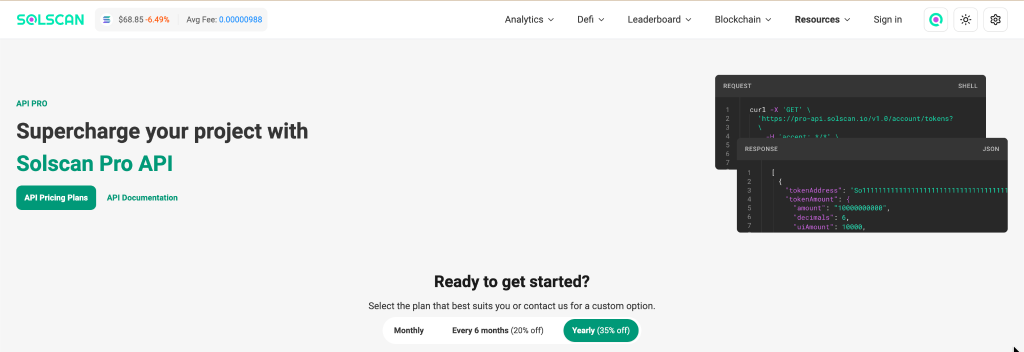
Solscan fills the role that Etherscan plays on Ethereum. It is the block explorer most of the Solana ecosystem already reaches for, and its Pro API exposes that same explorer grade data programmatically. If your app needs authoritative account, token, and transaction lookups rather than multichain breadth, this is the native option.
What the API covers. Endpoints span account data, token information (including a ranked token list and price data across Solana tokens), transaction detail with an actions endpoint that aggregates indexed transaction activity, NFT activities and collections, and DeFi activities. Transfer history reaches back several years, which matters for accounting and audit style use cases.
On pricing. Solscan runs a free public tier with reduced limits and a paid Pro tier that unlocks broader endpoint coverage and higher rate limits, with higher volume access available on request. The free tier is enough to test endpoints before committing.
Best for: block explorers, compliance and accounting tools, and any product that needs deep, Solana native transaction and token lookups. It is explorer data rather than a portfolio or DeFi position layer.
Choosing the Right Provider (or Combination)
There is no single best Solana API for every job. The five above serve different needs, and many production stacks use two of them together.
If your app is data first (portfolio trackers, analytics dashboards, AI assistants), CoinStats Solana API gets you to production fastest because it returns enriched, pre priced wallet, market, and DeFi data through one schema, and it is the only option here that resolves per wallet DeFi positions and ships an MCP Server for AI agents.
If you need token and market depth (memecoin tools, trading dashboards), Birdeye is the specialist. If you need real time streams and behavior analytics, Hello Moon is built for it. If you are NFT or indexing heavy, Shyft and its GraphQL layer fit best. If you need explorer grade lookups, Solscan is the Solana native choice.
A common pattern is to pair a data provider for balances, prices, and portfolio features with a dedicated RPC endpoint for execution and raw chain state. For a broader, cross chain developer view that goes beyond Solana, see our deep dive on the top crypto APIs in 2026, and if your project is specifically a portfolio product, our guide to crypto portfolio APIs compares the cross chain options. All five providers offer free tiers, so testing the fit before committing is straightforward.
The post Best Solana API Providers for 2026 appeared first on CaptainAltcoin.


You May Also Like

Switzerland vs Canada World Cup 2026 Prediction: Complete Tactical Analysis and Match Forecast

2026 World Cup Group G Standings: Egypt, Iran, Belgium and Qualification Scenarios

Scotland vs Brazil Prediction 2026: Odds, Lineups, Key Players and Score Forecast



