

Bitcoin Ignores Iran Strikes But Volatile Week Looms
Bitcoin held steady near $77,000 after fresh U.S. military strikes on Iranian targets over the weekend, defying expectations of a geopolitical sell-off. But with hawkish Federal Reserve signals, stalled futures open interest, and ongoing Middle East uncertainty, traders are bracing for a volatile week ahead.
Iran Strikes Landed, Bitcoin Didn’t Blink
U.S. forces carried out what the Pentagon described as “self-defense” strikes in southern Iran, targeting missile launch sites and boats placing mines during an ongoing ceasefire. The action was framed as restrained, coming amid a 60-day ceasefire extension with nuclear talks still in progress.
Bitcoin’s response was remarkably muted. The cryptocurrency was trading at $76,973 on May 26, down just 0.38% over 24 hours, with no sign of the panic selling that typically accompanies military escalation headlines.
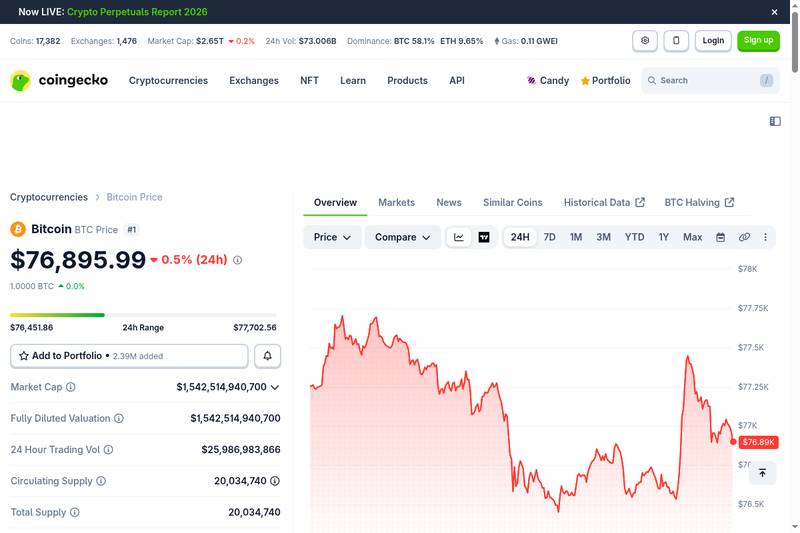 Bitcoin trading near $76,900, down just 0.5% over 24 hours despite fresh Iran strikes. Source: CoinGecko
That stands in sharp contrast to the earlier March 2026 Iran strike episode, which, according to unconfirmed reports, triggered roughly $300 million in long liquidations and sent BTC tumbling to around $63,000 before a recovery to $69,000. This time, the market barely flinched.
Why Bitcoin Is Holding Its Ground Despite Geopolitical Risk
The muted reaction suggests markets had already priced in escalation risk. The early-April ceasefire and its 60-day extension gave traders a framework for the conflict, reducing the shock value of follow-up strikes described as limited in scope.
Derivatives data reinforces the picture of cautious positioning rather than panic. Crypto futures open interest held just above $130 billion for four consecutive days during the earlier Iran tension episode, signaling that traders were neither aggressively adding nor fleeing positions. Over $400 million in leveraged futures liquidations had already flushed out the weakest hands during that period.
The Crypto Fear & Greed Index sits at 34, firmly in “Fear” territory, but not at the extreme levels that typically accompany capitulation events. Bitcoin is down roughly 23% year-to-date and sits approximately 39% below its all-time high of $126,080 set in October 2025, suggesting much of the bearish repricing has already occurred.
Bitcoin also outperformed equities on the news, a dynamic that has strengthened the narrative around BTC as a relative safe haven during geopolitical shocks. For context on how institutional crypto infrastructure is evolving alongside these market dynamics, OKX recently launched Exchange OS to let builders deploy custom crypto markets, reflecting growing institutional demand for flexible trading infrastructure.
What to Watch: The Catalysts That Could Make This Week Volatile
The absence of panic does not mean calm seas ahead. Three specific catalysts could drive sharp moves this week.
Fed rate path repricing. Fed Governor Christopher Waller warned that rate hikes cannot be ruled out if inflation persists, a statement that contributed to markets now pricing a possible 25 basis-point hike by October 2026. That directly undermines Bitcoin’s 2026 bull case, which rested on imminent rate cuts. Any further hawkish commentary this week could pressure risk assets broadly.
Oil and the Strait of Hormuz. U.S. and Iranian negotiators discussed opening the Strait of Hormuz roughly 30 days from a final deal. If talks stall or further strikes occur, oil price spikes would feed directly into inflation expectations, reinforcing the Fed’s hawkish stance. This creates a compounding loop: geopolitical tension pushes oil higher, oil pushes inflation expectations higher, and the Fed responds by tightening, all of which weigh on Bitcoin.
ETF flows and institutional sentiment. U.S. spot Bitcoin ETFs recorded outflows of -$105.2 million on May 22, according to a single source citing Farside data, the last available pre-holiday reading. Whether institutional buyers step back in this week or continue withdrawing will set the tone. The recent SEC approval of Nasdaq’s Bitcoin options has expanded the toolkit available to institutional traders, but that cuts both ways in a risk-off environment.
Key price levels define the range. Bitcoin holding above $76,000 keeps the “no panic” narrative intact. A break below could trigger cascading liquidations similar to the $400 million flush seen earlier this month. On the upside, reclaiming $80,000 would signal that the market has absorbed the geopolitical and macro headwinds.
A bullish resolution looks like stable oil, no further strikes, and a dovish Fed pivot. A bearish one looks like escalation in the Gulf, sticky inflation data, and continued ETF outflows. As regulatory clarity continues to shape the landscape, developments like Coinhouse securing a full MiCA license in France underscore how the institutional framework around crypto is maturing even as macro headwinds persist.
With 24-hour trading volume at $25.78 billion and a $1.54 trillion market cap, Bitcoin has the liquidity to absorb shocks. Whether it will need to this week depends on whether the ceasefire holds and how loudly the Fed speaks.
Disclaimer: This article is for informational purposes only and does not constitute financial or investment advice. Cryptocurrency and digital asset markets carry significant risk. Always do your own research before making decisions.


You May Also Like

The Digital Identity Crisis and How BrandSnag Helps Creators Reclaim Their Online Presence

Metaplanet buys 5,075 Bitcoin in Q1 to become 3rd-largest treasury

7 Best Fraud Prevention Tools for Financial Institutions in 2026



