Will Zcash Hit $10,000? A Realistic Look at ZEC's Price Potential

The cryptocurrency world is buzzing with bold predictions about Zcash. BitMEX co-founder Arthur Hayes recently claimed that ZEC could hit $10,000, sending shockwaves through the privacy coin community.
With Zcash surging over 200% in recent months and privacy concerns reaching new heights, many investors are wondering if this ambitious target is actually achievable.
Let's dive into the factors that could push Zcash toward five figures—and the obstacles standing in its way.
 
Key Takeaways
  • Zcash's zk-SNARK technology provides optional privacy that distinguishes it from transparent blockchains
  • The $10,000 target requires massive adoption and favorable conditions most analysts view as speculative
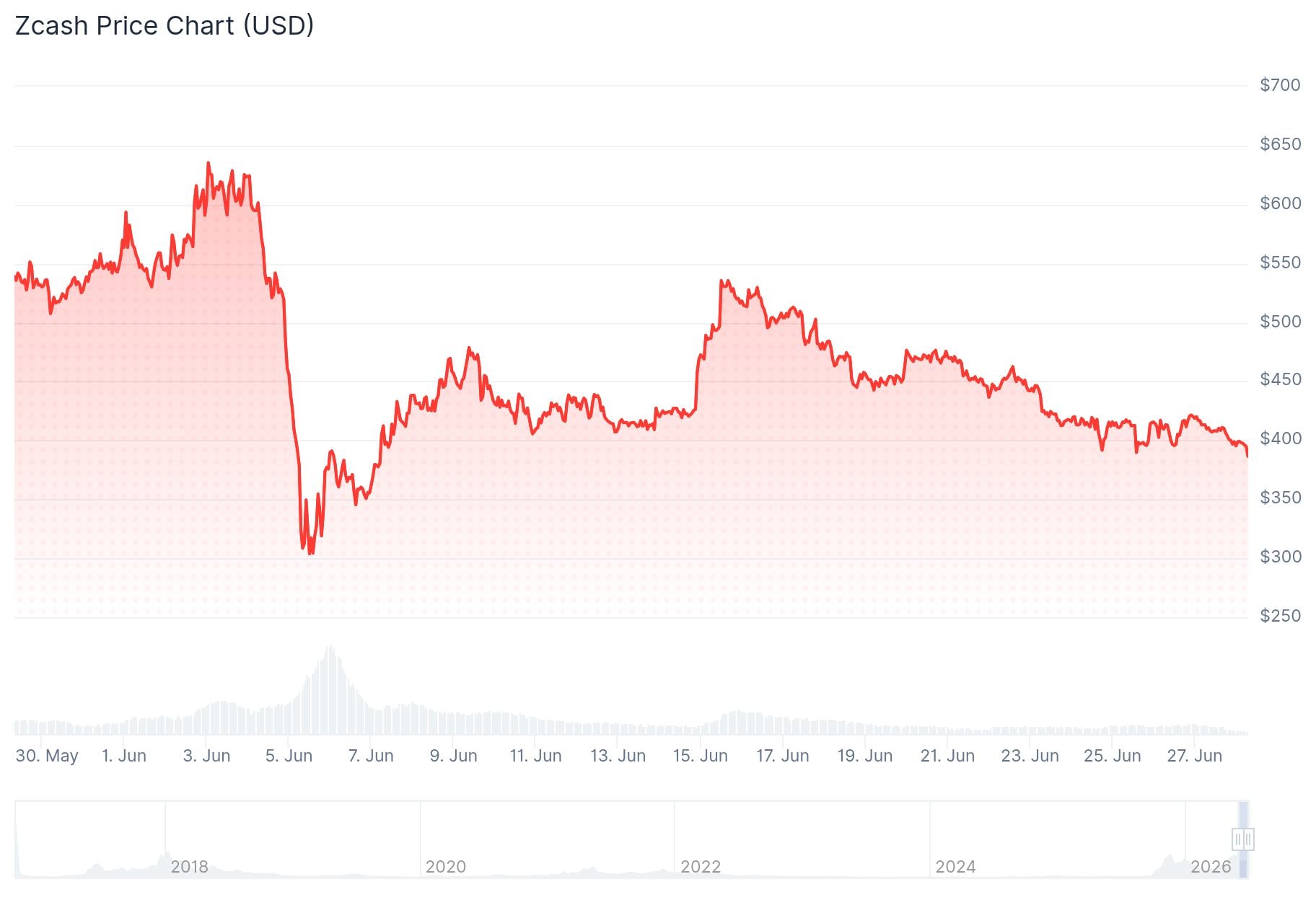
  • Near-term predictions range conservatively from $400-$1,000 based on current market dynamics
  • Growing privacy concerns and technical upgrades position Zcash for potential long-term growth
 

What's Driving Zcash's Recent Price Rally?

  1. Privacy Demand in an Era of Surveillance

Financial privacy has become a hot topic as governments and corporations increase surveillance of blockchain transactions.
Zcash addresses this concern with advanced cryptographic technology that shields transaction details from public view.
Recent data shows that approximately 30% of ZEC's circulating supply is now locked in shielded addresses, demonstrating real user demand for privacy features.
As regulatory pressure intensifies on transparent blockchains, more users are turning to privacy-focused solutions like Zcash.
  1. Technical Upgrades Powering the Surge

The Zashi cross-chain upgrade transformed Zcash's capabilities by connecting its shielded pool to networks like Solana and Ethereum.
This interoperability breakthrough triggered a sevenfold increase in shielded transactions practically overnight.
The upgrade improved transaction speed and scalability while maintaining the robust privacy protections that make Zcash unique.
These technical improvements have attracted both retail traders and institutional investors seeking legitimate privacy solutions.
 

Understanding Zcash's Privacy Technology

  1. How zk-SNARKs Work

Zcash uses zero-knowledge proofs called zk-SNARKs to verify transactions without revealing sensitive information.
This technology allows the network to confirm that a transaction is valid without exposing the sender, receiver, or transaction amount.
Unlike Bitcoin's transparent ledger, Zcash gives users control over their financial privacy through optional shielded addresses.
Users can choose between transparent transactions (similar to Bitcoin) or fully private transfers that encrypt all transaction details.
  1. Real-World Use Cases

Zcash functions as digital cash for the internet age, enabling private peer-to-peer payments without surveillance.
Companies are exploring Zcash for confidential payroll systems where employee salary information remains protected.
The cryptocurrency also serves cross-border payment needs for individuals and businesses requiring financial confidentiality.
These practical applications demonstrate that Zcash is more than speculation—it solves real privacy problems in the digital economy.
 

Can Zcash Realistically Reach $10,000?

  1. The Bull Case for $10,000

Arthur Hayes believes Zcash could capture 10-20% of Bitcoin's market value due to superior privacy technology.
Institutional interest is growing, with Grayscale's Zcash Trust expanding by 228% to $137 million in assets under management.
Zcash has a fixed supply of 21 million coins with a Bitcoin-like halving schedule, creating scarcity over time.
Rising concerns about financial surveillance could drive massive adoption of privacy-preserving cryptocurrencies in coming years.
  1. Major Obstacles to Consider

Reaching $10,000 would require Zcash to increase over 2,000% from current price levels.
Regulatory crackdowns pose the biggest threat, as some exchanges have delisted privacy coins due to compliance concerns.
Limited liquidity on major platforms restricts trading volume and makes large price movements more difficult.
Achieving a $10,000 price point would push Zcash's market capitalization above $210 billion—a massive leap requiring unprecedented adoption.
  1. Expert Price Predictions

Most cryptocurrency analysts project more conservative targets for Zcash in the near term.
CoinCodex forecasts ZEC could reach approximately $510 by year-end, representing steady growth rather than explosive gains.
Optimistic scenarios from some analysts suggest $750-$1,000 is possible if privacy demand accelerates significantly.
The $10,000 prediction remains highly speculative, with most experts viewing it as a long-term possibility rather than a near-term reality.
 

How to Trade Zcash Safely

Ready to trade Zcash? You can purchase ZEC on MEXC, a trusted cryptocurrency exchange with competitive fees.
After purchasing, consider transferring your ZEC to a secure wallet like Zashi or Trezor for enhanced security.
Understanding the difference between shielded and transparent transactions helps you maximize privacy when needed.
Always implement proper risk management by only investing amounts you can afford to lose in this volatile market.
 

FAQ

Will Zcash hit $10,000?
While technically possible, reaching $10,000 is considered highly speculative by most cryptocurrency analysts. Conservative predictions place Zcash between $400-$1,000 in the near term, with $10,000 requiring massive adoption and favorable market conditions over many years.
Why did Arthur Hayes predict $10,000 for Zcash?
Hayes believes Zcash could capture 10-20% of Bitcoin's total value due to its superior privacy technology and growing demand for financial confidentiality. His prediction assumes widespread adoption of privacy features and continued institutional investment in ZEC.
What makes Zcash different from other cryptocurrencies?
Zcash uses zk-SNARK zero-knowledge proof technology to enable optional privacy. Users can choose between transparent transactions (like Bitcoin) or fully shielded transfers that encrypt sender, receiver, and amount information while maintaining blockchain security.
Is Zcash legal to buy and trade?
Zcash is legal in most jurisdictions including the United States. However, some exchanges have delisted privacy coins due to regulatory pressure around compliance requirements. Always check your local regulations before trading.
What factors could push Zcash to $10,000?
Mass adoption of privacy features, sustained institutional investment, favorable regulatory clarity, technological improvements, and increasing demand for financial privacy could combine to drive significant long-term growth toward ambitious price targets.
 

Conclusion

The $10,000 Zcash prediction captures attention, but investors should maintain realistic expectations.
While Zcash's privacy technology and recent upgrades position it well for growth, reaching five figures requires extraordinary market conditions.
Focus on the cryptocurrency's fundamental value proposition—true financial privacy—rather than chasing speculative price targets.
Ready to explore Zcash? Start trading ZEC on MEXC and join the privacy revolution in cryptocurrency.
 
Market Opportunity
LOOK Logo
LOOK Price(LOOK)
$0.02131
$0.02131$0.02131
-9.62%
USD
LOOK (LOOK) Live Price Chart

Description:Crypto Pulse is powered by AI and public sources to bring you the hottest token trends instantly. For expert insights and in-depth analysis, visit MEXC Learn.

The articles shared on this page are sourced from public platforms and are provided for informational purposes only. They do not necessarily represent the views of MEXC. All rights remain with the original authors. If you believe any content infringes upon third-party rights, please contact service@support.mexc.com for prompt removal.

MEXC does not guarantee the accuracy, completeness, or timeliness of any content and is not responsible for any actions taken based on the information provided. The content does not constitute financial, legal, or other professional advice, nor should it be interpreted as a recommendation or endorsement by MEXC.

Latest Updates on LOOK

View More
How Resilient Retailers Tackle The January Cash Flow Crunch

How Resilient Retailers Tackle The January Cash Flow Crunch

The post How Resilient Retailers Tackle The January Cash Flow Crunch appeared on BitcoinEthereumNews.com. A sharp January cash flow dip is predictable for retailers, but the strongest businesses turn it into a manageable season by planning ahead. getty For many small retailers, December looks strong on paper but January tells a different story. Sales slow, tax and supplier bills come due, and the cash flow that felt comfortable at peak trading can suddenly look precarious. New analysis from Starling Bank, QuickBooks, and Xero suggests this isn’t a one-off pattern but a predictable cash flow crunch. However the businesses that cope best are not those that are immune to those pressures. They are the ones that treat January as a known event to plan around, rather than an annual shock. Optimizing cash flow is a key skill for SME retailers to master, especially since lack of cash is the number one reason that businesses fail. The January Cash Flow Cliff Examining shopper behavior, this pattern is hard to miss. After weeks of gifting, socializing, and big-ticket purchases, consumers pull back sharply in the new year. Starling Bank’s SME customer data reveals “a clear and consistent ‘January dip’ in deposit balances that typically begins in late December and deepens in January, before gradually stabilizing towards the end of March, in line with the UK tax year-end,” says Dan Hogan, director of business tools at Starling. For retailers, that dip isn’t just about money leaving their accounts. It reflects customers spending less in-store and online, delaying non-essential purchases, and waiting for paydays before they re-engage. Hogan also points to a “self-imposed spending freeze,” with average card spend dropping in December and staying low through February as business owners tighten their own belts to rebuild reserves. That instinct is mirrored on the consumer side. Xero’s small business data shows that “retail sales grew just 1.1% year-on-year in the…
2025/12/10
Rangebound markets, resilient onchain lending

Rangebound markets, resilient onchain lending

The post Rangebound markets, resilient onchain lending appeared on BitcoinEthereumNews.com. This is a segment from the 0xResearch newsletter. To read full editions, subscribe. While crypto prices have shown a modest recovery in the short term, negative breadth and relative underperformance to TradFi benchmarks on the monthly suggests a prevailing bearish environment. Zooming out, we look at the secular growth trends within stablecoins and lending as durable sectors for multi-year growth. Indices Crypto markets remain rangebound after November’s harsh selloff. The past week has shown a modest recovery, with BTC at $90,400 now being 12% off of its recent correction low of $80,700. Over the trailing 24 hours, the AI and Modular sectors were the top winners, with TAO (+6.4%)  and TIA (+6.2%) as notable contributors to this short-term strength. The Perp Index was the top loser, with DYDX (-3.1%) and HYPE (-0.6%) accounting for the sector’s weakness. Zooming out to the monthly, the picture remains unfavorable. TradFi benchmarks like Gold, Nasdaq and the S&P 500 are all green over the past month, while every crypto index we track is measuring negative returns. Breadth is decisively negative on the monthly for all crypto indices, with no safe haven provided. Notably, the Protocol Revenue index is the top performing among crypto sectors, suggesting relative strength in protocols with strong fundamental positioning. Despite recent strength, it remains to be determined whether this rally is countertrend to a prolonged downtrend, or if the low is in for the rest of 2025. Market Update Amid the downtrend, don’t lose sight of the bigger picture, and take a moment to appreciate just how far we’ve come. At the bear market low, lending applications within DeFi accounted for just $5 billion in deposits, a rounding error within the larger financial system. In the years since, this figure has grown to $71 billion in deposits, having just previously…
2025/12/10
Bitcoin Price Alarming Patterns Point to a Dive to $80k After FOMC Decision

Bitcoin Price Alarming Patterns Point to a Dive to $80k After FOMC Decision

The post Bitcoin Price Alarming Patterns Point to a Dive to $80k After FOMC Decision appeared on BitcoinEthereumNews.com. Bitcoin price rose for three consecutive days as traders waited for the upcoming FOMC decision. BTC was trading at $93,500, up sharply from last month’s low of $80,635. Still, the coin has formed some alarming patterns that point to a harsh reversal after the Federal Reserve interest rate decision.  Bitcoin Price Has Formed Risky Chart Patterns The daily chart reveals that the BTC price has crawled back in the past few days as investors bought the dip. It also jumped as investors anticipated the Fed to cut interest rates by 0.25%. It will be the third rate cut of the year.  However, a closer look at this chart shows that the coin could be at risk of a dive, potentially to the support at $80,637. The ongoing rebound is made up of two ascending and converging trendlines. These lines are about to meet, which is when bearish breakouts normally happen. The wedge is part of the bearish pattern, a common continuation sign. This pattern has a vertical line and a symmetrical triangle pattern. All these patterns formed a few weeks after the coin formed a death cross pattern. This pattern is made up of a 50-day and 200-day moving averages crossover. It is one of the most common risky patterns in technical analysis.  Also, the patterns formed after it made a double-top pattern with a neckline at $107,420. A combination of a double-top and a death cross pattern often leads to more downside. Bitcoin Price Chart Therefore, these patterns mean that the value of BTC will have a bearish breakout. If this happens, the next key target level to watch will be at $80,637, its lowest point in November this year. Such a move would mean a 13% drop from the current level. On the other hand, a rebound above…
2025/12/10
View More