Overview
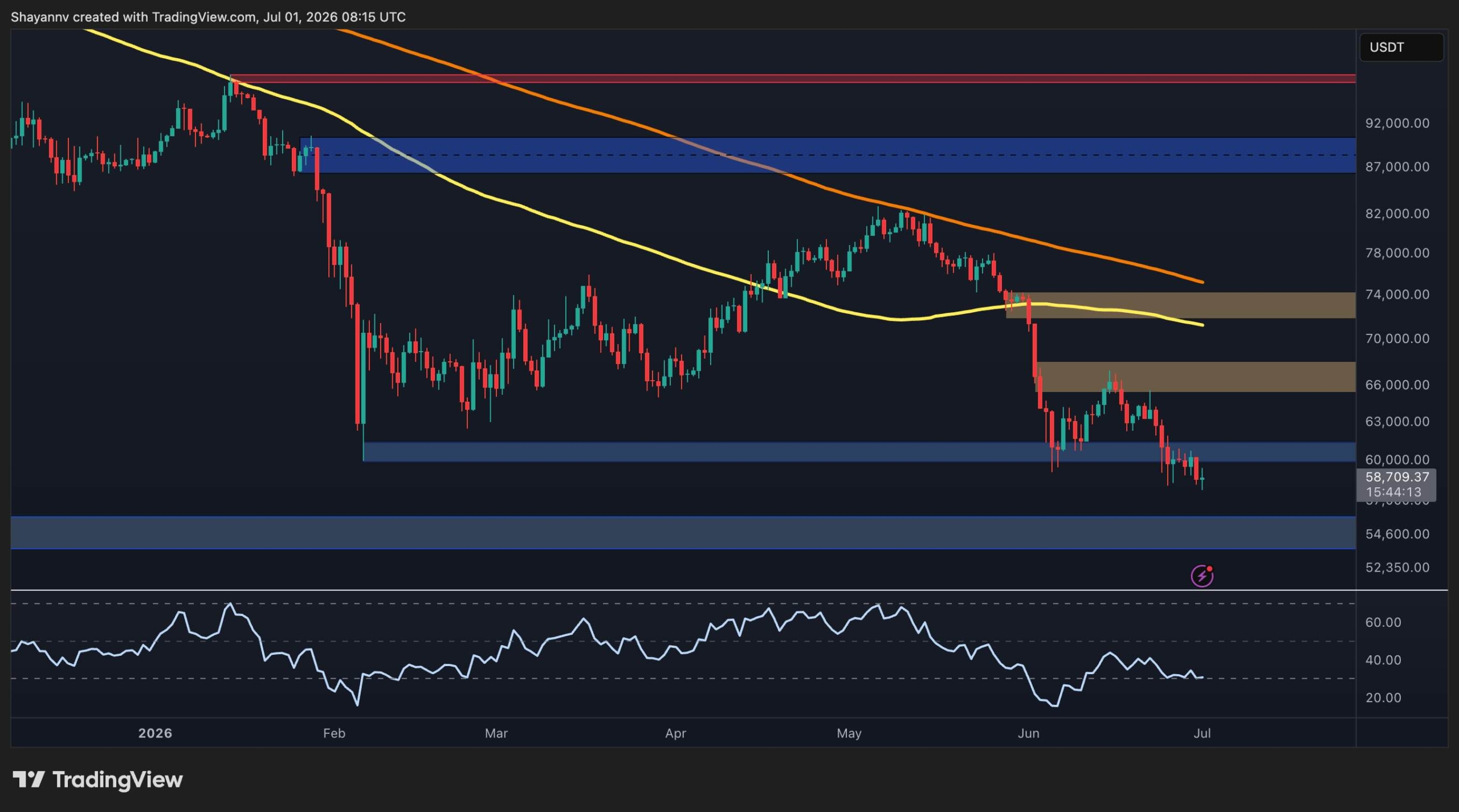
Bitcoin entered July 2026 in a cautious market environment. The price is hovering near the $60,000 area, while traders are watching whether ETF outflows continue, whether the Federal Reserve changes the rate narrative, whether key technical support holds, and whether options positioning amplifies short-term volatility.
That makes July less about simple bullish continuation and more about whether Bitcoin can rebuild liquidity, confidence, and institutional demand.
Key Takeaways
The key July variables for Bitcoin are ETF flows, the Federal Reserve, the $60,000 support zone, options positioning, and trading volume.
U.S. spot Bitcoin ETFs remained under pressure in late June, making fund flows a major short-term signal.
The Federal Reserve’s July 28–29 FOMC meeting is likely to be a key macro event for traders.
If Bitcoin holds above $60,000, the market may enter a recovery phase; if it loses that level, sentiment could weaken further.
July may reward disciplined risk management more than aggressive directional positioning.
Why July Matters for Bitcoin
Bitcoin’s 2026 market structure is no longer driven only by native crypto narratives. It is now deeply connected to ETF flows, U.S. liquidity conditions, interest-rate expectations, and institutional risk appetite.
For traders, July is important because Bitcoin is approaching a decision zone. If ETF outflows slow, macro expectations stabilize, and the $60,000 zone holds, Bitcoin may attempt a recovery. If ETF selling continues and Fed expectations turn more hawkish, Bitcoin could retest lower support levels.
Users can monitor Bitcoin price action, market depth, and trading activity through
MEXC.
Five Key Factors Traders Are Watching
1. Whether Spot Bitcoin ETF Outflows Slow
ETF flows are one of the most important signals for July.
According to
Farside Investors’ Bitcoin ETF flow data, U.S. spot Bitcoin ETFs posted net outflows on June 24, June 25, June 26, June 29, and June 30, with total net outflows reaching $691.7 million on June 25. This shows that institutional demand has not yet stabilized.
ETF flows matter because they represent marginal spot demand. When ETFs see persistent inflows, Bitcoin benefits from stronger institutional buying. When ETFs experience repeated outflows, traders begin to worry that institutions are reducing exposure.
In July, traders should watch two signals closely:
Whether ETF flows shift from net outflows to steady inflows
Whether major products such as BlackRock’s IBIT and Fidelity’s FBTC show renewed buying demand
If ETF flows recover, Bitcoin may regain a stronger rebound base. If outflows widen, the $60,000 area could face heavier pressure.
2. The Federal Reserve’s July Meeting
Macro conditions remain central to Bitcoin’s July outlook.
For Bitcoin, the Fed matters in three ways:
Higher-for-longer rates can pressure risk assets.
More hawkish Fed language can support the dollar and Treasury yields, weighing on Bitcoin.
A more neutral tone could give Bitcoin room to stabilize.
Before the late-July FOMC meeting, Bitcoin may remain sensitive to inflation data, labor-market signals, and public comments from Fed officials.
3. Whether the $60,000 Zone Holds
The $60,000 area is both a technical level and a psychological level.
If Bitcoin continues to trade above this zone, it suggests that buyers are still willing to defend the market. If Bitcoin breaks below it and fails to reclaim the level quickly, stop-loss flows and trend-following selling may accelerate.
For traders, the key question is not whether Bitcoin briefly dips below $60,000. The more important question is whether it can reclaim and hold that level.
4. Whether Options Positioning Adds Volatility
The options market is becoming a larger driver of Bitcoin price behavior.
In July, traders should watch:
Large options expiry dates
Demand for downside protection
Changes in implied volatility
Price clustering around major strike levels
If put demand rises and implied volatility increases, Bitcoin may face sharper short-term swings. If call demand returns, sentiment could improve.
5. Whether Regulation or Institutional Narratives Deliver a Catalyst
Regulatory expectations remain part of Bitcoin’s broader market backdrop.
In
Reuters’ report on Citi’s revised crypto outlook, slower progress on U.S. crypto legislation was cited as one factor weighing on sentiment. For institutional investors, regulatory clarity can affect allocation decisions, product development, and long-term participation.
If U.S. crypto regulation makes progress in July, it could improve risk appetite. If legislative momentum stalls, institutions may remain cautious.
Three Possible Bitcoin Scenarios for July
Scenario 1: ETF Outflows Slow and Bitcoin Recovers
If ETF flows turn from persistent outflows to modest inflows, and the Fed avoids a more hawkish signal, Bitcoin may reclaim the $60,000 area with stronger conviction and attempt a broader recovery.
In this scenario, traders would likely shift focus from downside protection to whether the rebound is supported by volume.
Scenario 2: ETF Pressure Continues and Bitcoin Chops Sideways
If ETF outflows continue but macro conditions do not deteriorate further, Bitcoin may remain in a weak range around the $60,000 zone. Short-term trading opportunities may increase, but trend conviction could remain low.
In this environment, position sizing and stop-loss discipline become more important than directional conviction.
Scenario 3: Macro Pressure and ETF Outflows Combine
If ETF outflows accelerate while the Fed sounds more hawkish, Bitcoin could lose the $60,000 zone and test lower support levels.
In this scenario, sentiment would likely weaken across the broader crypto market, with altcoins and leveraged positions facing greater pressure.
How Traders Can Approach Bitcoin in July
Traders should avoid focusing only on price. A stronger July framework should include ETF flows, macro expectations, technical levels, options positioning, and trading volume.
First, watch ETF flows. If outflows slow, institutional selling pressure may be easing. If outflows expand, the market is still reducing risk.
Second, watch the $60,000 zone. A temporary break is not necessarily decisive, but failure to reclaim it would be a warning sign.
Third, watch the Fed. The July 28–29 FOMC meeting could shape risk appetite for the rest of the month.
Fourth, watch options positioning. Rising implied volatility and growing put demand may signal that traders are preparing for larger moves.
Fifth, watch volume. A rebound without volume confirmation is more likely to be a technical bounce than a true trend reversal.
Exclusive View from the MEXC Crypto Pulse Research Team
The MEXC Crypto Pulse Research Team believes Bitcoin’s July 2026 outlook should not be reduced to a simple bullish or bearish call. The more accurate view is that Bitcoin is entering a repricing phase shaped by ETF flows, macro expectations, and technical support.
Unlike earlier retail-led cycles, the 2026 Bitcoin market is more dependent on ETF demand, options positioning, and institutional risk appetite. That may make price moves slower, but once direction is confirmed, the trend could become more persistent.
In our view, the most important July signals are whether ETF outflows narrow, whether the $60,000 area becomes support again, and whether the Fed meeting changes liquidity expectations. If all three improve, Bitcoin could stage a tactical recovery. If all three deteriorate, the market may need more time to clear risk.
FAQ
What is the most important Bitcoin indicator in July 2026?
The most important indicators are U.S. spot Bitcoin ETF flows, the $60,000 support zone, the July FOMC meeting, options positioning, and trading volume.
What happens if Bitcoin falls below $60,000?
A break below $60,000 does not automatically confirm a bearish trend. However, if Bitcoin fails to reclaim the level quickly, it may signal weaker demand and could trigger more stop-loss selling.
Why do ETF flows matter for Bitcoin?
Spot Bitcoin ETF flows represent institutional and traditional-market demand. Persistent inflows support spot buying, while repeated outflows suggest institutions may be reducing exposure.
Can the Federal Reserve affect Bitcoin?
Yes. Bitcoin is increasingly sensitive to macro liquidity. Fed policy expectations can influence the dollar, Treasury yields, risk assets, and Bitcoin valuations.
Is July 2026 a good time to buy Bitcoin?
This article does not provide buy or sell advice. July is more about monitoring key signals and managing risk than making decisions based on a single price level. Users should conduct their own research and assess their own risk tolerance.
Disclaimer
This article is for informational and market research purposes only. It does not constitute investment advice, financial advice, legal advice, tax advice, or any recommendation to buy, sell, or hold any digital asset. Cryptocurrency prices are highly volatile, and Bitcoin may experience sharp price movements within short periods. Any asset, data point, forecast, third-party view, or market information mentioned in this article should not be interpreted as a trading recommendation. Users should conduct their own research and assess their risk tolerance before participating in any digital asset market. The MEXC Crypto Pulse Team is not responsible for any direct or indirect loss arising from the use of this information.
About the Author
The MEXC Crypto Pulse Team focuses on crypto market trends, macro trading conditions, on-chain narratives, industry developments, and digital asset ecosystem research. The team tracks public market data, ETF flows, macro calendars, third-party market platforms, and industry news sources to help users better understand the structure, risks, and opportunities of the crypto market.
Research References