


Understanding the price prediction of Bitcoin (BTC) gives traders and investors a forward-looking perspective on potential market trends. Price predictions aren't guarantees, but they provide valuable insights by combining historical performance, technical indicators, market sentiment, and broader economic conditions.
Bitcoin (BTC) Current Market Overview
As of December 1, 2025, Bitcoin (BTC) is trading at approximately $118,405.70 with significant market activity. Its 24-hour trading volume reflects steady liquidity and continued investor engagement across major trading pairs[2]. Recent movements show BTC fluctuating within a dynamic range, demonstrating the cryptocurrency's characteristic volatility as market participants reassess positions heading into the final month of 2025.
Despite global macroeconomic uncertainty and regulatory scrutiny, Bitcoin has maintained its position as the world's largest cryptocurrency by market capitalization. The asset has demonstrated resilience throughout 2025, though analyst sentiment regarding its near-term trajectory remains divided, with expectations ranging from bullish continuation to cautious consolidation.
Key Drivers Behind BTC Price Prediction
Price forecasts for Bitcoin depend on multiple interconnected drivers:
Investor Sentiment and Market Psychology: Social media buzz, institutional adoption announcements, and community engagement significantly shape Bitcoin's demand dynamics. The crypto fear and greed index continues to show volatility, indicating swings in investor confidence regarding Bitcoin's ability to replicate past growth cycles[3].
Macroeconomic Conditions: U.S. Federal Reserve policy decisions, dollar strength, inflation trends, and global interest rate movements create ripple effects throughout cryptocurrency markets. Bitcoin's correlation with traditional assets has evolved, making macro conditions increasingly relevant to Bitcoin price forecasts.
Regulatory Environment: Policy announcements from major jurisdictions, particularly the United States and European Union, can trigger substantial price movements. Recent regulatory developments have introduced short-term uncertainty for the broader cryptocurrency market.
Technical Cycles and Historical Patterns: Bitcoin's four-year market cycle has historically influenced price trajectories. Analysts continue monitoring whether current price action aligns with traditional cycle patterns, as this framework has proven influential in shaping long-term Bitcoin price predictions[7].
Historical Performance and Bitcoin (BTC) Forecast Insights
Bitcoin's historical volatility profile demonstrates the cryptocurrency's capacity for both substantial gains and significant drawdowns. The asset's all-time high and all-time low represent the extreme boundaries of its price discovery process since inception.
Examining past price cycles reveals repeating patterns of accumulation, explosive growth, and correction phases. Analysts are currently monitoring whether Bitcoin is entering a new accumulation phase or approaching a cyclical peak. The four-year cycle framework suggests that 2026 could mark a critical inflection point, with some analysts warning of potential bear market conditions[7].
Short-Term Price Prediction for Bitcoin (BTC)
In the immediate term, Bitcoin traders are monitoring critical support and resistance levels. Current price action suggests consolidation within a defined range, with December 2025 expected to close near $124,237.53, representing modest upside from current levels[2].
Short-term Bitcoin forecasts indicate Bitcoin could trade between $111,813.78 (support) and $136,661.28 (resistance) through December 2025[2]. If Bitcoin maintains momentum above key support levels, the price could attempt to break resistance, potentially opening the path for a 5–10% gain over the next two to four weeks.
However, analyst perspectives diverge significantly. While some forecasters project continued gradual appreciation, others warn of potential downside risks. One notable Bitcoin market analysis suggests Bitcoin could experience a correction to $50,000 in 2026 following a potential peak, though this represents a minority view among current market participants[4][5].
Long-Term Price Forecast for Bitcoin (BTC)
Long-term predictions for Bitcoin rely heavily on fundamental adoption trends, regulatory clarity, and overall cryptocurrency market maturation. Multiple Bitcoin price forecasting models project substantially higher prices by 2030 and beyond.
According to analytical forecasts available on MEXC, Bitcoin is expected to reach approximately $177,881.90 by the end of 2029[2]. Extended forecasts suggest even more substantial appreciation, with projections indicating Bitcoin could trade in the $290,000+ range by 2040, representing cumulative gains exceeding 200% from current levels[1].
However, it's important to note that only approximately 5% of cryptocurrency experts currently expect Bitcoin to reach $200,000 by 2026, indicating that most market participants view such near-term BTC price targets as unlikely[3]. The consensus among analysts suggests a more gradual appreciation trajectory, with significant price increases distributed across multiple years rather than concentrated in the immediate term.
Risks and Uncertainties in Bitcoin (BTC) Price Prediction
No forecast is without substantial risk. For Bitcoin, key uncertainties include:
Regulatory Decisions: Policy changes in major markets like the United States, European Union, and Asia could dramatically alter Bitcoin's investment thesis and price trajectory. Potential restrictions on cryptocurrency trading, custody, or mining could trigger significant downside.
Macroeconomic Shifts: Interest rate hikes, inflation acceleration, or recession concerns could reduce investor appetite for speculative assets like Bitcoin. Conversely, currency debasement or geopolitical instability could increase demand.
Market Cycle Dynamics: If Bitcoin is indeed approaching a cyclical peak as some analysts suggest, a substantial correction could occur regardless of long-term fundamentals. Historical precedent shows Bitcoin has experienced 70%+ drawdowns during bear markets.
Competitive Pressures: Emergence of alternative cryptocurrencies or central bank digital currencies (CBDCs) could affect Bitcoin's market dominance and utility perception.
These risks can drastically alter price expectations from baseline forecasts. Recent policy discussions and macroeconomic uncertainty have already introduced short-term volatility for Bitcoin and the broader cryptocurrency market.
Conclusion
While no one can predict the future with certainty, monitoring price predictions for Bitcoin (BTC) gives investors a framework to prepare for different scenarios. MEXC provides up-to-date Bitcoin forecasts, real-time data, and advanced trading tools to help you navigate Bitcoin price movements with confidence. Whether you're a long-term investor or active trader, understanding the multiple perspectives on Bitcoin's price trajectory—from conservative to bullish outlooks—enables more informed decision-making in this dynamic market.
Description:Crypto Pulse is powered by AI and public sources to bring you the hottest token trends instantly. For expert insights and in-depth analysis, visit MEXC Learn.
The articles shared on this page are sourced from public platforms and are provided for reference only. They do not represent the position or views of MEXC. All rights belong to MEXC. If you believe any content infringes upon the rights of a third party, please contact service@support.mexc.com for prompt removal. MEXC does not guarantee the accuracy, completeness, or timeliness of any content and is not responsible for any actions taken based on the information provided. The content does not constitute financial, legal, or other professional advice, nor should it be interpreted as a recommendation or endorsement by MEXC. For expert insights and in-depth analysis, visit MEXC Learn.
Learn More About Bitcoin
View More
MEXC Alpha Trader Research Weekly | ETF Outflows End After 8 Weeks, but a $425M Sell-Off Raises the Question: Who Is Driving BTC?

MEXC Alpha Trader Research Weekly | NFP Sparks a Rebound, but ETF Outflow Pressure Lingers: Can BTC Hold $63,000?

Bitcoin (BTC) Price Prediction July 2026: Can BTC Still Hit $100K After Crashing Below $60,000?
Latest Updates on Bitcoin
View More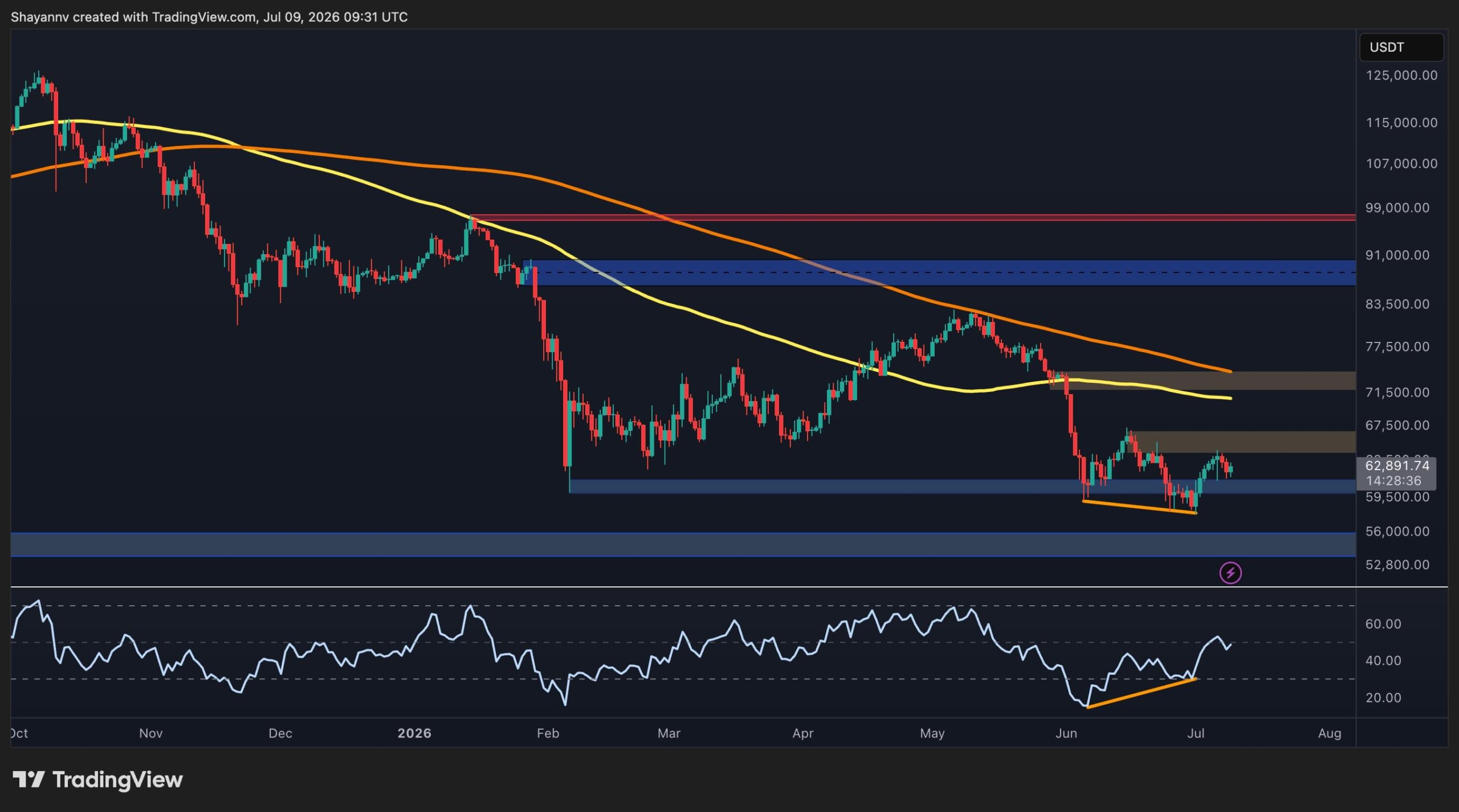
Bitcoin Price Analysis: Has BTC Cleared the Danger Zone After $64K Surge?

JPMorgan Says Bitcoin’s Bigger Risk Is Permissioned Blockchains

JPMorgan Warns: Private Bank Blockchains Threaten Bitcoin (BTC) More Than Strategy Sales
HOT
Currently trending cryptocurrencies that are gaining significant market attention
Crypto Prices
The cryptocurrencies with the highest trading volume
Newly Added
Recently listed cryptocurrencies that are available for trading